"A person does not grow from the ground like a vine or a tree, one is not part of a plot of land. Mankind has legs so it can wander" – Roman Payne. Travelogues and pictures from my wanderings in the US and around the world…..
When you think of Bengali food, it’s rich flavors and amazing textures, there are three things that immediately come to mind;
maach (fish)
Mustard oil
Misti & Rosogulla
There are of course other things like Calcutta Pan that are typically Bengali.
My recent visit to Kolkata inspired me write this short blog on the Bengali cuisine and share my experiences as a vegetarian.
My tryst with Bengali food started very early in life.. with one of my childhood buddies, a Bengali and his lunch box at school. As we sat under the papal tree at school and opened our lunch boxes, my friend would open his lunch box and unleash a feast for the senses. We’d be very curious about what aunty had packed for him… it was almost always maach and some vegetables and rice.
My marriage to a girl from Kolkata brought the cuisine into my daily life. Usha is a vegetarian and that meant our Bengali culinary experiences at home were all vegetarian. I learnt to appreciate the nuances of the cuisine and various delicacies that Usha would spin up for us at home – Alu Dum, Kumro Alu, Begon Bhaja, Puchka and Jhalmoori. Me, a South Indian guy, fell in love with the Bengali cuisine. We always have Sondesh and Rosogulla on festive occasions.
My recent visit to Kolkata on a business trip gave me an opportunity to indulge in the various vegetarian delicacies in the Bengali cuisine. Here were some of the winners in my list:
Luchi – Alu Dum – Firstly, this is not the same as Puri Alu Bhaji. It is similar but very different. Luchi looks like a puri but is made of maida flour (instead of wheat flour). Alu Dum is the best accompaniment to Luchi.. spicy and flavorful, potato in a rich and thick gravy. In Kolkata, it is typically cooked in mustard oil, which gives it a distinct flavor. The mustard oil adds a pungent and slightly bitter taste to the rich potato curry, balancing the spices beautifully. It is an all day meal.. it was served in the breakfast buffet at the Taj and also part of spread at dinner.
Baigon Bhaja – Baigon or Baingan/ Brinjal is on of my fav vegetables. It comes in many shapes and varieties. Baigon Bhaja is made from the large round baigon. It is a classic Bengali dish, simple yet amazingly tasty and flavorful. It is made with thinly sliced eggplant (baigon) dipped in a simple batter of gram flour (besan), turmeric, salt, and some masala, then shallow or deep-fried until crispy. I like the shallow fried variety, it is crispy and crunchy outside and a soft middle. It is usually a side dish or can be eaten with rice. I’ve made this at home, the shallow fried variety or sometimes tried to grill this as well.
Cholaar Daal – This is typical Bengali daal made with Chana Dal. It is made with cooked Chana daal, coconut, turmeric and spices including a bay leaf for lasting flavor. Chana daal is used a lot in Bengali Cuisine – rich in protein, available in abundance in the region and has been a tradition for many many years. Cholaar Daal is usually had with steamed white rice or can also be had with Luchi or pulao.
Cholaar Paturi is a variation of the daal. While the daal is soupy, the Paturi is steamed in a banana leaf. The Chana daal is mixed with spices, mustard paste, coconut and wrapped in a banana leaf and steamed. Paturi means “wrapped”. Cooking this way gives it a nice aroma and flavor.
Bengalis have a sweet tooth and love their mishti. Mishti can be consumed in many ways – Misti Doi and Rosogulla are the most popular.
Mishti Doi – It means sweet curd or yoghurt… milk based sweet treats.. mishti Doi is sweet cream yogurt which is made by fermenting yogurt with sugar or jaggery.
Ek dom jeebher chomotkar ( a feast for the senses)..
Amritsar is known as the golden gateway to Punjab’s heart and soul. It is home to the most famous gurdwara – the Golden Temple a.k.a Sri Harmandir Sahib. There are many temples here making it the spiritual capital of the state of Punjab. It is also the HQ for Punjabi food – home to some of the best and most famous Dhabas. Amritsar had a significant role to play in the fight for independence from the British Raj – there are many heroes among its brave, resilient people and many tragic stories during the fight and partition after Independence. All of this makes Amritsar a must-see destination.
We arrived in Amritsar from Delhi on warm and sunny Sunday afternoon. After we walked out of the airport, we quickly found our driver and were on our way to the Ramada Inn. The hotel is located in the heart of the city, very close to the main market. The driver gave us our first history lesson on Amritsar – Maharaja Ranjit Singh built a huge wall with 12 gates around the city of Amritsar. Only one gate “The Ram Bagh Gate” stands today. We had to enter through this gate to get to our hotel. The driver gave us a lot of tips about the city and things to do near the hotel.
Amritsar was founded by Sri Guru Ramdass ji, the fourth guru of the Sikhs in about 1574 A.D. The construction of Amrit Sarovar from which the city gets its present name was also started by Sri Guru Ramdass. The city is an amazing blend of narrow gallis (lanes), bustling bazaars, terrific aromas from street food vendors and dhabas and spiritual experiences. Its people are proud, kind and very very welcoming.
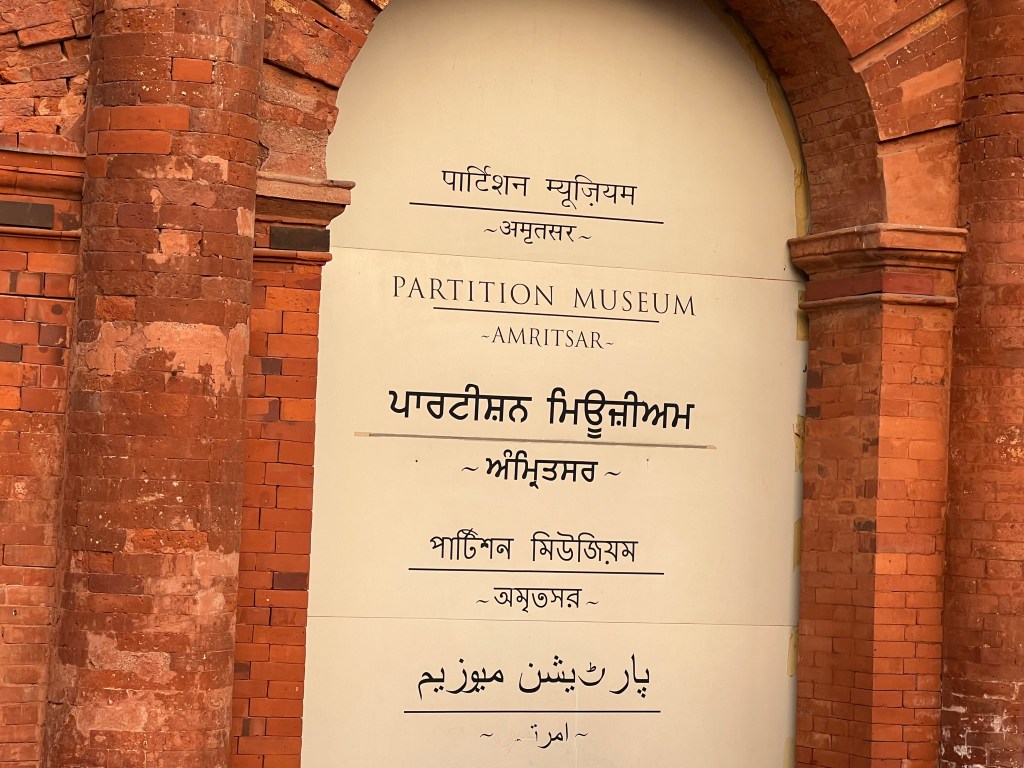
After we completed our check in and freshened up, we left for the Partition Museum. It was very close to the hotel, a 10 min walk, through the main market area. After Declaration of Independence from the British and the India / Pakistan Partition, it was a very traumatic time for the people of Punjab, especially in Amritsar given its proximity to the border ( only 28 km from Pakistan). Millions of people in were affected by Partition and endured a lot of suffering from the violence that engulfed the region.The Partition Museum in Amritsar was opened on August 17, 2017 on the 70th anniversary of Indian independence and the Partition of India and Pakistan. The museum is located in the historic Town Hall building. There were several galleries with displays capturing various themes starting from the freedom movement (the resistance), prelude to Independence & Partition, migrations during Partition, the violence that engulfed the region and the struggles of the refugees.
The museum was very well organized and it was a moving experience. Reading about the freedom fighters, their sacrifices and the aftermath of the Partition was very powerful and emotional. We spent a couple of hours here before returning to our hotel.
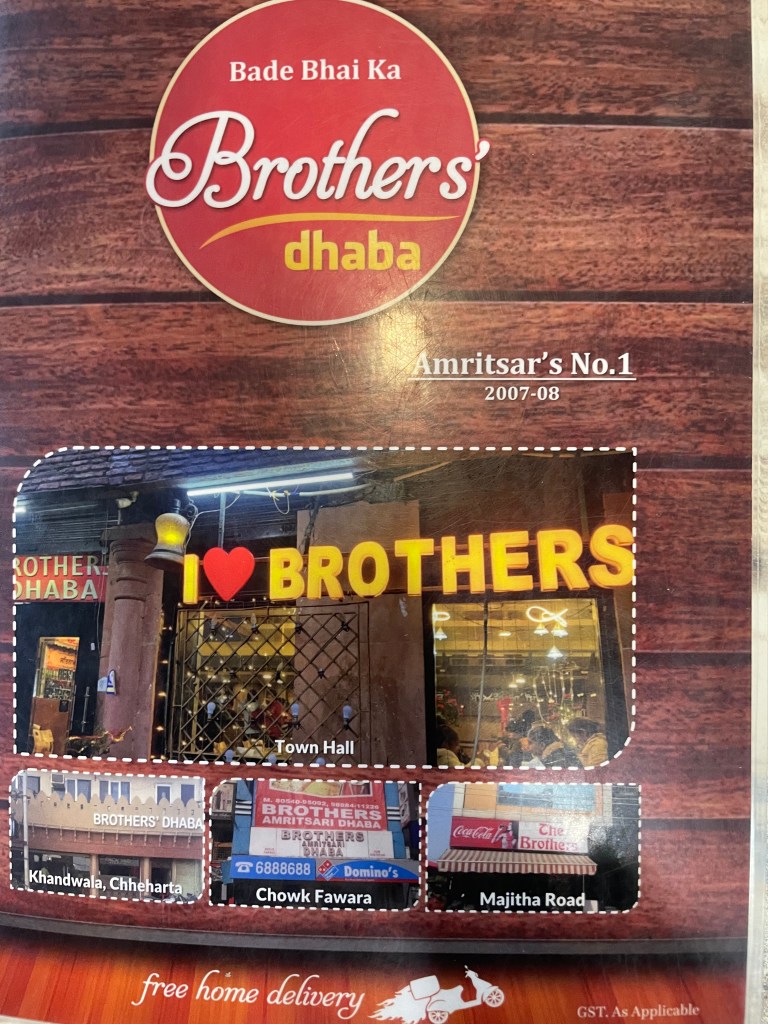
Dinner was at Brothers dhaba, one of the 4-5 recommended local restaurants by several friends. What is Dhaba ? It is a traditional Indian eatery in the Punjab region, often located on roadsides or in rural areas. Brothers Dhaba is an iconic eatery in Amritsar very well known for its flavorful dishes and portions as generous as the large hearted Punjabis. We ordered the famous Amrtisari Kulcha, Dal Makhani among other dishes.
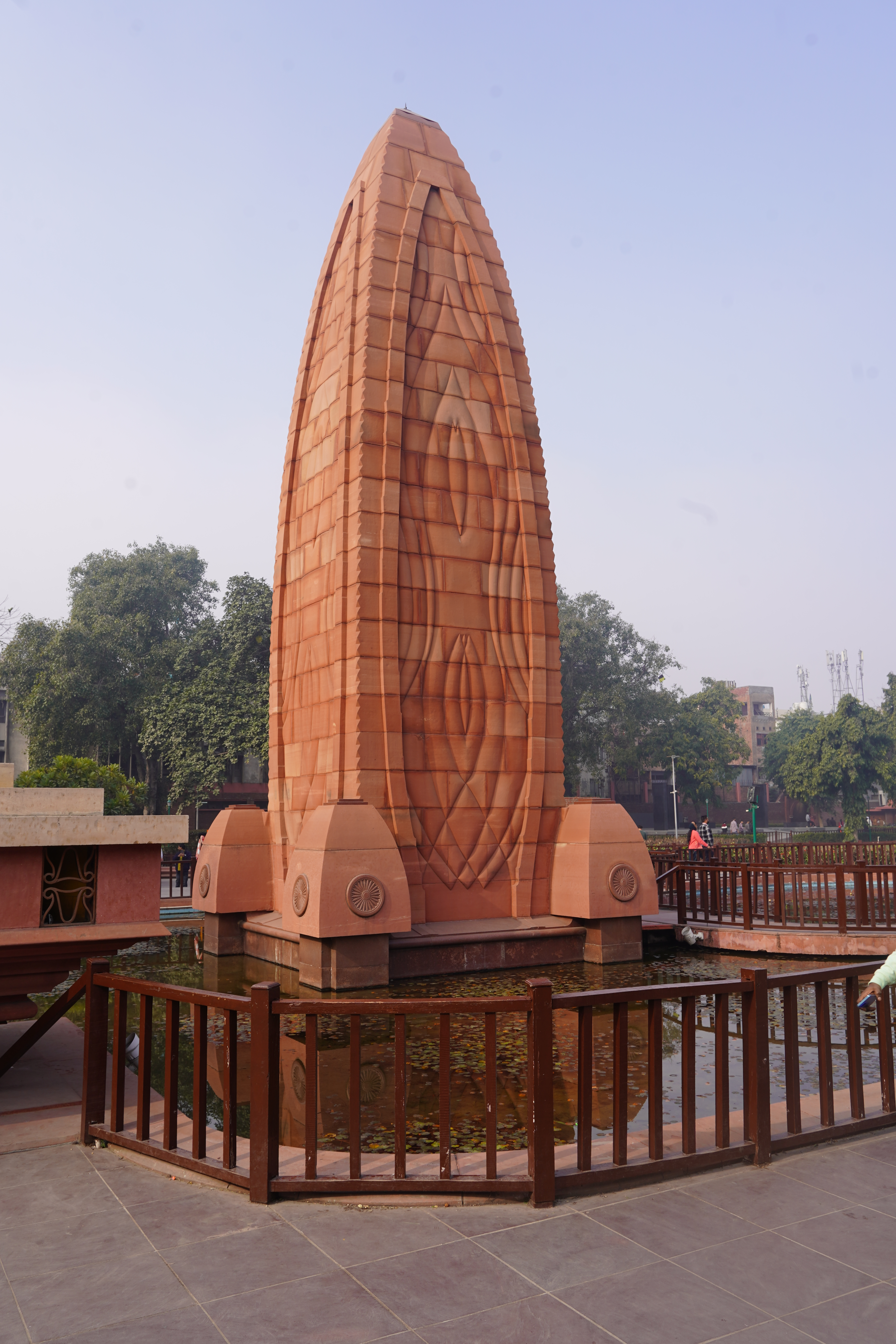
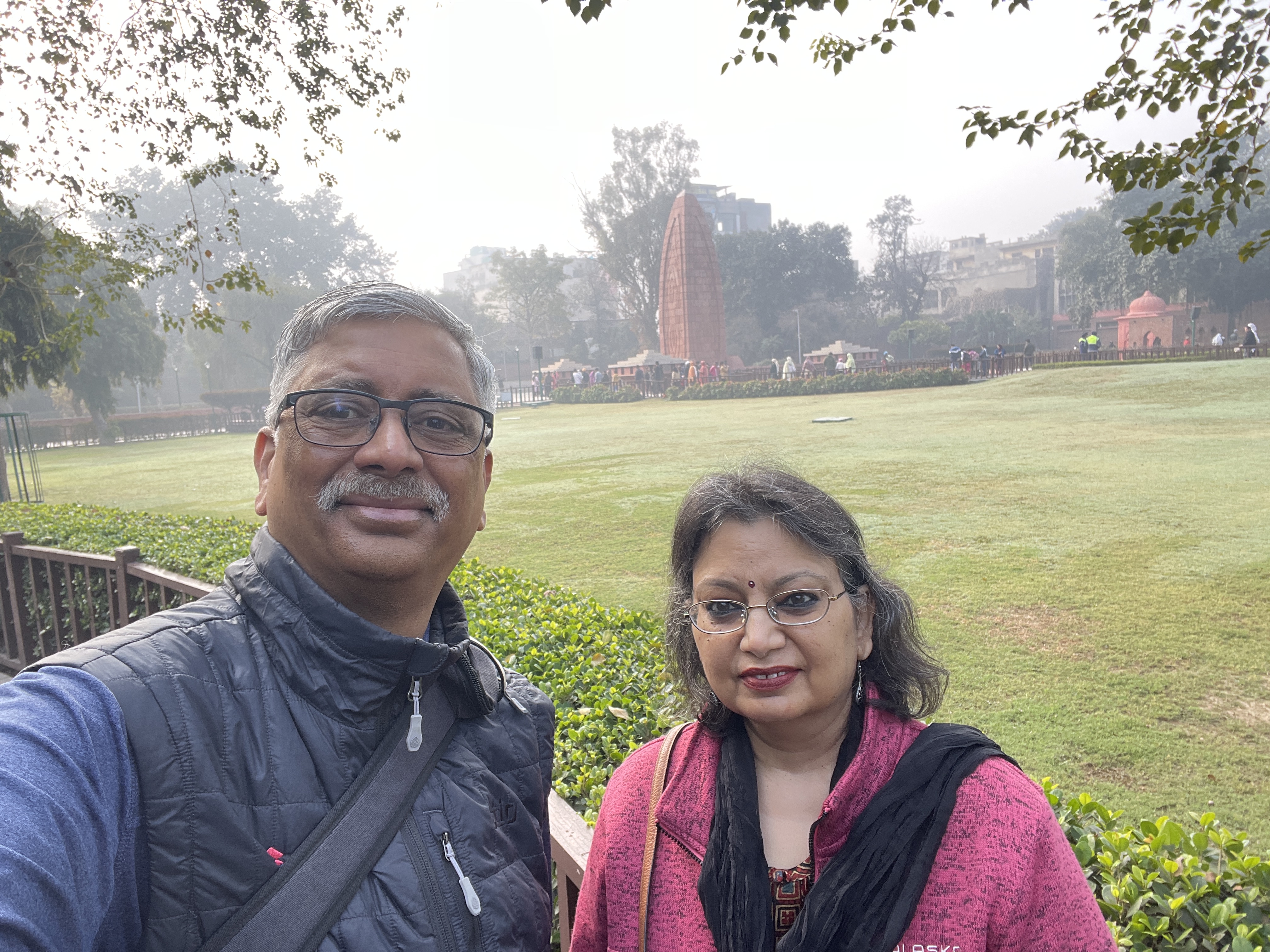
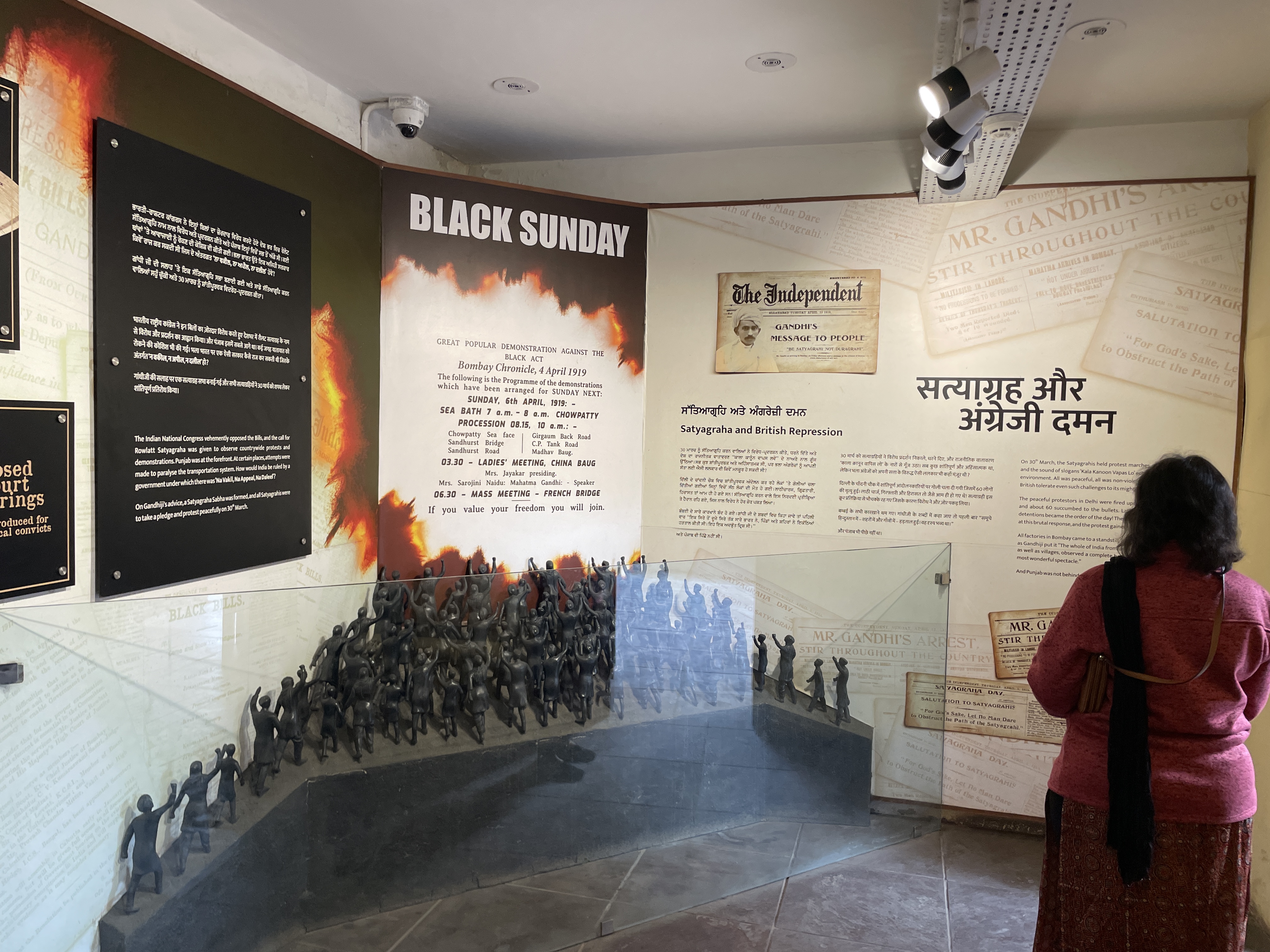
Next morning we were up early and on our way to the Jallianwala Bagh Museum. It was chilly morning (45F) and there was thin mist in the air. As kids, we had learnt about the tragic massacre at the Jallianwala Bagh on April 13, 1919. General Dyer ordered his men to start firing without warning at a gathering of several thousand people at the Bagh. Several hundred innocent people died and many other injured, The Museum serves as a reminder of India’s fight for freedom and the sacrifices made by the people of Punjab. The Bagh is a large open space with several exhibit halls with displays and memorabilia. There are several personal artifacts of victims and eyewitness accounts of the event on that fateful day. We spent a couple of hours here at the Museum.. a very moving experience.
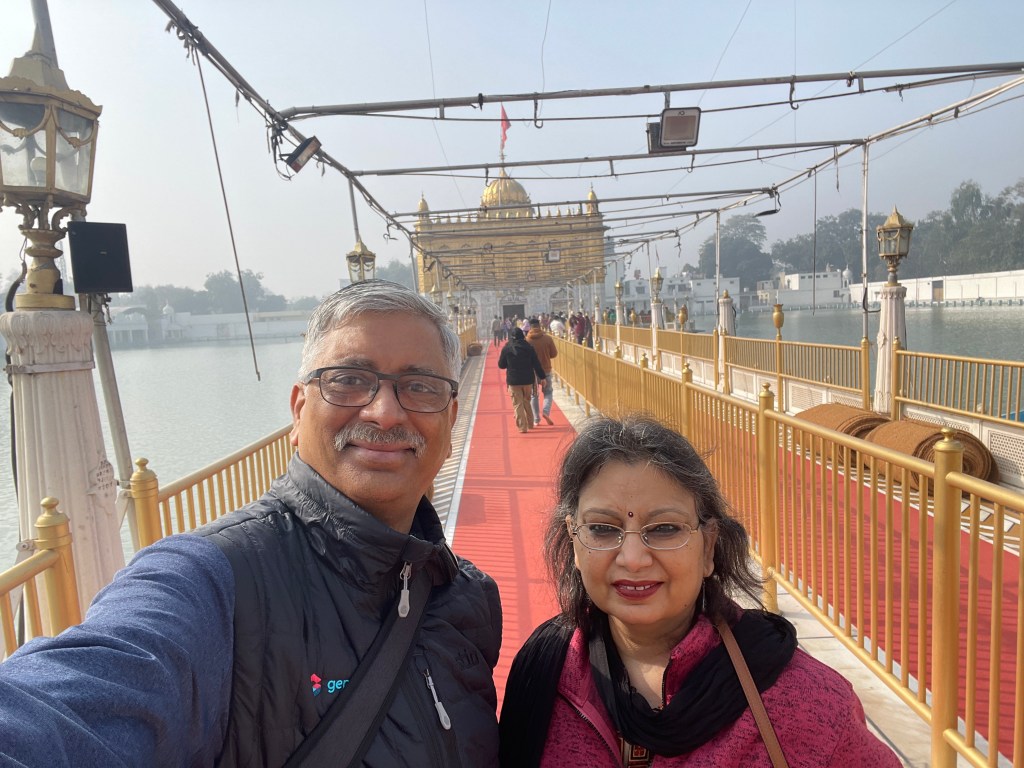
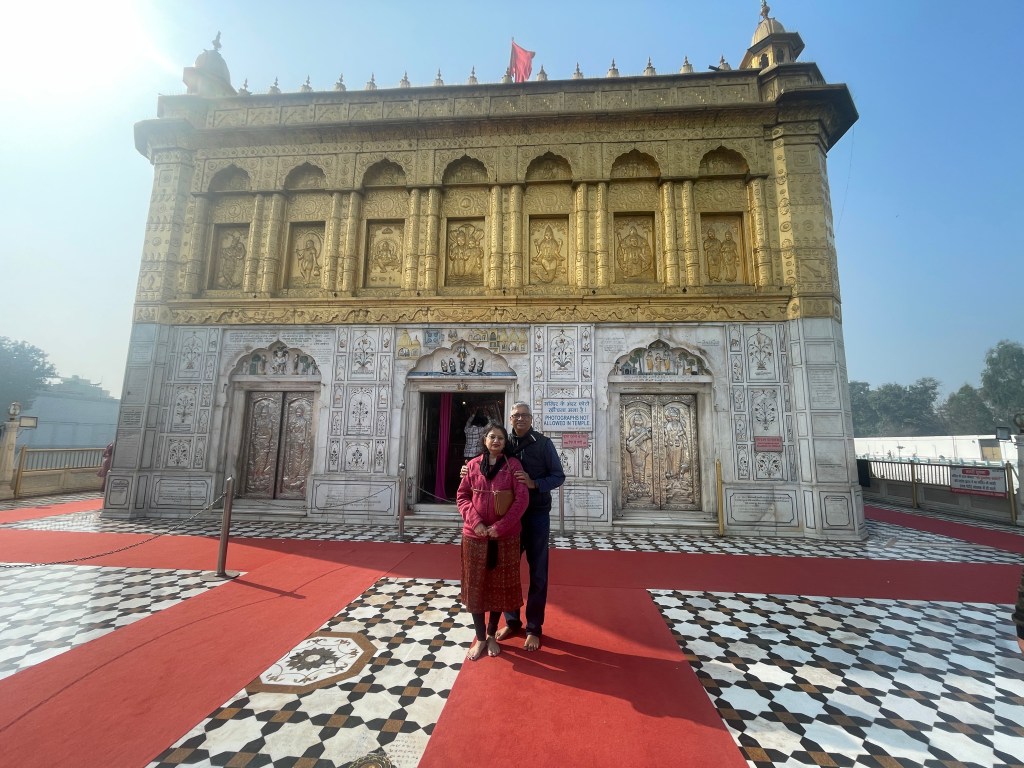
Our next stop was the Durgiana Mandir. It is also known as the Sitla Mandir and is a very revered Hindu temple dedicated to Goddess Durga. The temple is architecturally very unique with a blend of Sikh and Hindu influences. There is a large sacred pool called the “Amrit Kunda” (pool of Nectar) and the temple is located in the middle. There’s a large walkway leading to the temple. The temple was not very crowded and we had a good darshan of the Goddess.
We read about the Bada Hanuman Mandir in the Durgiana Temple complex and went there next for darshan of Lord Hanuman. A couple of interesting facts about this temple that I picked up;
The idol of Hanuman here is a ‘rare’ one, as it is one of the two sculptures that show him in a sitting position. The other is at Hanuman Gari in Ayodhya.
Parents visit the temple, make a vow that if they get blessed with a son they will dress him as a Monkey and bring him to the temple for worship.
We had a very good darshan of Lord Hanuman and we were back in the car with our driver / guide Saurabh. Next stop was lunch… we had a reservation at the famous Yellow Chilli restaurant. Yellow Chilli is a chain of restaurants opened by celebrity Chef Sanjiv Kapoor. We ordered some simple Punjabi food for lunch. Food was delicious and lived up to the hype.
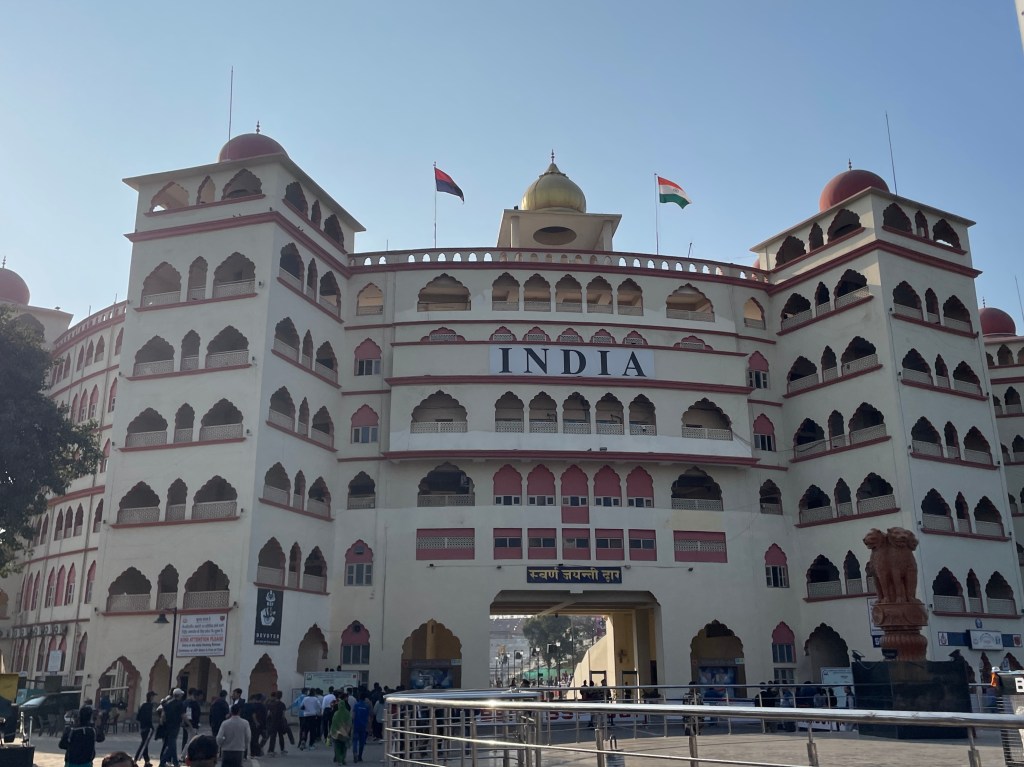
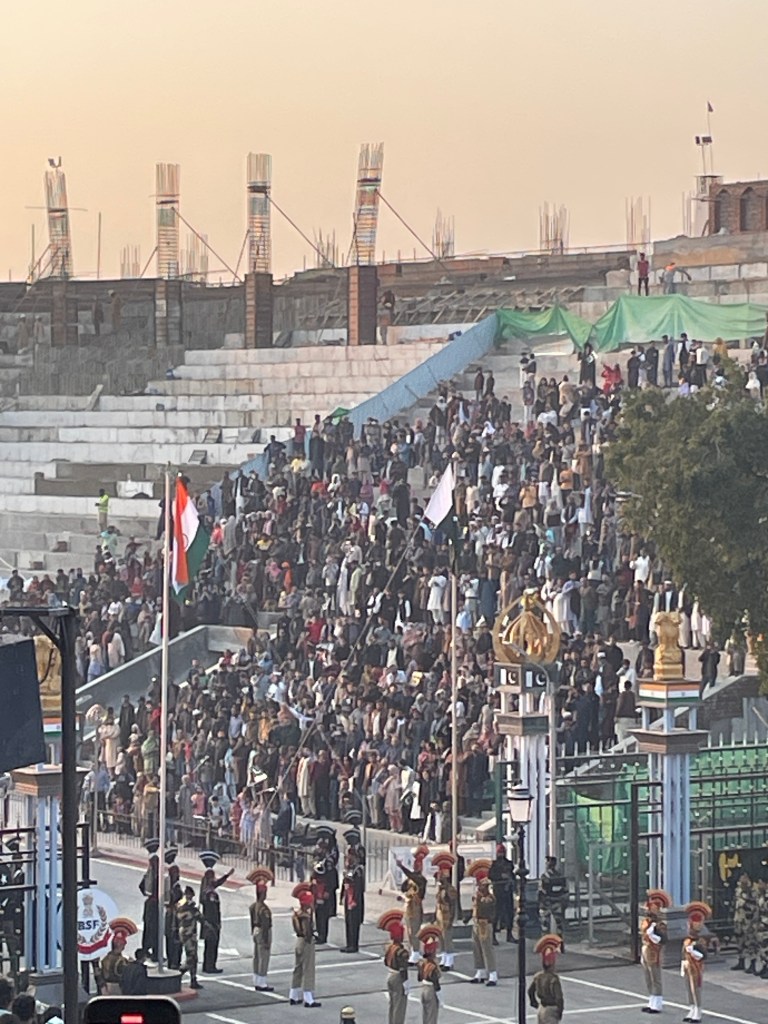
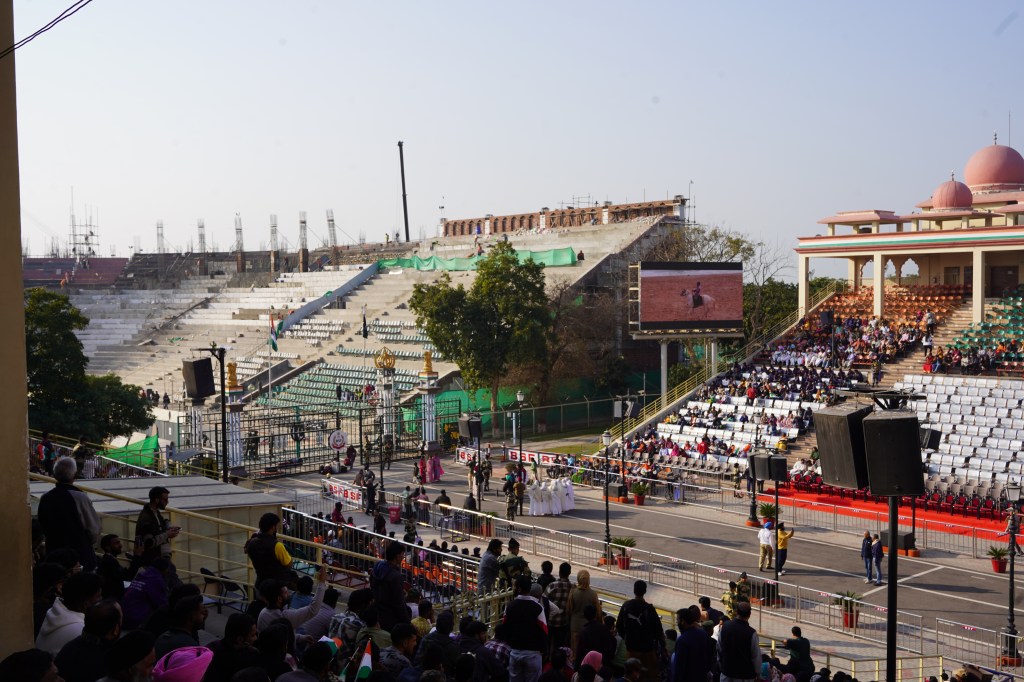
One of the must see attractions in Amritsar is the Attari-Wagah Border Ceremony – this is a daily military ritual performed by the border security forces of India and Pakistan. The ceremony takes place at the Attari-Wagah border crossing, which connects the Indian city of Amritsar to the Pakistani city of Lahore.
It took an hour to reach the Atari border from our hotel. There is a lot of pomp and celebration associated with the ceremony. Soldiers from both countries perform elaborate marching and drill routines, showcasing their military prowess. The Border Security Force (BSF) manages the ceremony on the Indian side. There was singing of patriotic songs and waving of Indian flags as the ceremony unfolded. Over the years this daily event has become a symbol of national pride and patriotism. It was a cool and unique experience. We could see across the border gate into Pakistan and a similar ceremony on that side as well.
After an exhilarating experience at the border, we went back to our hotel. We made a pit stop for some chai and also enjoyed some chaat including a local delicacy – Bun Tikka.
Dinner was a quiet affair. We ordered room service – Alu and Paneer Paratha with side of Amritsari Aachar (pickle) and Dahi (yogurt).
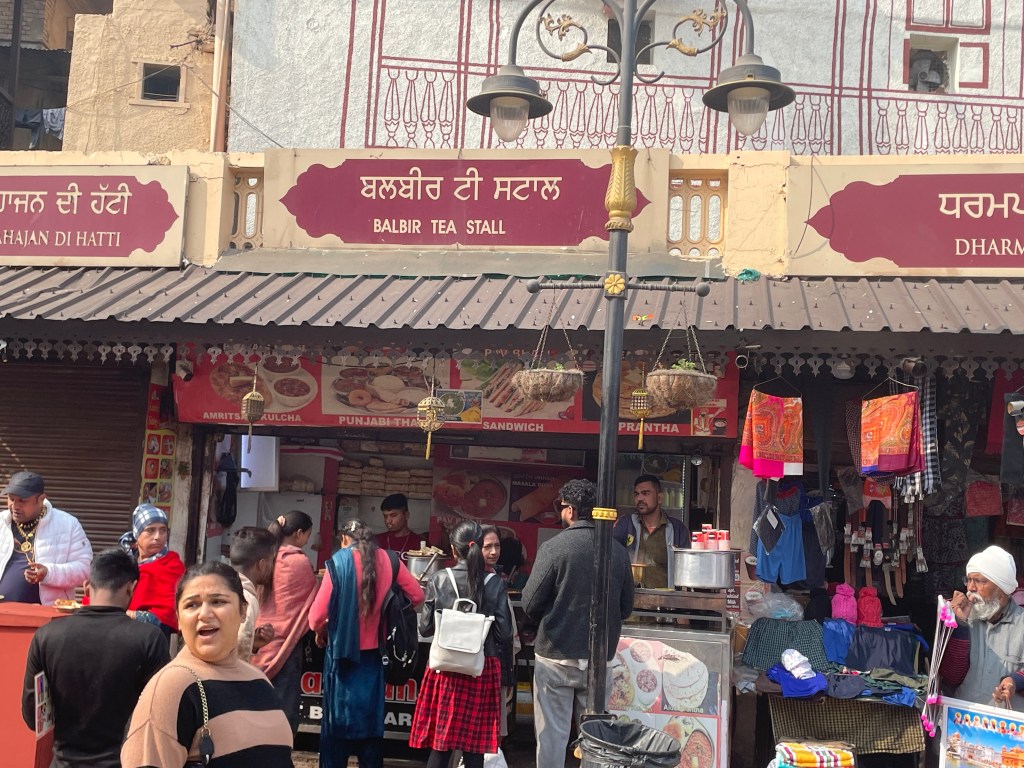
We were off to an early start next morning… there was an air of excitement and anticipation as we left for the Golden Temple a.k.a Sri Harmandir Sahib. It was a short ride from the hotel to the parking area for the temple. It was in the heart of the walled city – the market area was quite crowded with shoppers, visitors and devotees. It was a short walk to the temple complex along a paved walkway – shops and eateries on both sides with colorful wares and delicacies. After our temple visit, we had some chai at Balbir Tea Stall.
As we entered the temple complex, we could immediately feel the spiritual atmosphere – very serene and vibrant. We heard the recitation of the kirtans (bhajans) fill the air and some of the devotees recite a quiet prayer.
The Golden Temple has a rich history – here’s a quick summary; The construction of Amrit Sarovar and Harmandir Sahib in its midst was stared by Sri Guru Ramdass and completed his successor, Sri Guru Arjan Dev. When Guru Arjan Dev completed the writing of Holy Granth sahib, a copy of Guru Granth Sahib was ceremonially installed in Harmandir Sahib. The Granth ( Holy Book) is worshipped here by all the devotees. The scripture contains over 6,000 shabads (hymns) and passages from various Sikh Gurus, as well as Hindu and Muslim saints. The scripture is divided into 1,430 pages, with 33 sections, and contains various ragas (musical modes) and shabads. (Wikipedia)
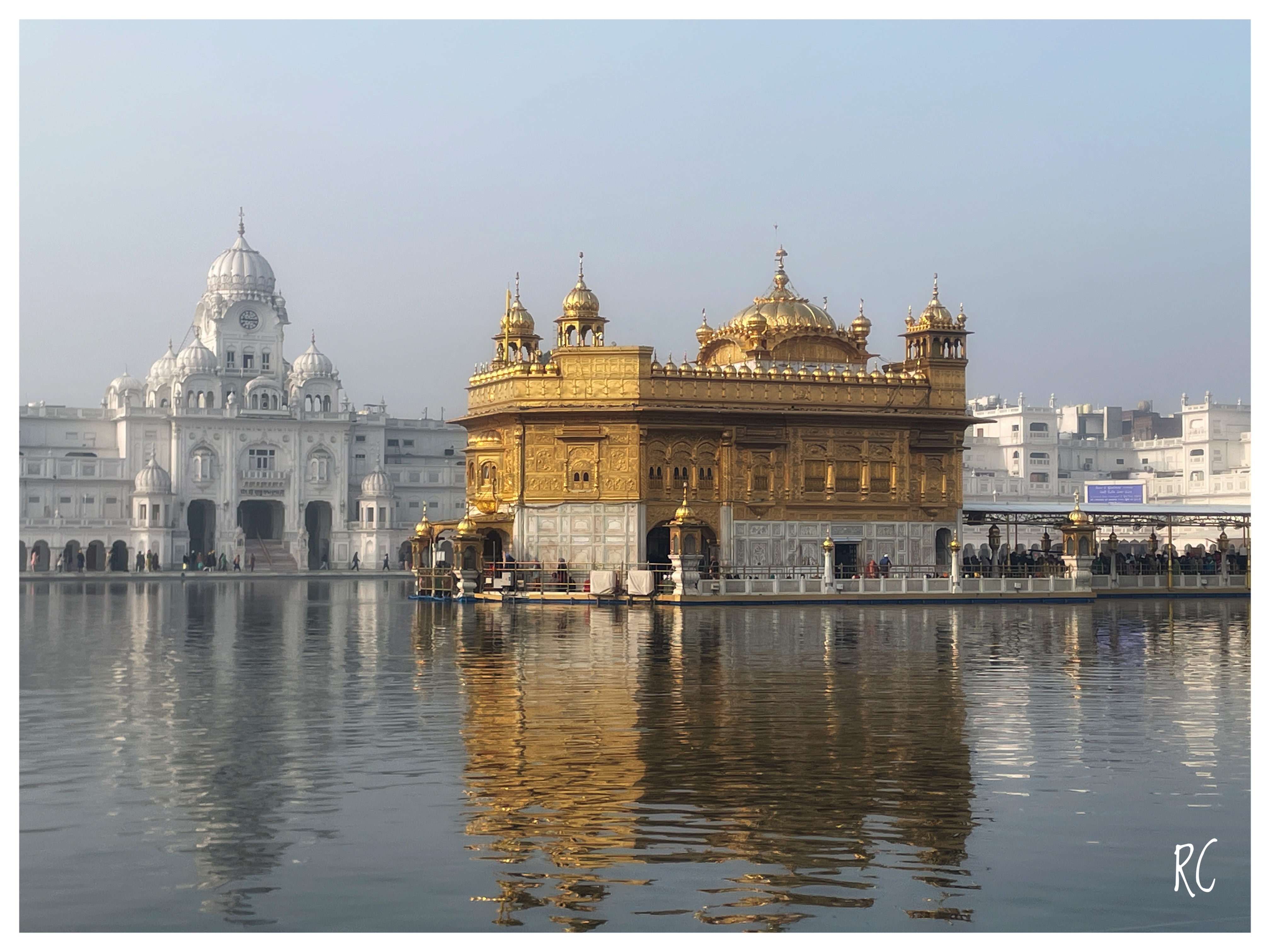
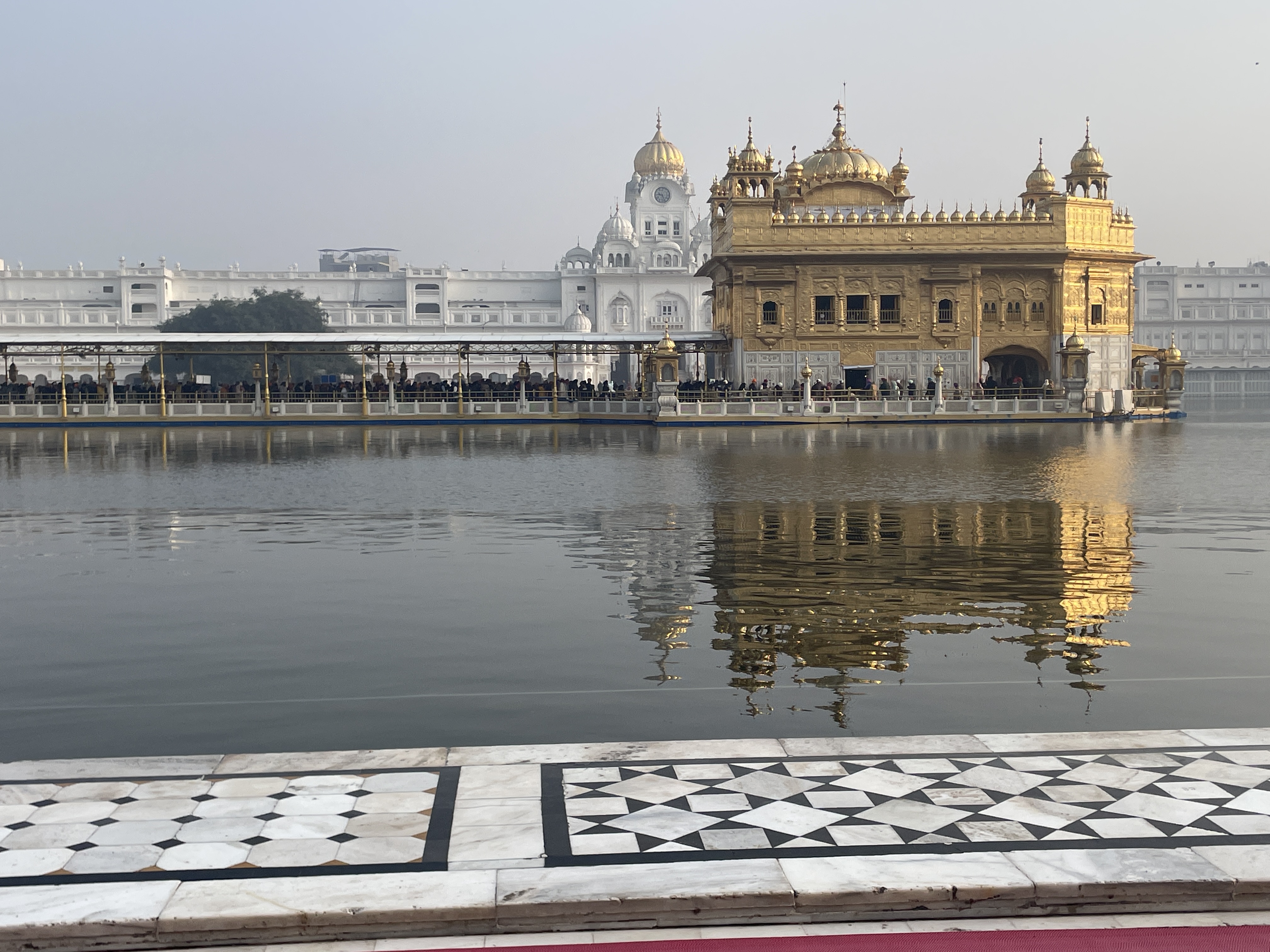
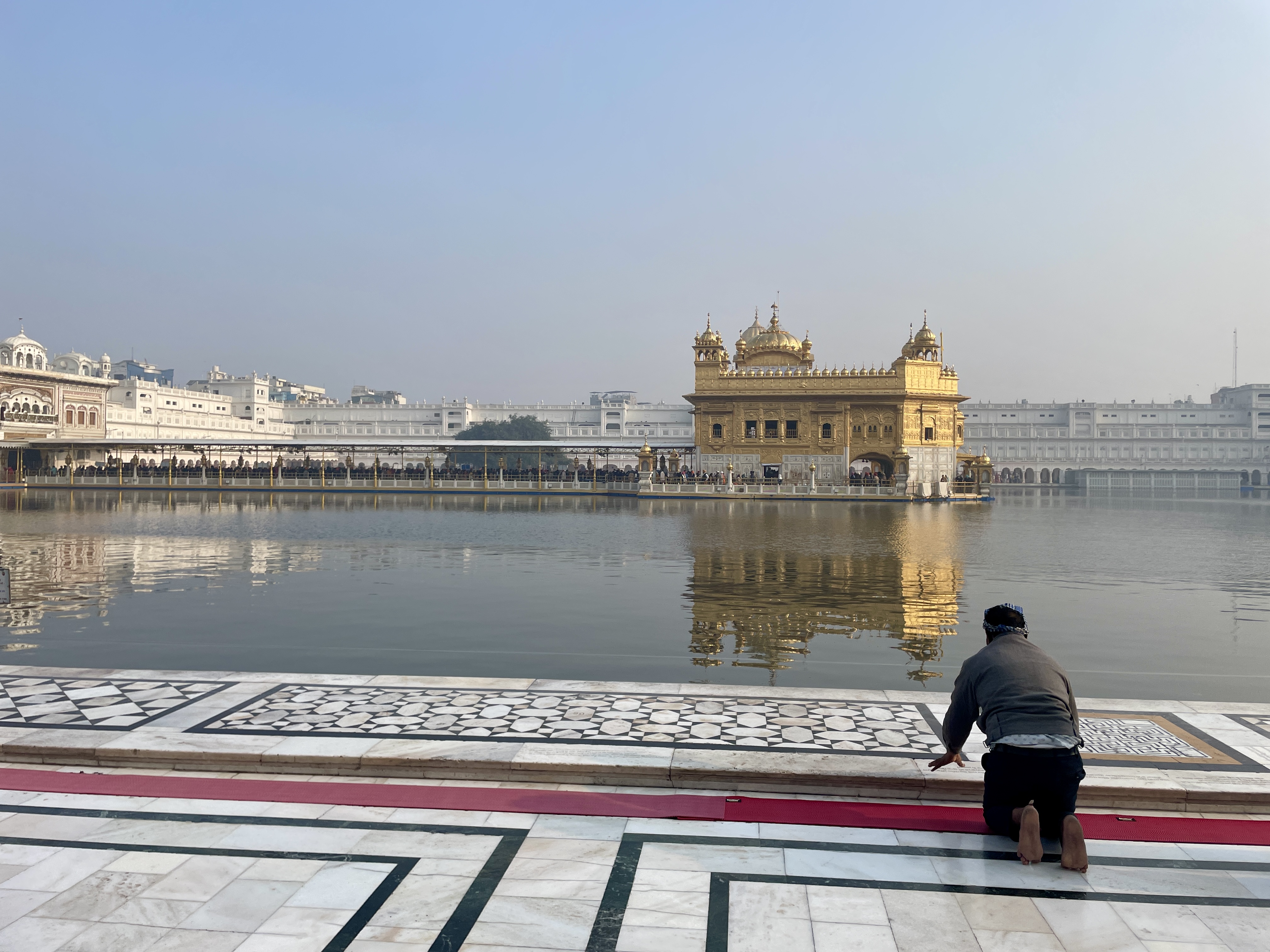
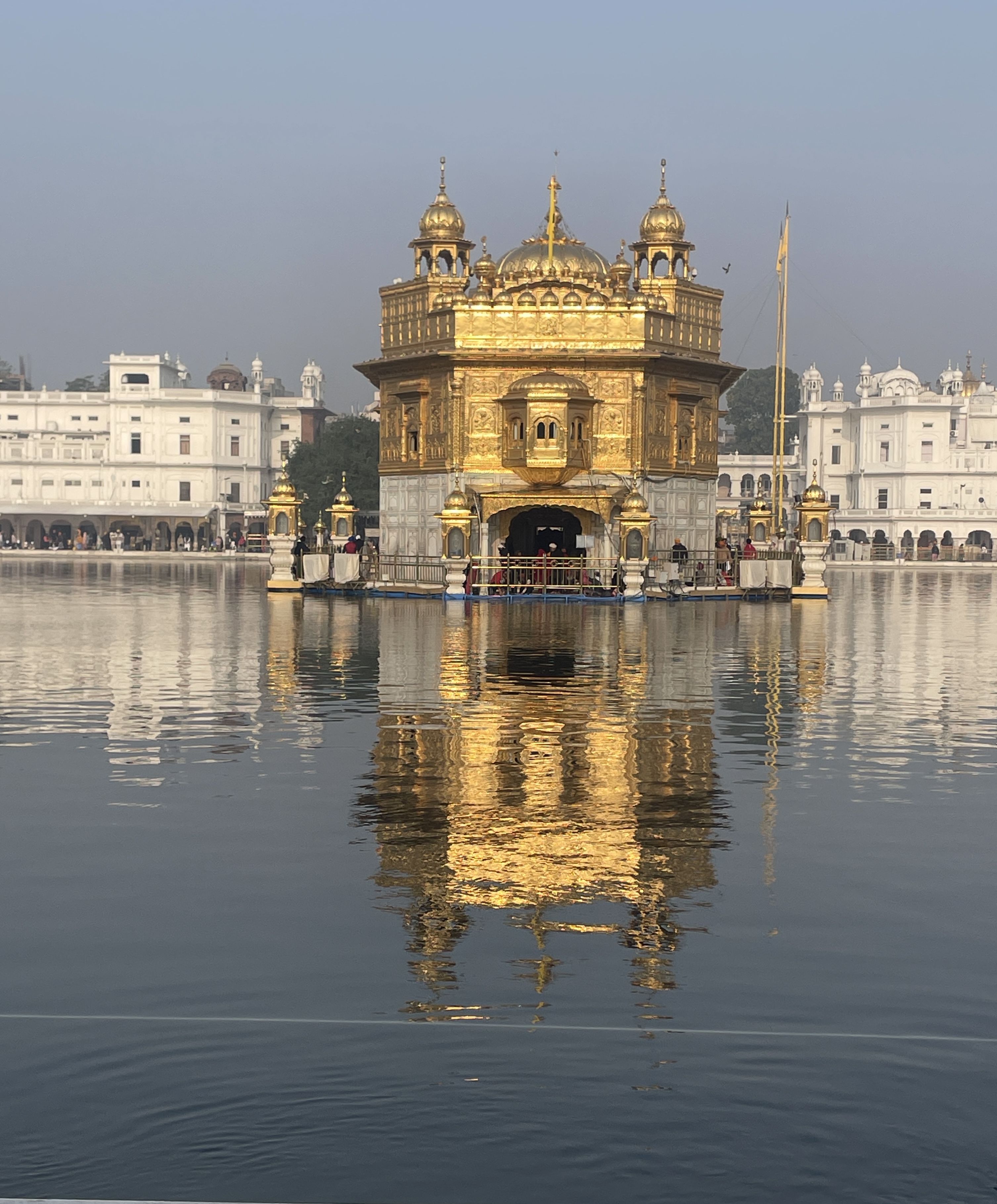
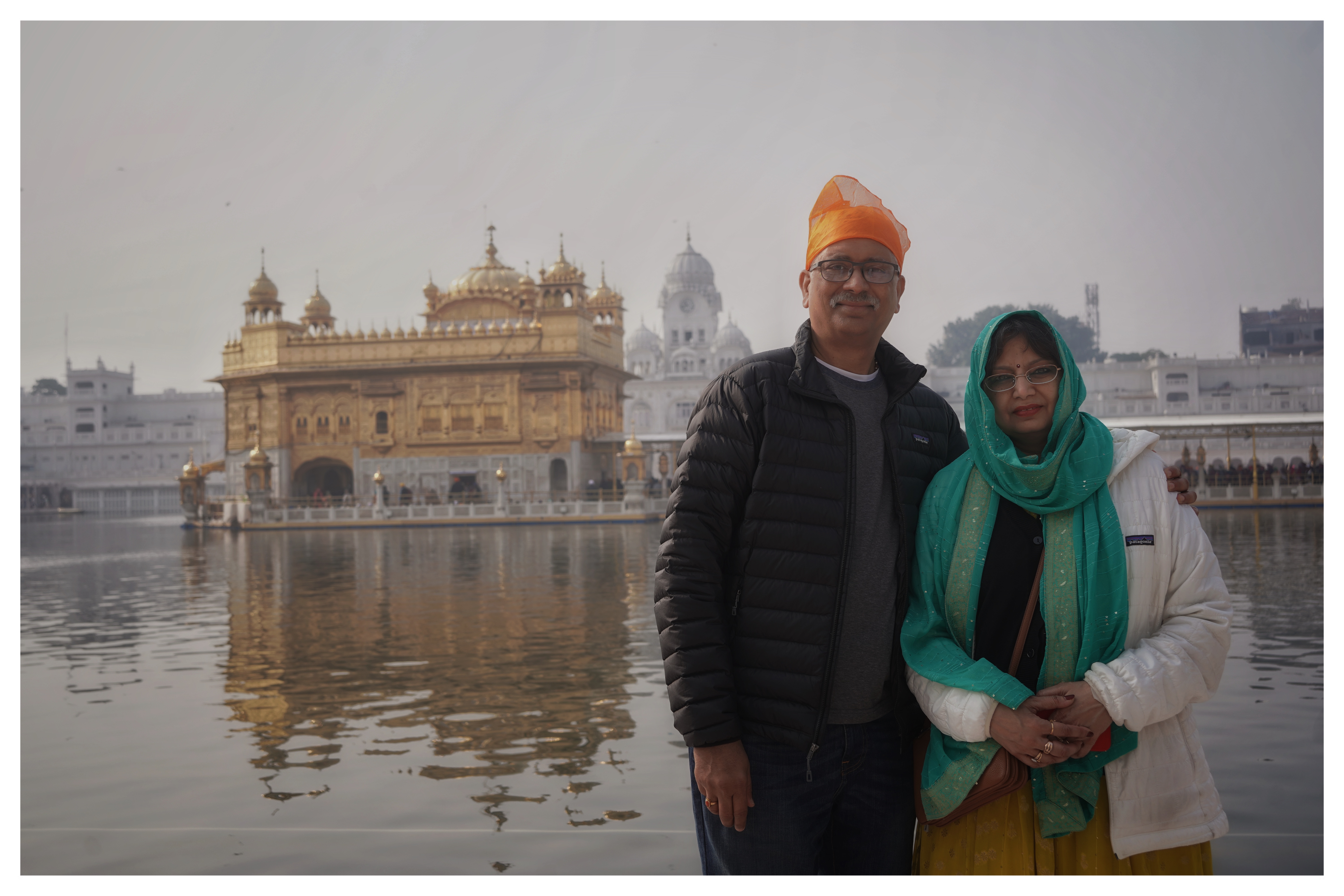
After we deposited our footwear at the stall, we put on our head covering – it is mandatory in the Sikh tradition for men and women to cover their heads as a mark of respect. We washed our feet and entered the temple. The sight was spell binding – the Amrit Sarovar sparkled in the early morning sun and the golden dome of the temple glittered. The recitation of the Gurnani echoed through the air making the spiritual experience complete. The white marble floors symbolized the purity of the temple and brought to life the vibrant colors of the temple.
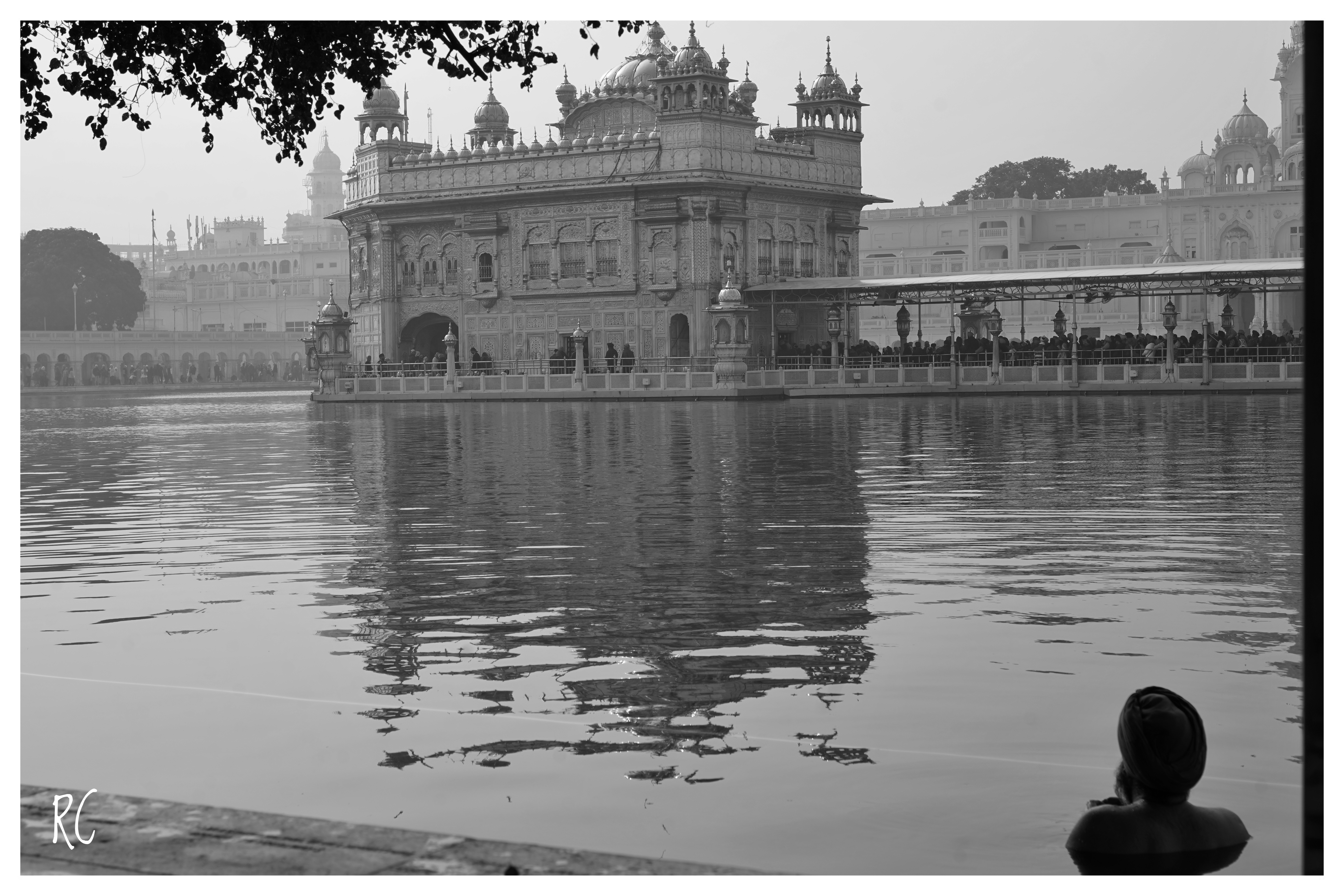
We walked around the parikrama of the temple before join the line to enter the main temple which housed the Granth. We saw several devotees taking a dip in the Amrit Sarovar. A few others sat in silent prayer .. there were stalls offering devotees a drink of water. Sikhs do not believe in idol worship, they believe in worshiping Waheguru (the supreme being). As we made our way to the temple, devotees chanted prayers in unison creating a unique sense of calm and serenity. In the main temple, the Granth is worshipped – verses were being silently read by the priest while the Gurbani was being melodiously being recited by a group of singers which was broadcast across the temple complex. We had a few minutes to offer our prayers in the inner sanctorum and sat for a few minutes outside to extend the experience. We spent a few more minutes exploring other parts of the temple and taking a few pictures to memorialize our experience. We enjoyed the Karah Prasad (made of wheat flour, sugar and milk) and made our way out of the temple. We were unable to visit the famous langar at the temple.
Words cannot describe the spiritual and uplifting journey that we experienced . You need to be here in person. I’ve tried my best to capture this in words and pictures.
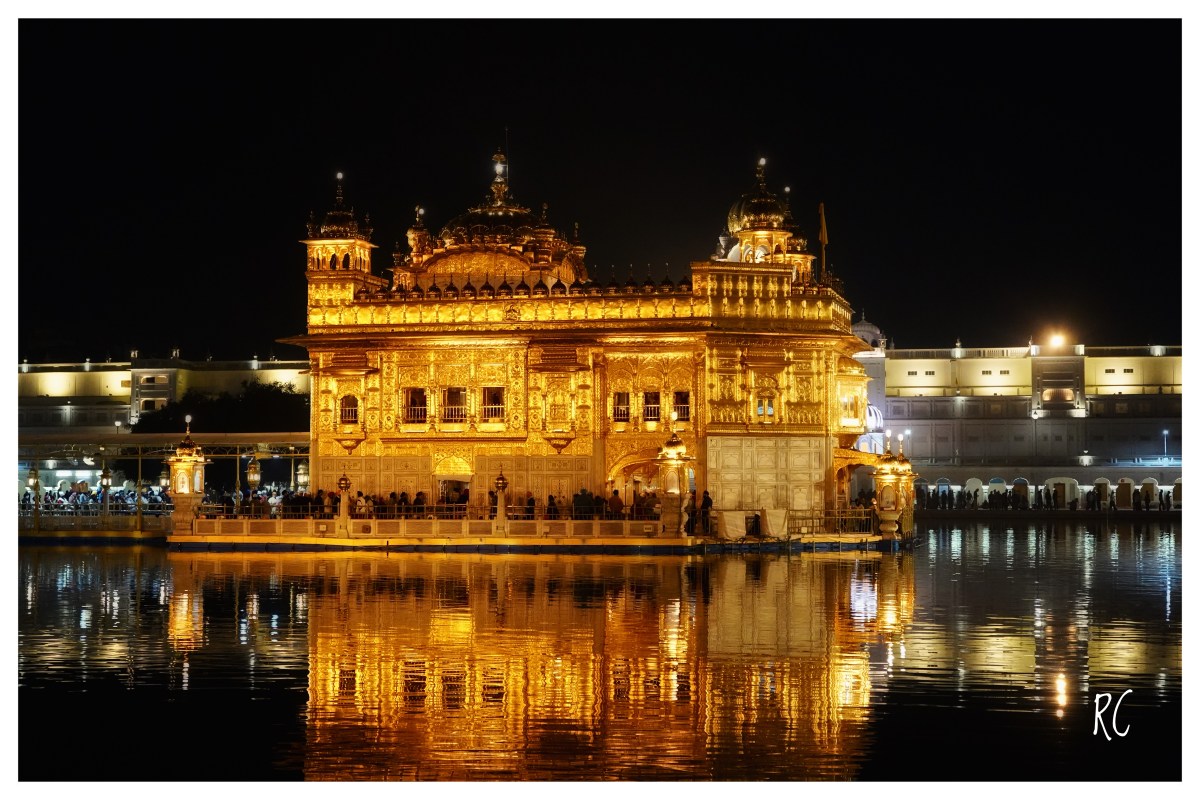
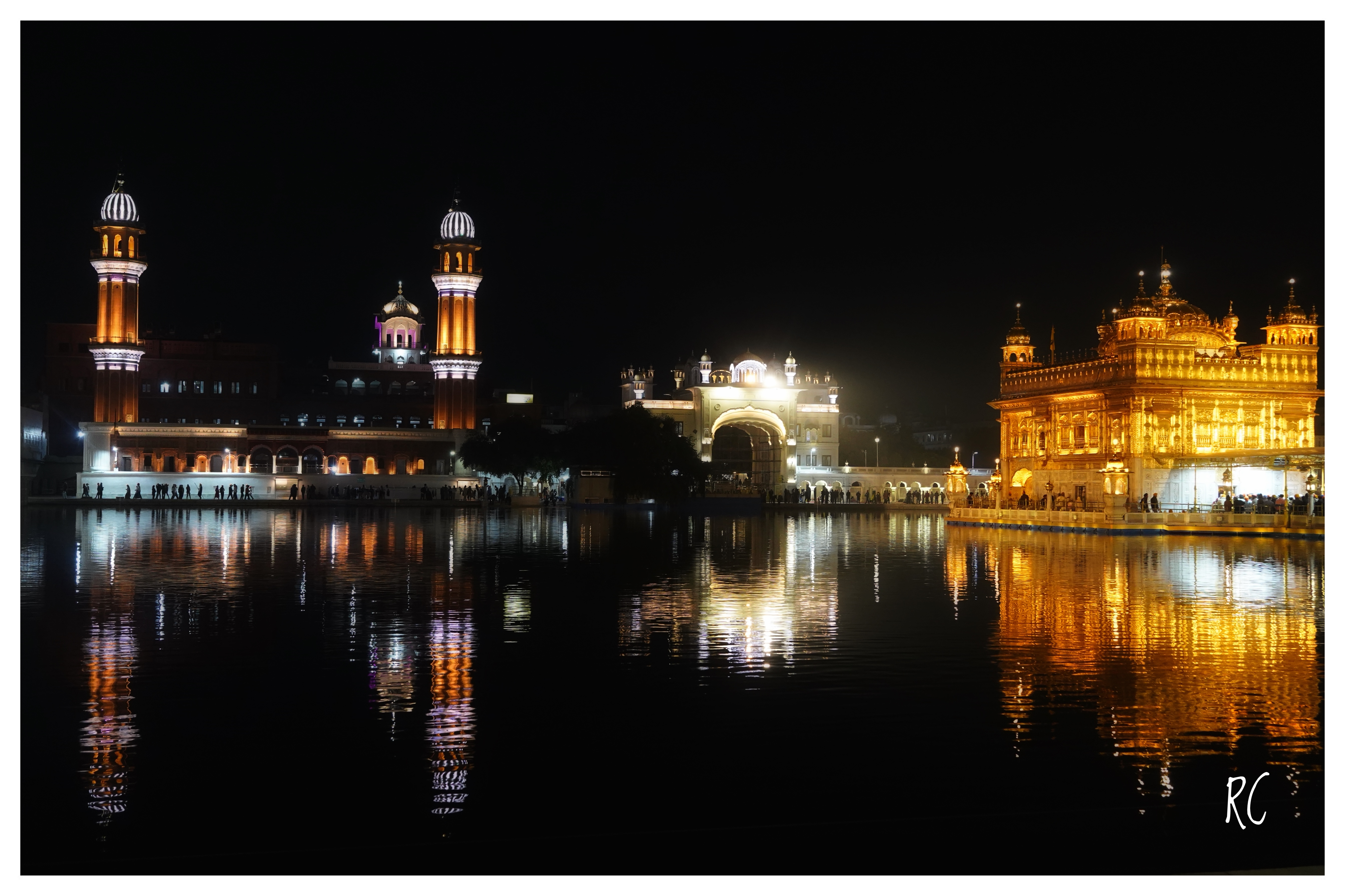
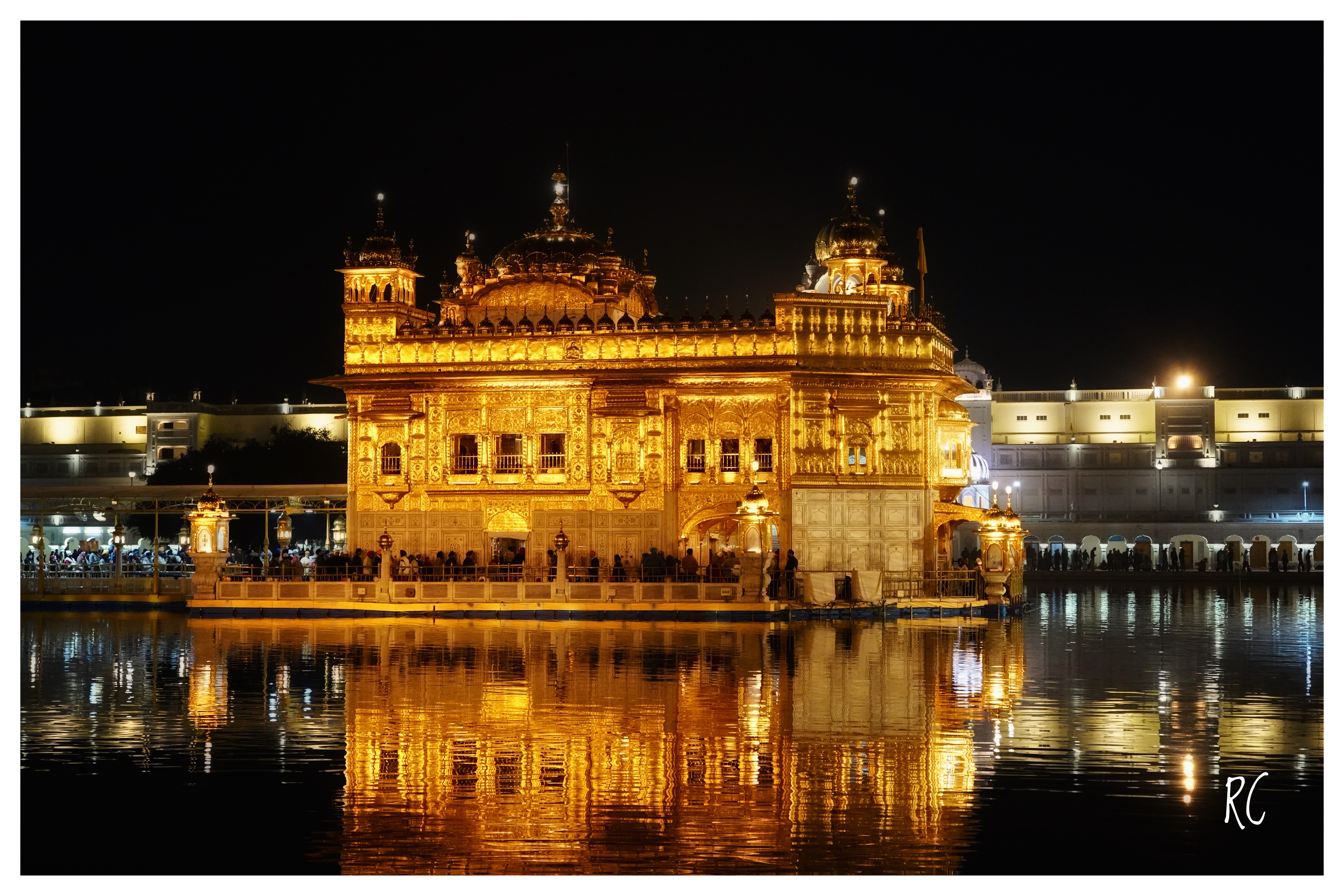
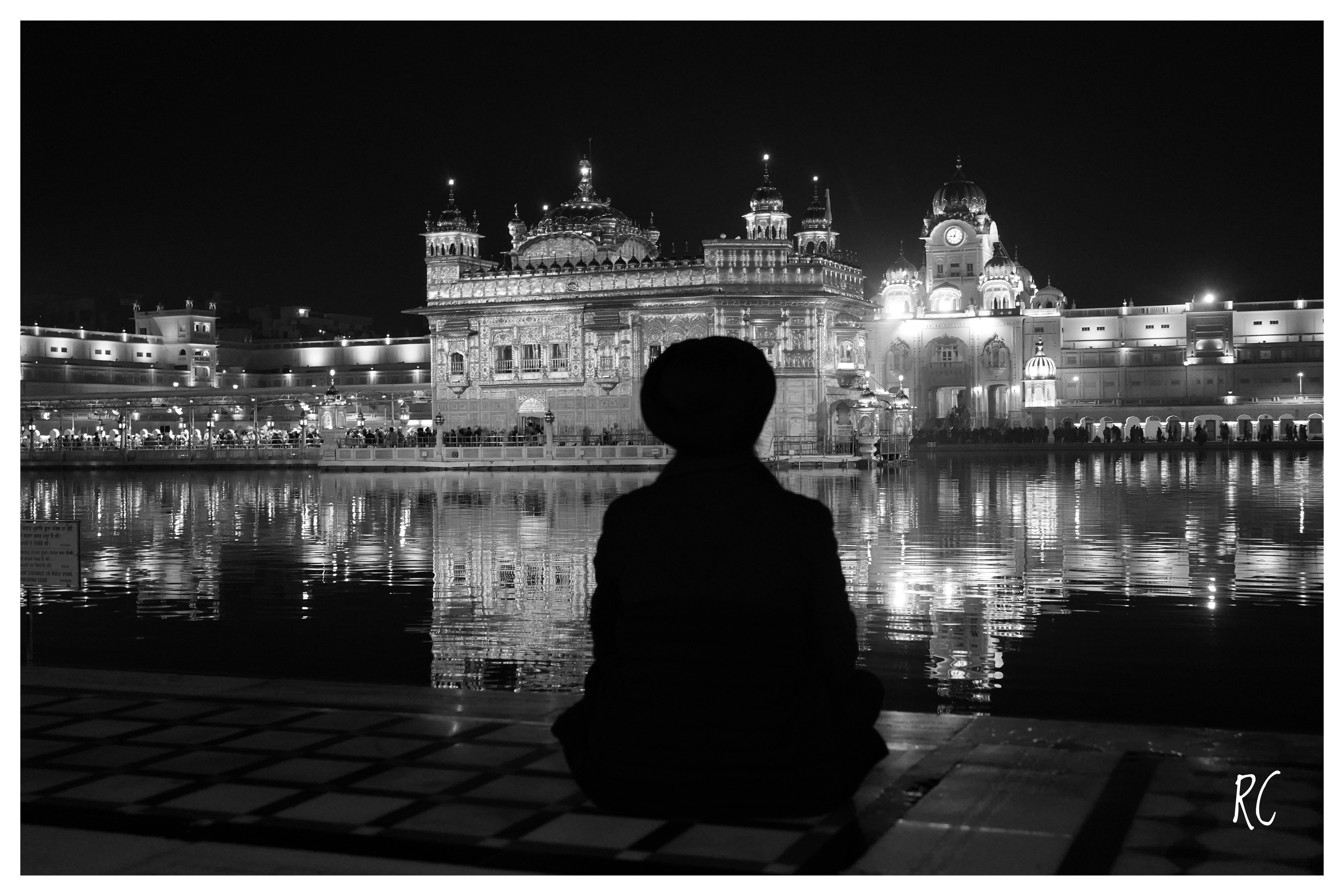
We came back to the Temple later in the evening to offer our prayers and experience the visual treat under lights. The temple’s golden dome shone brightly under the night sky and the floodlights highlighted the stunning architecture. The temple’s golden glow reflected in the Amrit Sarovar creating a stunning visual effect. It was mesmerizing…..
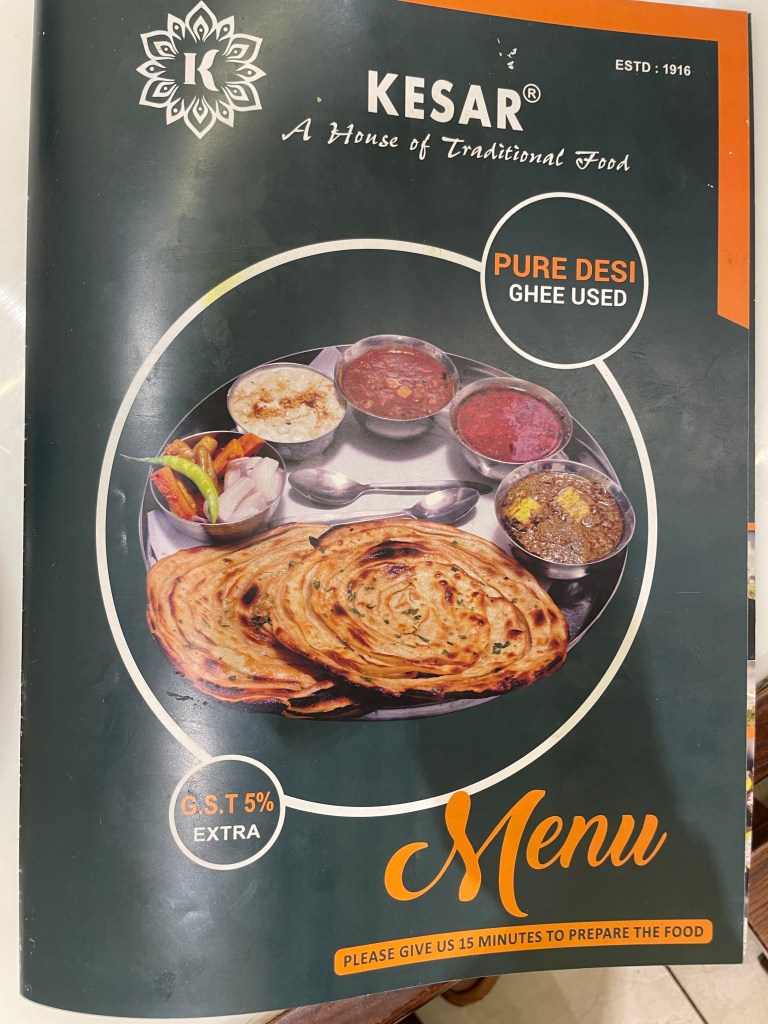
We had planned to get lunch at the iconic Kesar Da Dhaba. This is a legendary eatery which has been serving delicious and authentic Punjabi food since 1916. We came in here for a late lunch… we enjoyed some of the finest Dal Fry, Baingan Bartha, Amristsari kulcha and some of the finest Gulab Jamun.
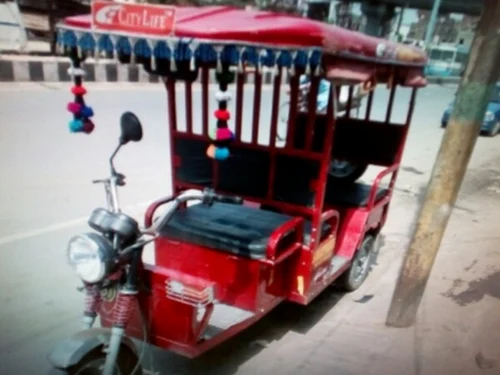
Before going to Kesar Dhaba, we went on a shopping expedition to Hall Market.. Amritsar is very famous for its Phulkari saris and dresses. It is a traditional Punjabi embroidery .. floral embroidery. The Hall Market area is a connected via a series of narrow “gallis” or lanes. The only way to access these “gallis” is on foot, a scooter or the EV tuk tuks (a 4-seater electric rickshaw) … We negotiated a deal with an EV tuk tuk from our hotel – he would take us to Hall Market and Kesar Dhaba and bring us back after lunch. The Phulkari shopping experience was quite amazing.. and that’s an understatement. After this, we were in for another high pressure selling exhibition – we went into a store selling the famous Amritsari pappads, pickles and many other items including nuts & spices… The salesman was quite the character – charming, convincing and extremely persuasive. We ended up buying quite a few items here.. yes, a few more than we had planned to buy.
EV Tuk Tuk (web photo)
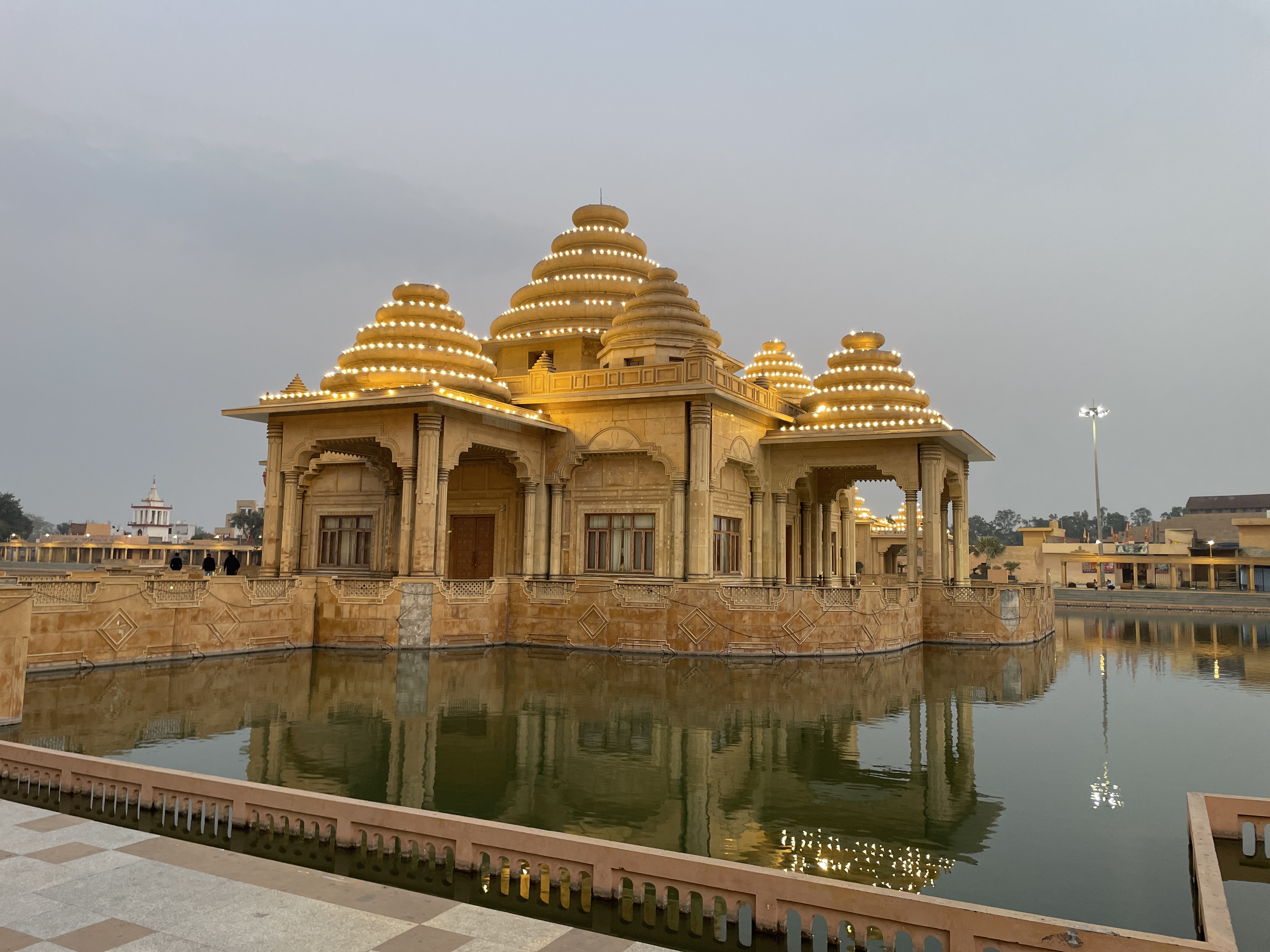
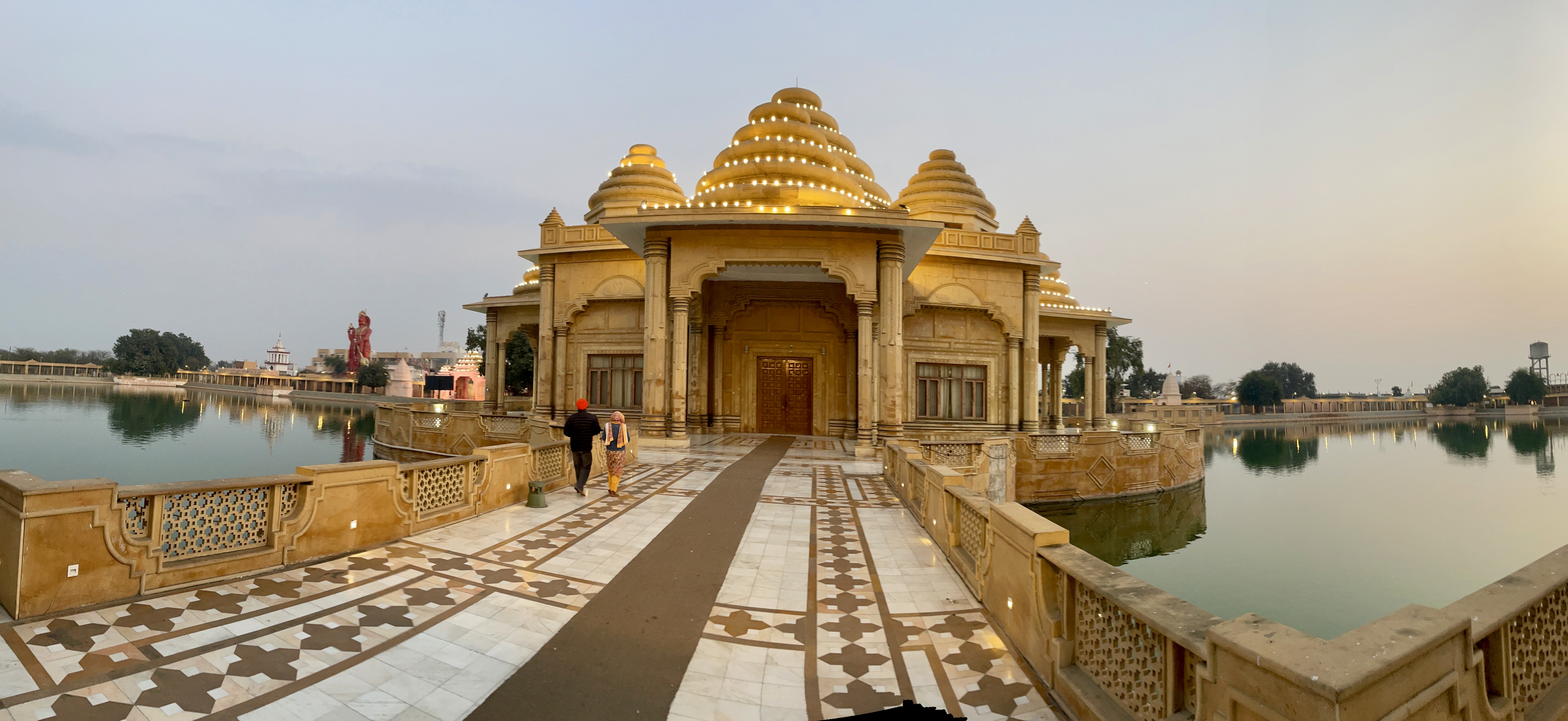
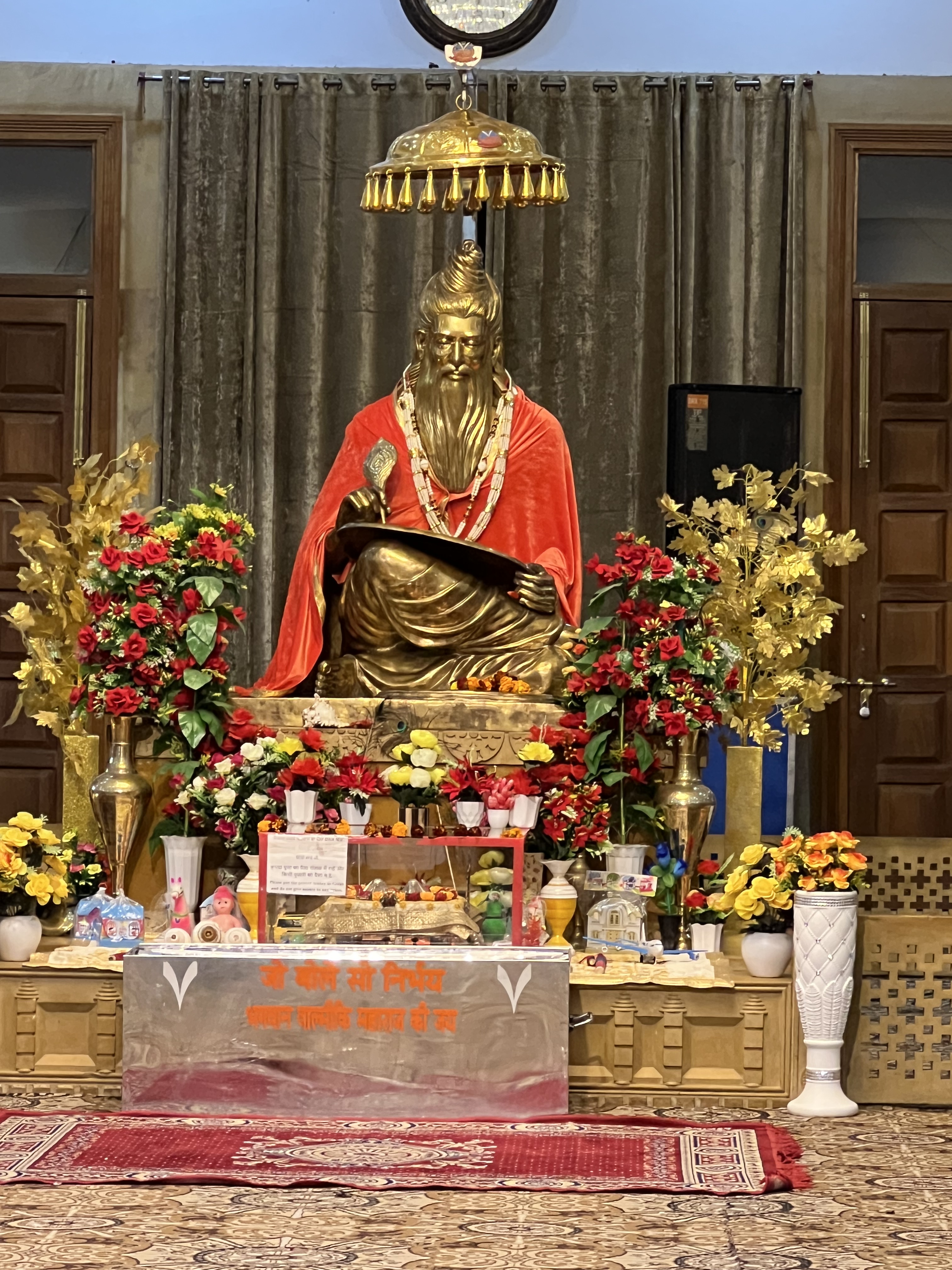
Our last stop in Amritsar was to visit the famous Ram Tirath Mandir – a place of historic and spiritual heritage of India. The temple is dedicated to Lord Rama and Sage Valmiki. It is believed to the place of birth of Lord Rama’s sons Luv and Kush. The temple has idols of Rama, Sita, Luv & Kush and Sage Valmiki. It has many connections to the Ramayana and many various scenes and stories from the epic. There were not too many people here and we enjoyed our visit. The temple also features a large pond on either side of the main temple. We were there at dusk and with all the decorative lights turned on, it was a beautiful sight.
Saurabh took us back to the hotel. We called it an early night. We had a long drive the next morning … to Dharamshala.
Amritsar was indeed a gateway to Punjab’s heart and soul. A beautiful pilgrimage that took us to several temples… and a fantastic culinary journey. Not to forget the very emotional visits to Partition Museum and Jallianwala Bagh Museum.
Over the years, I’ve read a lot about Dharamshala and it has been on my list of places to visit. I first heard about this small town when Dalai Lama (14th) moved his residence here in 1990s. The proximity of the this town to the Himalayas was also part of the allure.. Finally.. I got the opportunity to come here last week (Feb 2025). We were in Amritsar and knew that Dharmshala is “close by”…. So we decided to visit here for a few days.
Dharamshala is a small town in the North Indian State of Himachal Pradesh, nestled in the Kangra Valley. It is at an altitude of 4780 feet ( 1457 m) in the shadows of the Dhauladhar ranges. The Dhauladhar mountains are part Shiwalik mountain ranges of the lower Himalayas and stretch about 200 Km (125 miles). Dharamshala is also a spiritual center. As the name suggests, it is a house or place of Dharma (moral & spiritual code of conduct). The town got its name from an old rest house constructed by devotees near the Bhagsunag temple for pilgrims. And the name stuck… the 14th Dalai Lama ( and the Tibetan administration) moved to Dharamshala in 1960. The town has several Hindu temples as well and has an interesting mix of Hindu and Buddhist cultures.
All this makes Dharamshala a very interesting place to visit and take in the various experiences.
Getting here .. we drove to Dharamshala from Amritsar. It was only 200 km/125 miles but it was a 5 hour drive on NH 54. The roads were terrible.. a new highway is being constructed. Our driver Saurabh (native of Kangra region) tried his best to make the drive as comfortable as possible in our Toyota Innova Crysta. We arrived in Dharamshala around 1 pm after a brief rest stop in Nurpur. The restaurant had some amazing Poori and Alu Bhaji (potato curry).
At the rest stop in Nurpur (Kangra District)
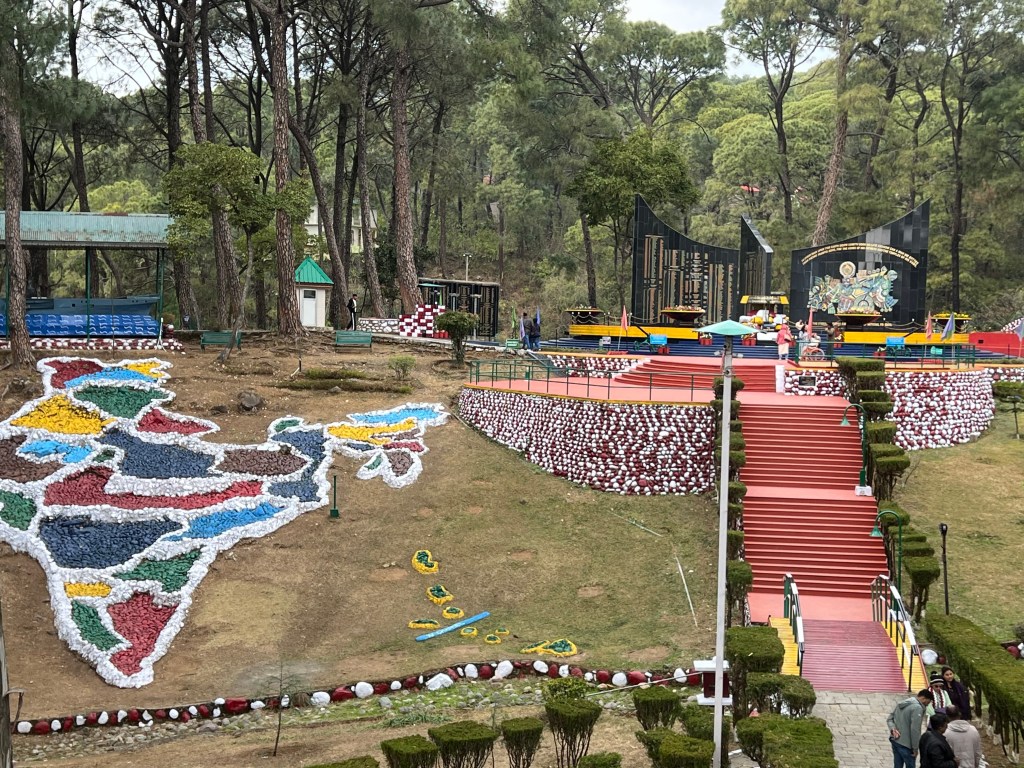
Our first stop in Dharamshala was at the War Memorial which was in the heart of town. The War Memorial is a poignant tribute to the heroes who laid down their lives in various battles fought since 1947 including UN Peace Keeping Missions. The memorial made of black stone symbolizes the courage and sacrifice of the soldiers from the Kangra region. Behind the main monument, are tall stone panels with names of the martyred soldiers etched on them. We walked around the memorial complex, took a few pictures and got back into the car to our next stop.
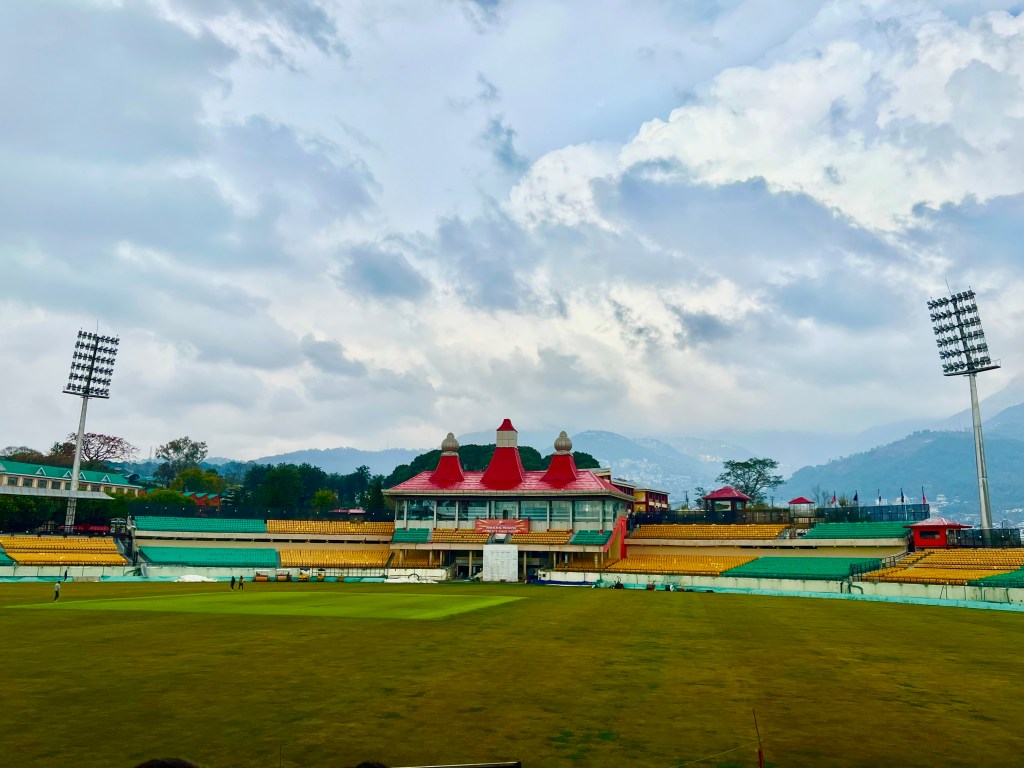
We went to the Dharamshala Cricket Ground… world’s highest stadium at an altitude of 4791 feet. Over the years, I’ve watched several cricket matches on TV that were played at this stadium. It was nice experience to walk into the stadium and see this ground in a truly spectacular setting. The mountains in the background, the colorful stands and the lush green outfield made this a treat for the eyes. I tried to capture all this as best as I could with my camera.
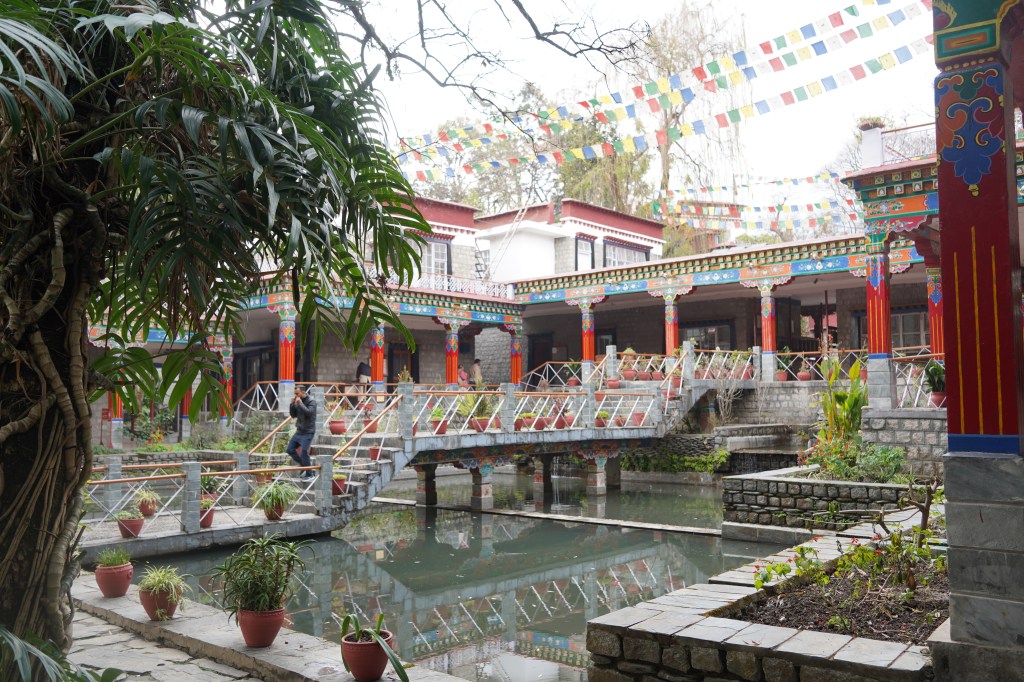
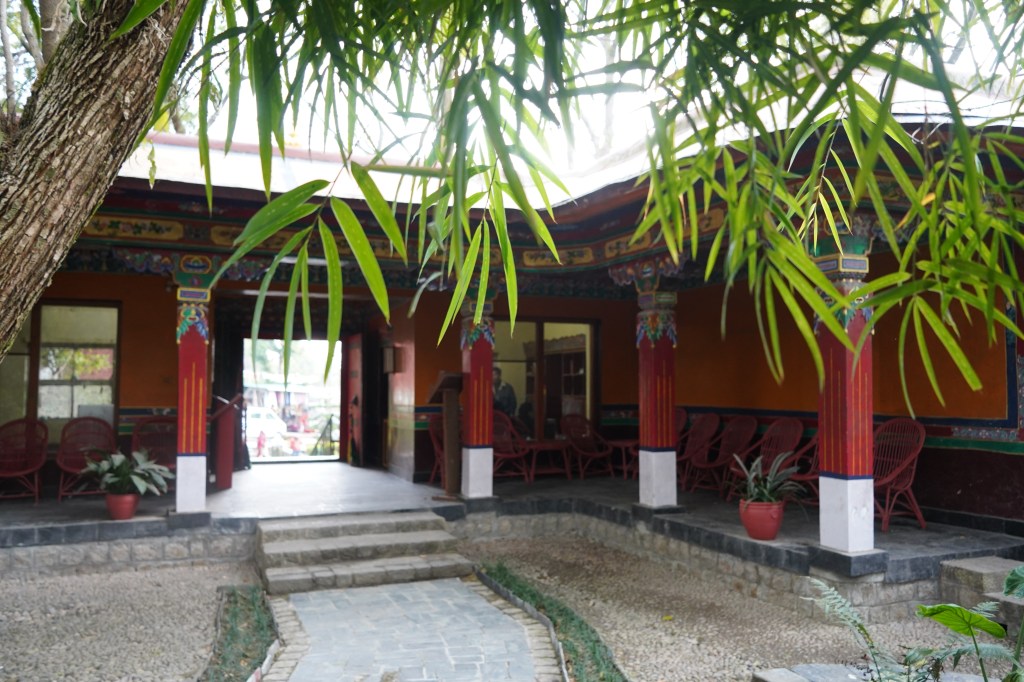
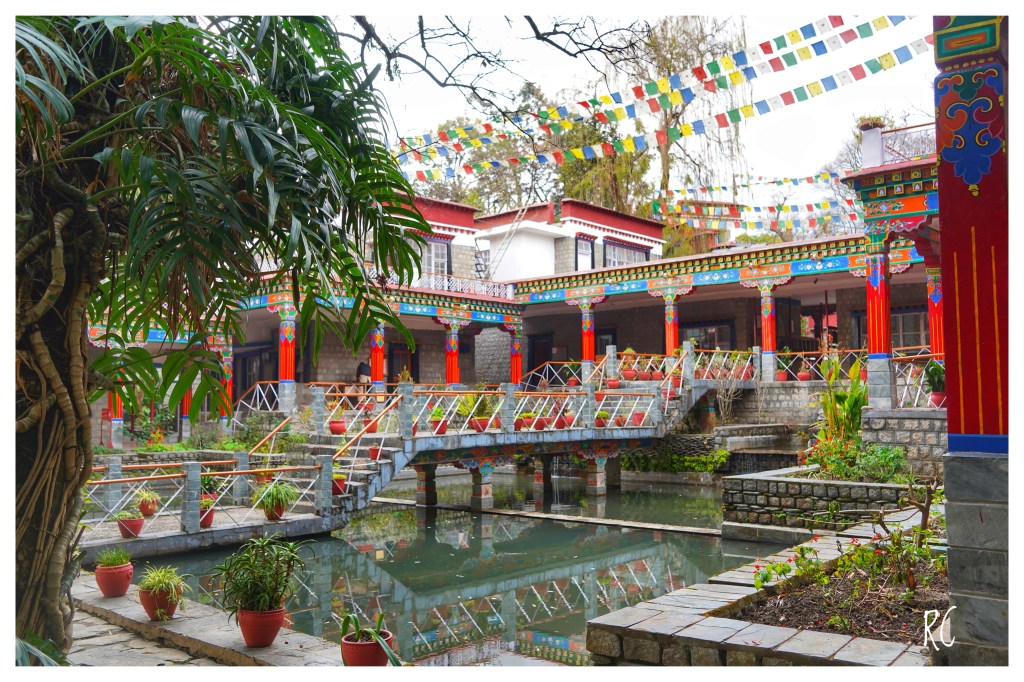
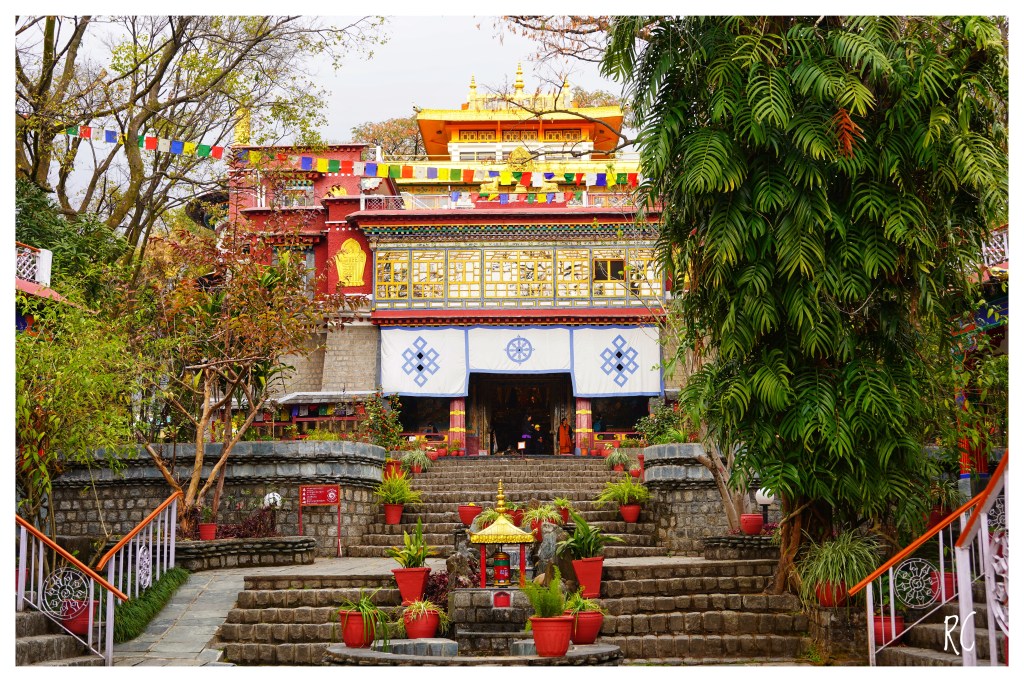
We drove from the stadium to the main attraction for the day – the Norbulingka Institute (a Buddhist center and a monastery). Founded in 1995 by Kelsang and Kim Yoshi at Sidhpur, the Insitute is dedicated to the preservation of the Tibetan culture in its literary and artistic forms.The institute is named after Norbulingka , the traditional summer residence of the Dalai Lama, in Lhasa, Tibet. The ground plan is based on the proportions of Avalokitesvara, the thousand-armed god of compassion, with the temple as the head. (Wikipedia). The monastery here makes this a religious center also. There is a beautiful exhibition room with various exhibits showcasing cultural and religious elements.
The center was very calm, peaceful and serene, perfect for relaxation and contemplation. Air was filled with the gentle gurgling sounds of the flowing water and the fountains added to the landscape. There was a gentle breeze blowing across and the afternoon Sun was peeking through the clouds. A cobblestoned walkway meanders through this beautiful enclave and leads to the Norbulingka Temple. It is called the Deden Tsuglakhang (Seat of Happiness).
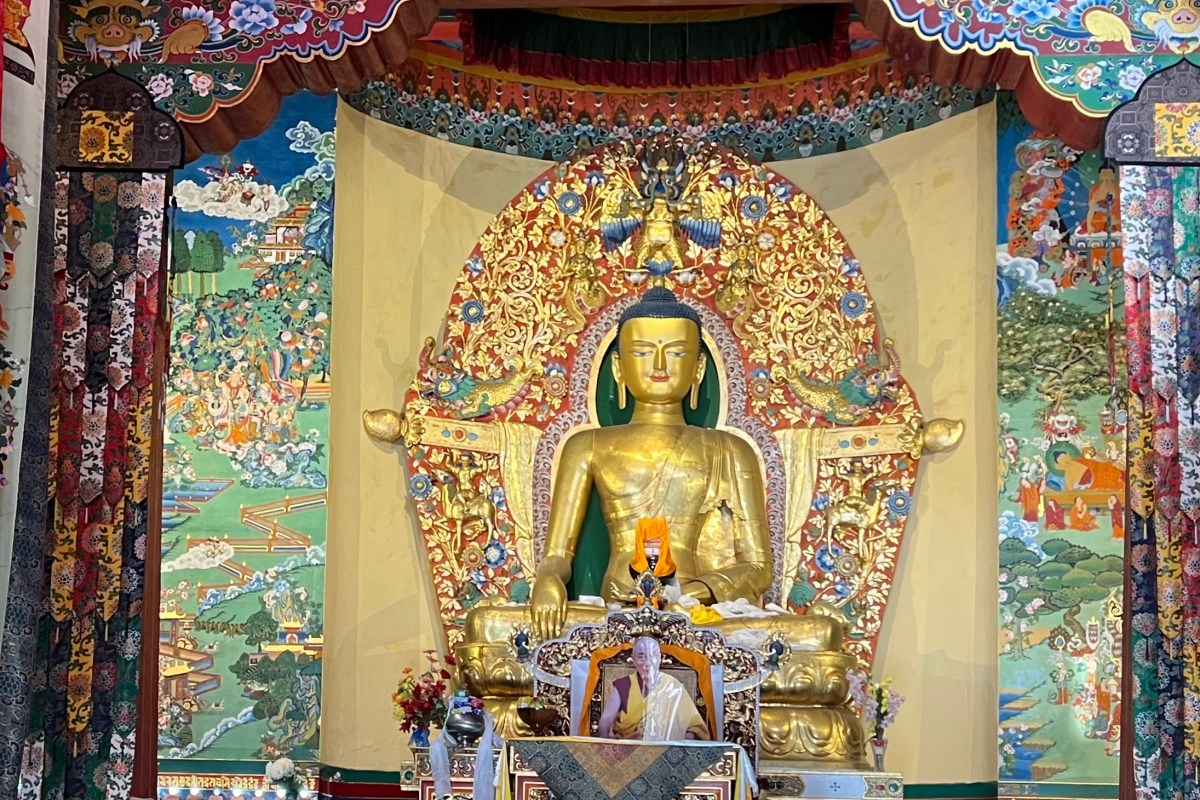
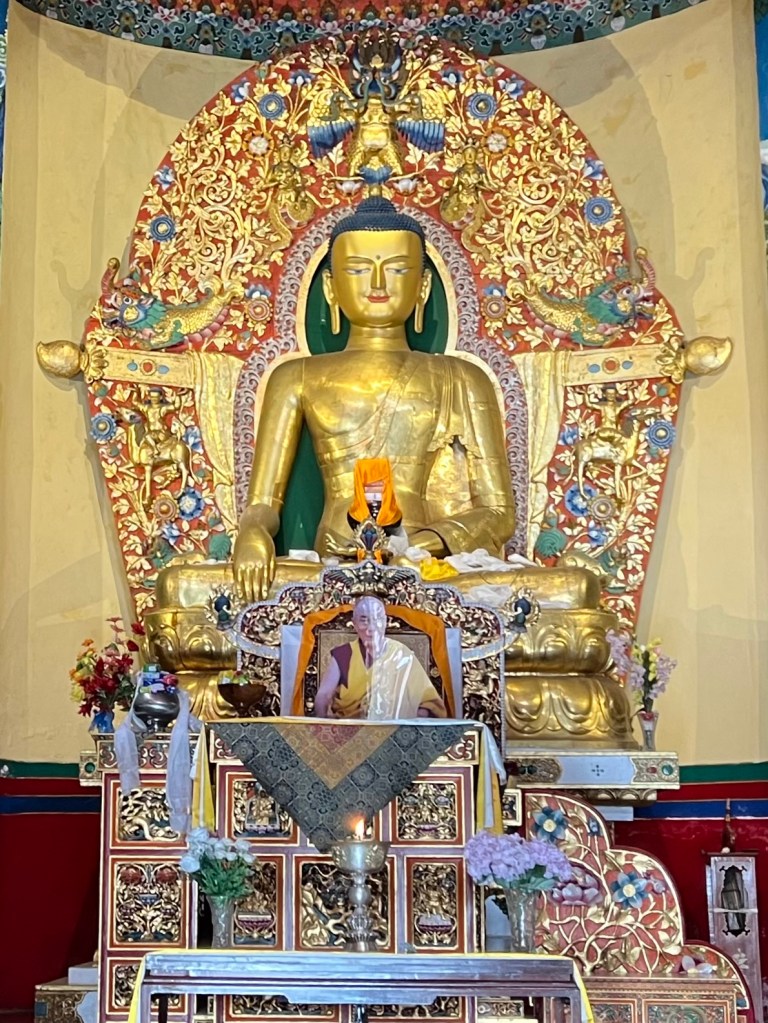
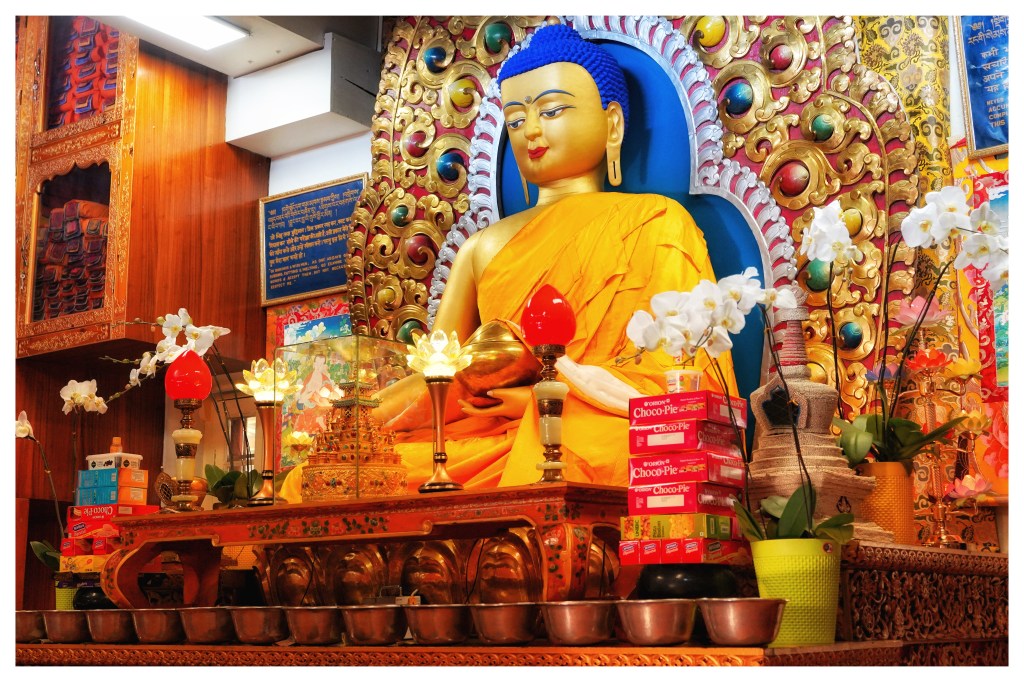
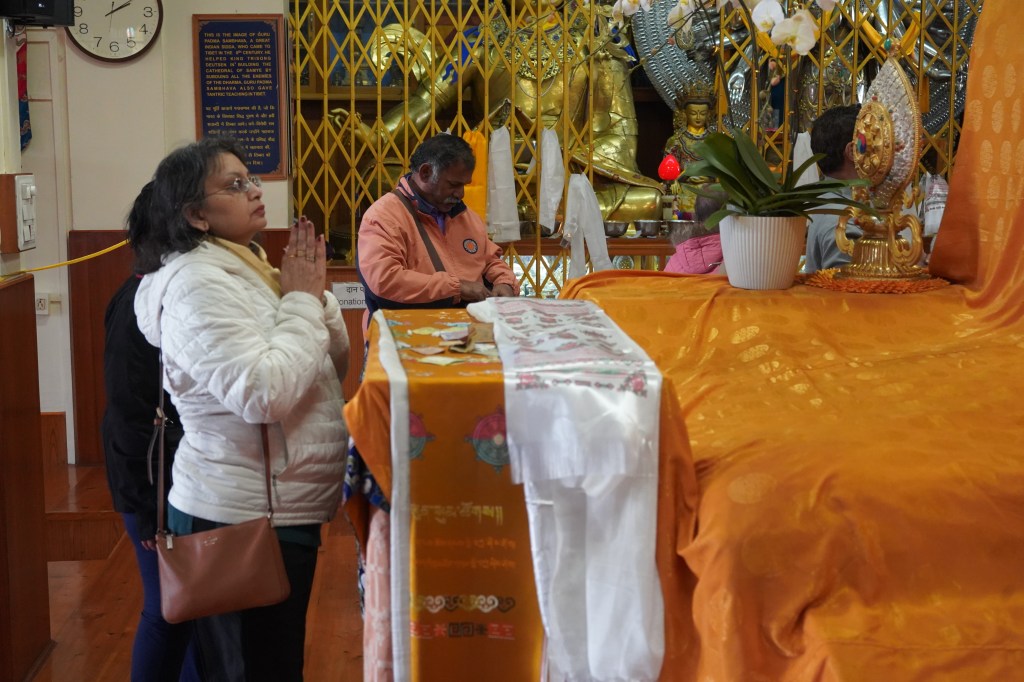
The temple is an example of Tibetan religious architecture and provides for a perfect setting for meditation and prayer. There are several elements created by Norbulingka artists – the centerpiece is a 14 feet tall gilded statue of Buddha Shakyamuni, apparently the largest outside Tibet, crafted from hand-hammered copper sheets. This statue is symbolic of the huge influence Buddha’s teachings have had on Tibetan culture. Painted behind the statue are the 12 deeds of the Buddha Shakyamuni. There are 1173 images of Buddha surrounding the temple and decorating the 44 ft high temple hall. (Source: Poster at the Temple)
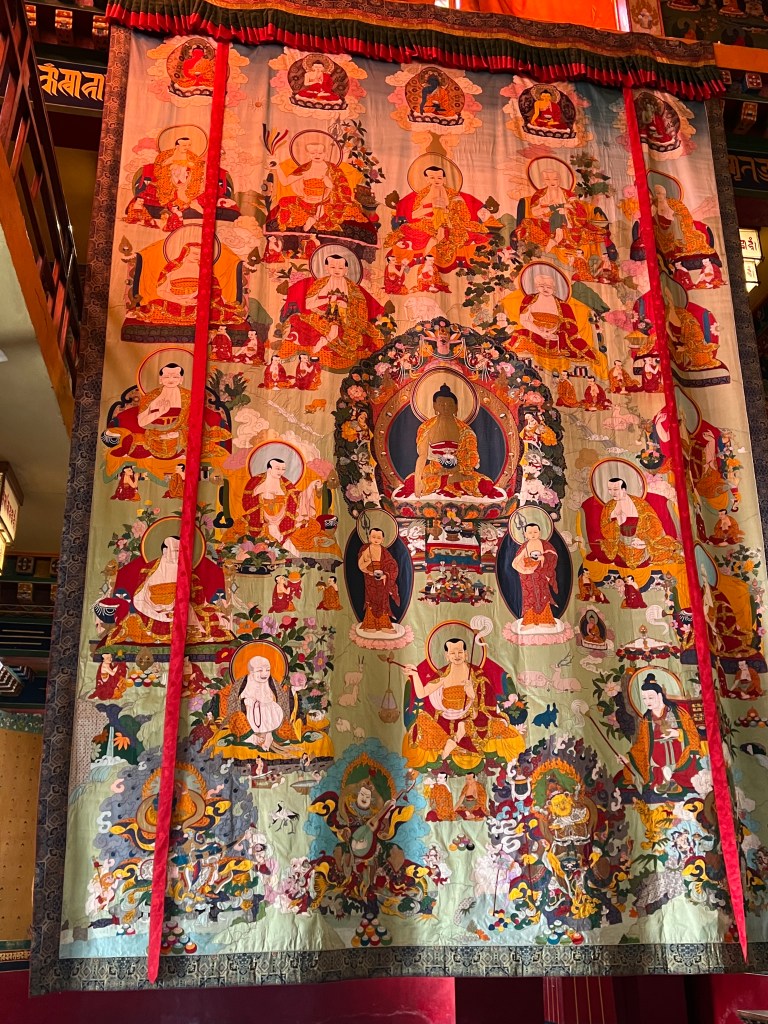
To the left of the statue, there was a large cloth hanging from the ceiling… it is a Thangka Applique is a tapestry which is over two stories high displaying the Buddha and the Sixteen Arhats (Sanskrit: “one who is worthy”): Over twenty feet tall, the applique is composed of over 20,000 pieces of silk and brocade hand-stitched by artisans at Norbulingka. In Tibet it is said, visualizing Buddha Shakyamuni surrounded by the Sixteen Arhats and an assembly of Bodhisattvas is good karma and helps develop insight into Buddha’s teachings. (Source: Poster at the Temple )
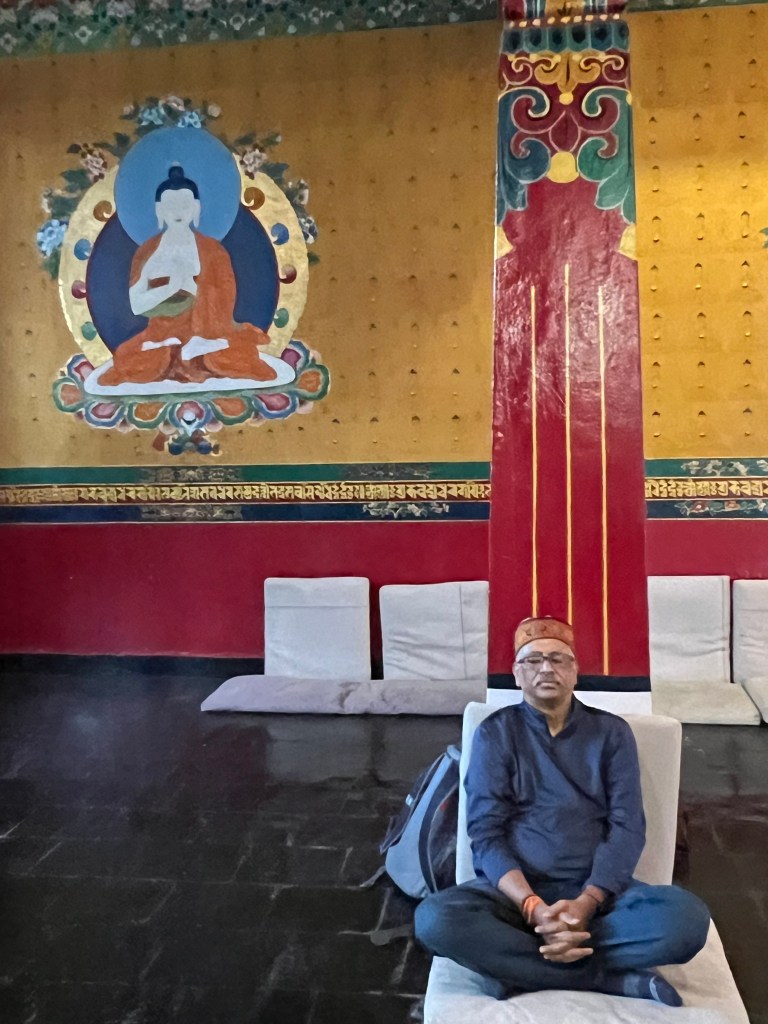
I sat down for a silent prayer and a moment of reflection – had to soak in the atmosphere and vibe of the place.
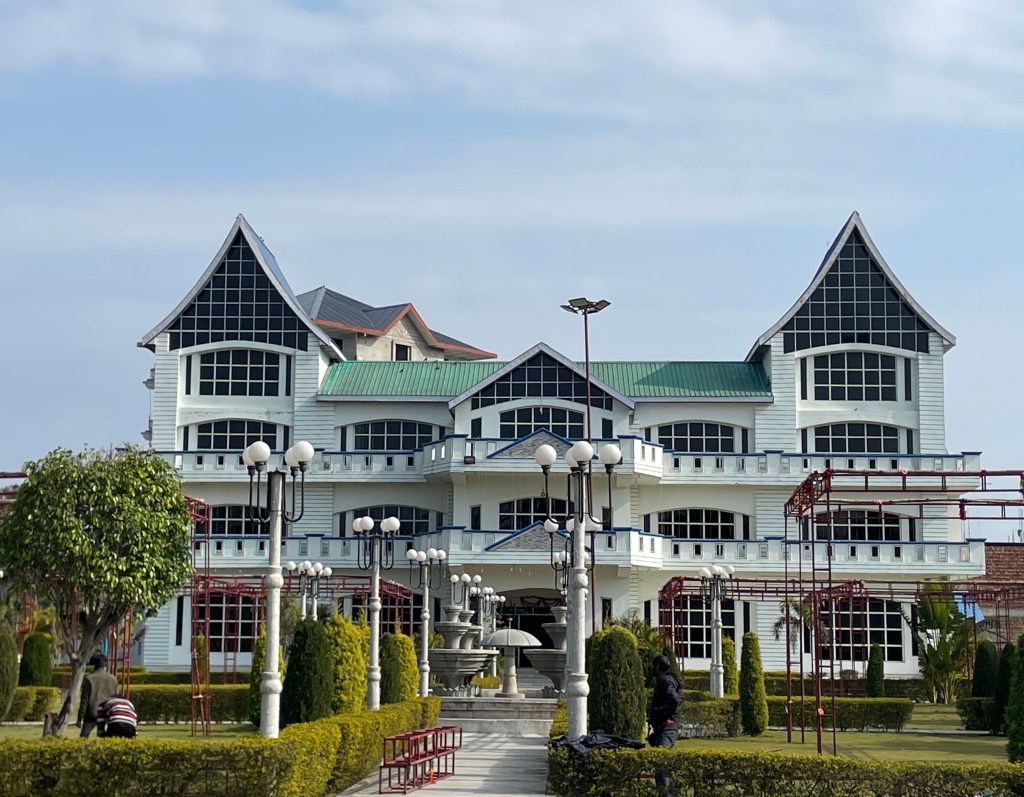
After we spent about an hour at the Institute / Temple, we left for our hotel. We checked in at the Club Mahindra Dharamshala resort and decided to have a quiet evening. It was a long day that started at 8.30 am in Amritsar. We had dinner at the restaurant in the resort. We had Thupka – a hearty noodle soup and rotis with Madra (a traditional Himachali vegetable curry).
After a restful night, we were ready for Day 2 in Dharmshala. Our driver Saurabh had a packed agenda planned for us. It was a beautiful weather day.. the sun was out and it was about 50 deg F.
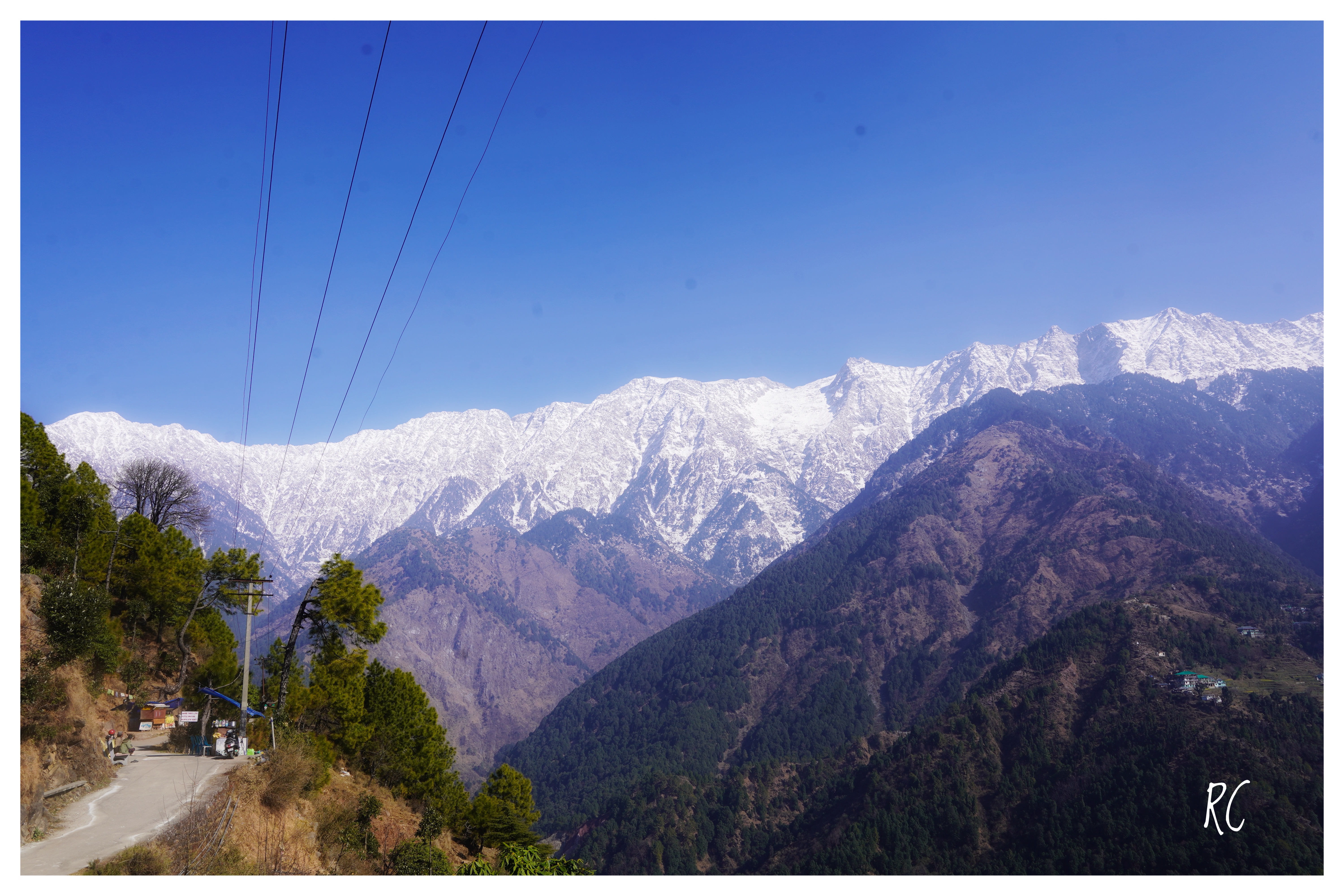
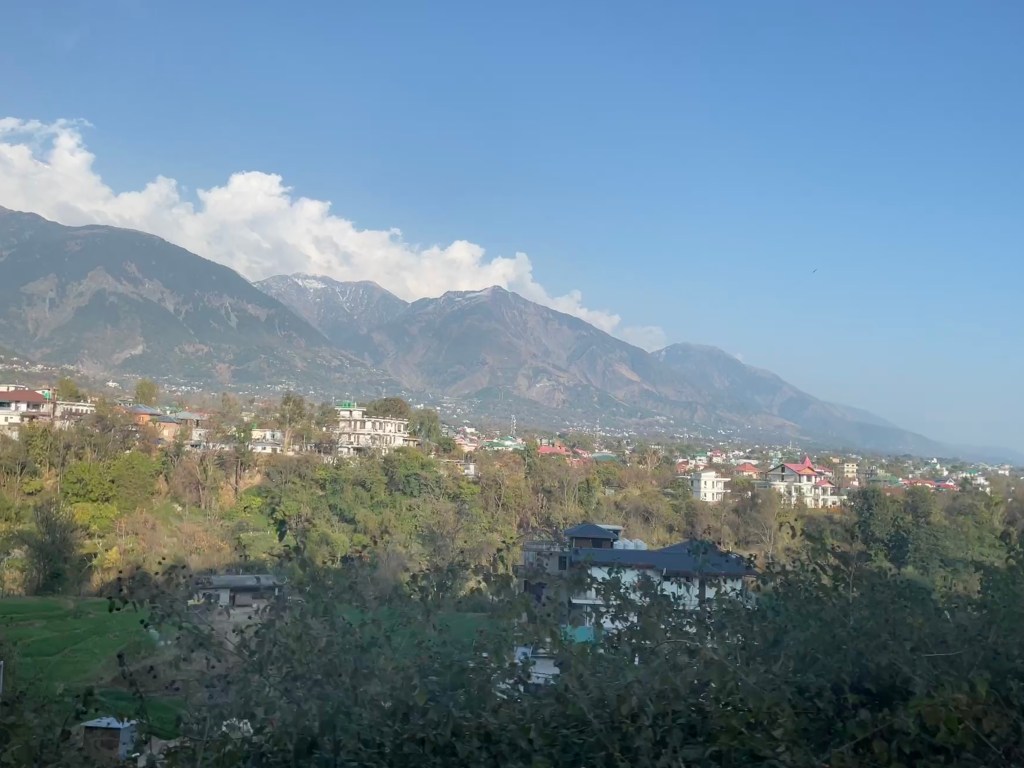
The plan is to drive to McLeodganj (also called upper Dharmshala). McLeodganj is located in the Kangra Valley at an elevation of 6830 feet (2,082 M). It is known as “Little Lhasa” or “Dhasa” because of its large population of Tibetans. The Tibetan government-in-exile is headquartered in McLeod Ganj. Fun fact about the Dhauladhar Range – the highest peak is called the “Hanuman Ka Tibba”, at about 19,626 feet (5,982 m). It is named after the Hindu god Hanuman who according to legend, was said to have rested here during his journey to the Himalayas. I understand Mcleodganj is a very popular destination for trekkers.
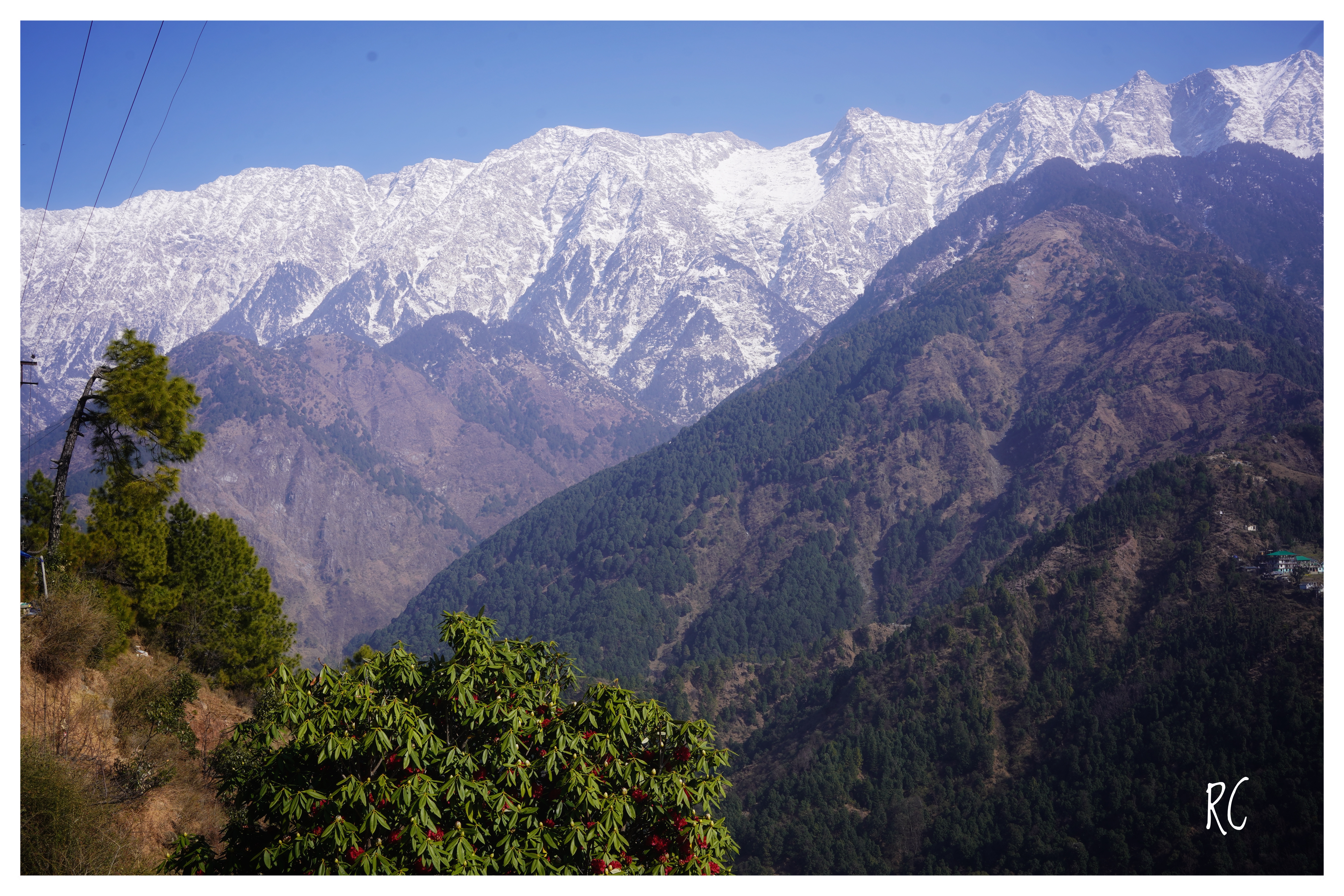
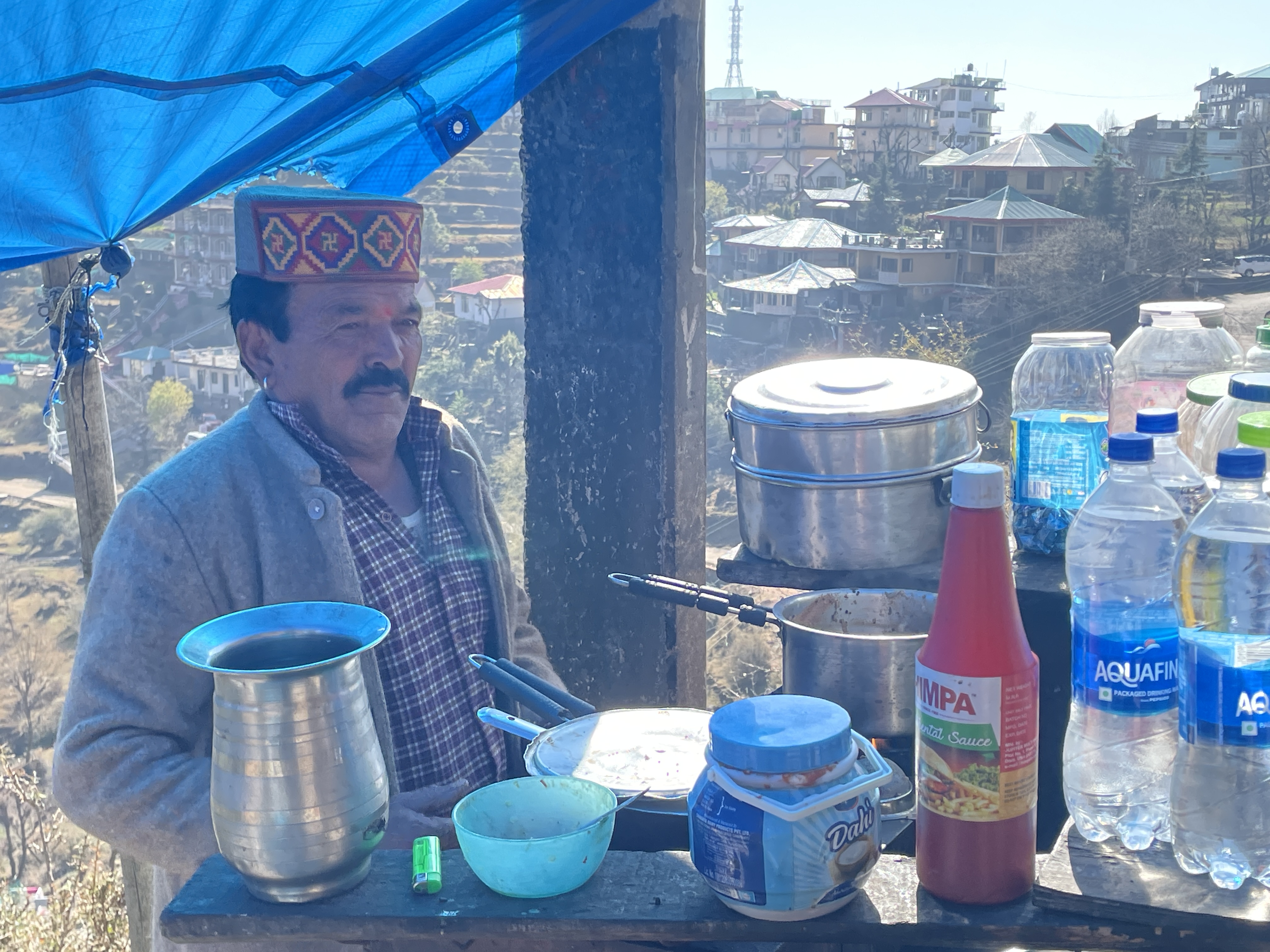
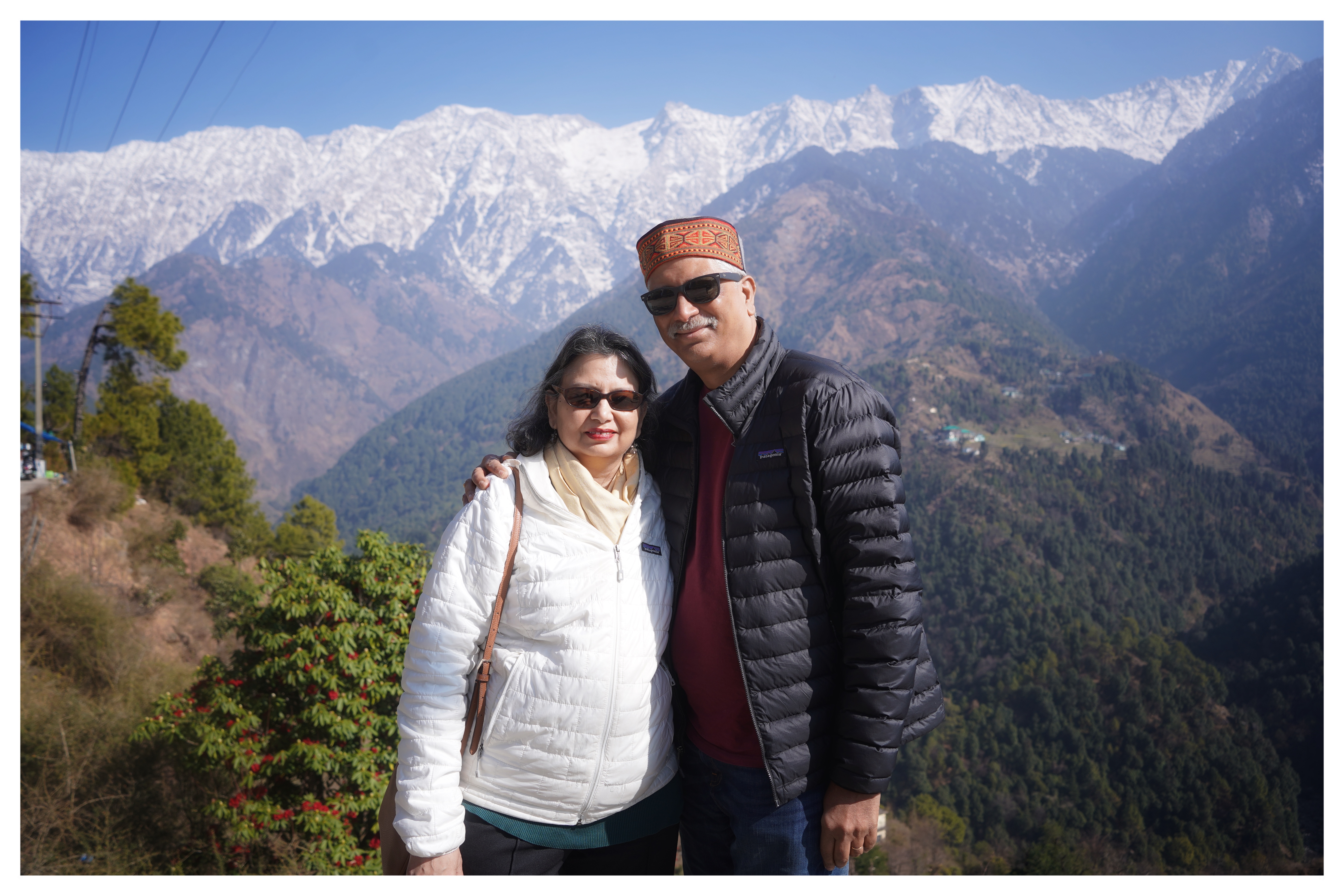
Our first stop was at Nandi Point. This is a view point offering breathtaking panoramic views of the mountains. It had snowed the last night in the mountains making the views of a landscape even more stunning. We walked around for a little bit, took a lot pictures trying to capture beauty of the scenery. We stopped by at a roadside stall for some chai – the Tau ji made very good chai (and very sweet) chai for us.
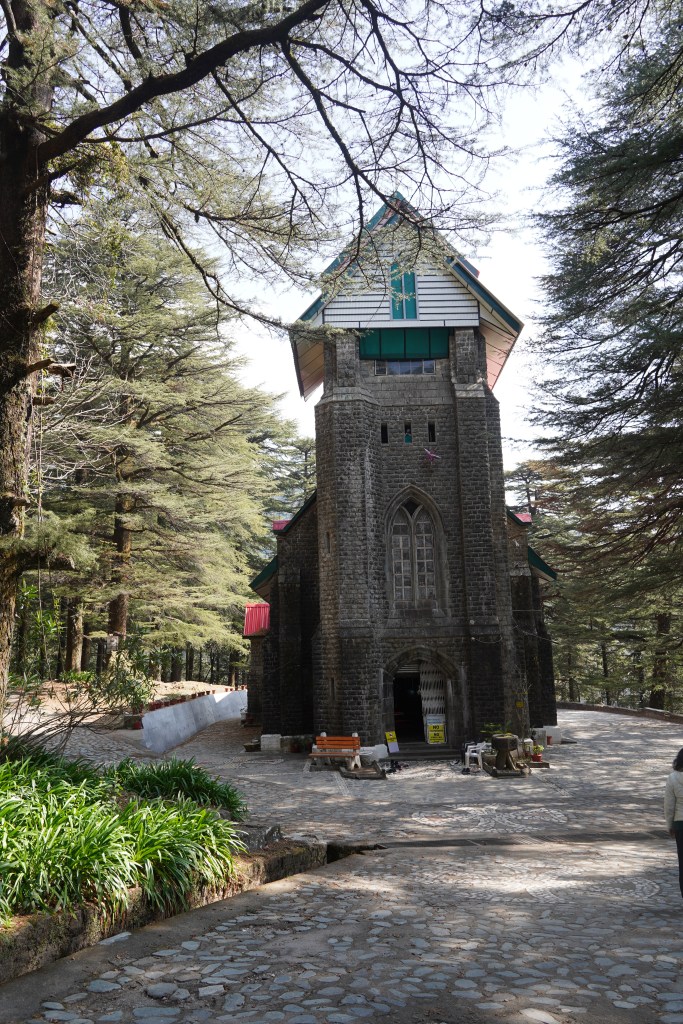
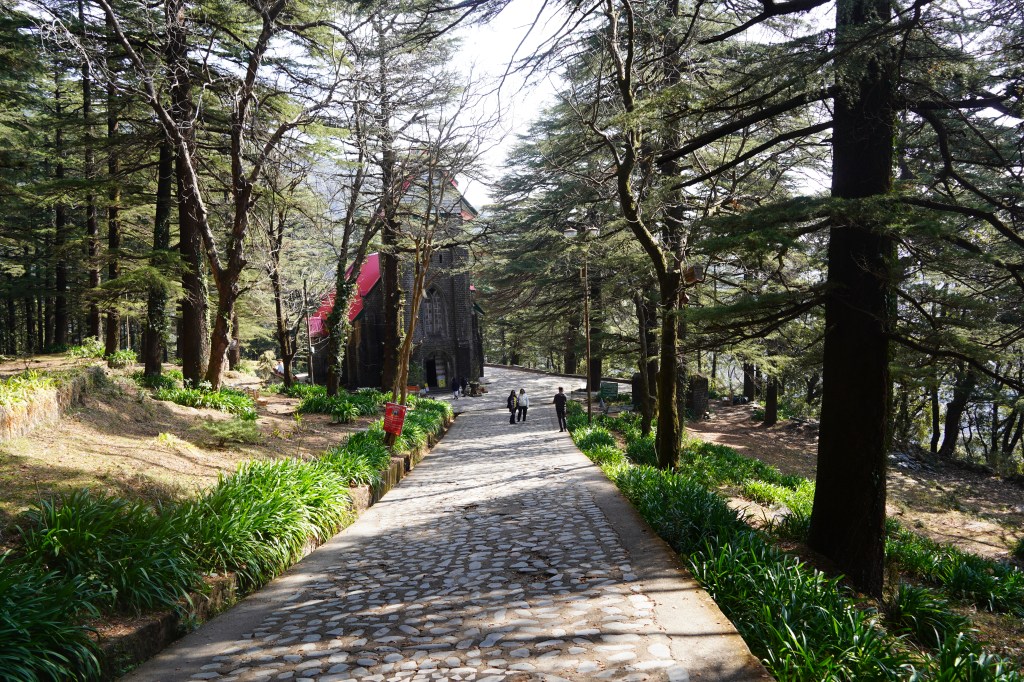
Our next stop was at the Church of St. John in the Wilderness.. a pretty odd name for a church, I thought. This is a Protestant church built in 1852 is located in a dark pine forest with lots of greenery around. There is a long cobbled walkway leading to the church. It is built in a neo-Gothic architecture and has Belgian stained glass windows. Compared to the many churches that we’ve seen around the World, this one did not really impress. There is a statue of Lord Elgin behind the statute. Lord Elgin was a Governor-General & Viceroy of India and died in Dharmshala in 1863.
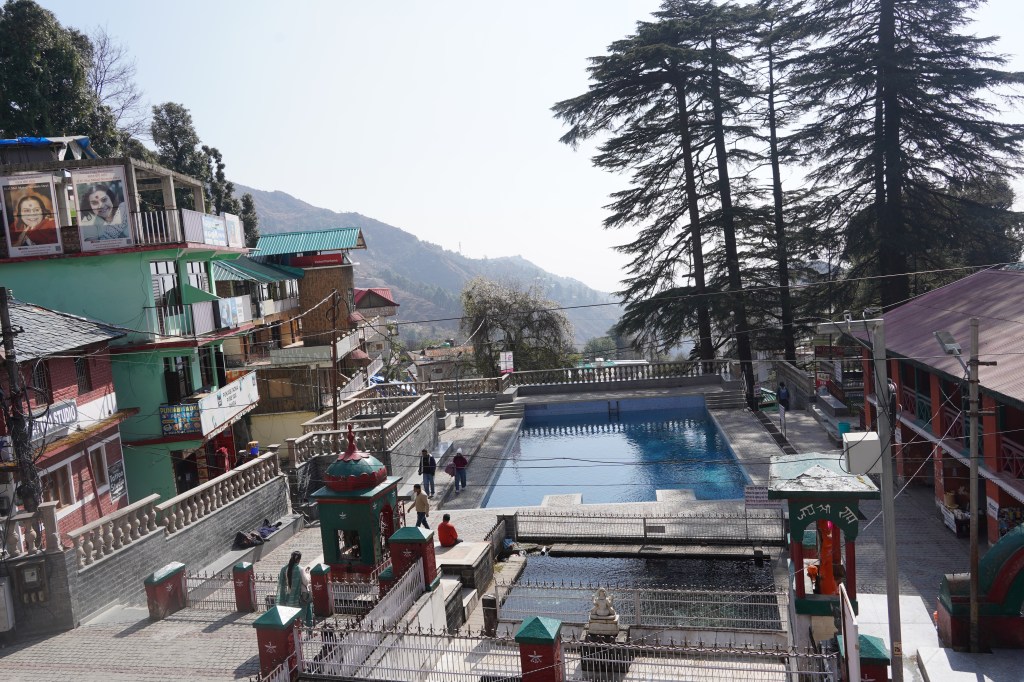
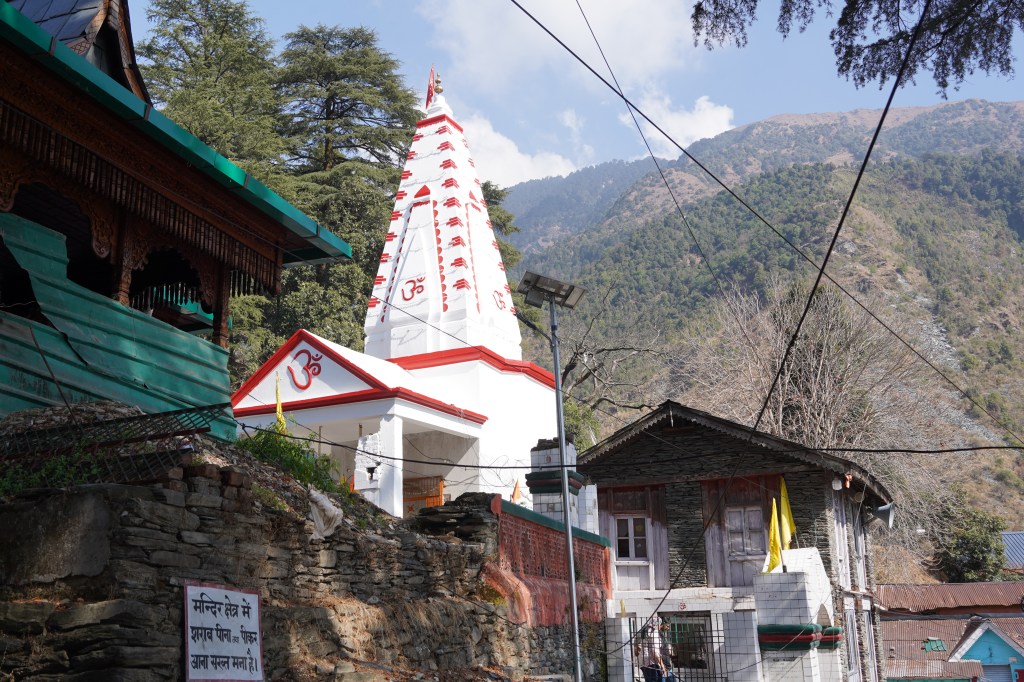
Now we were on our way to Mcleodganj to visit the main attraction of the day – the Namgyal Monastery. It was a steep uphill climb to Mcleodganj. Saurabh did a fine job driving the Innova through narrow roads and negotiated the sharp turns expertly. We arrived in Mcleodganj after a 30 min drive and made a stop in the village of Bhagsug. Saurabh dropped us here so that we could visit a famous temple in the area – the Bhagsunag (a.k.a. Bhagsunath) temple. One of most ancient temples (over 5000 years old) in the area, it is located on the slopes of the Dhauladhar mountains. It was a short walk to the temple though the market street. There are two man-made pools at the entrance to the temple where the main god is Lord Shiva. The locals consider the pools to be sacred and believe the waters have miraculous powers of healing. The temple was very small and simple structure with a very low entrance to the inner sanctorum. After saying our prayers and seeking the blessings of Lord, we walked back to market area.
Bhagsu Falls are in the vicinity of the temple but we were told that there is no water in the falls and it is best to skip this. Back in the car, we continued our journey to the Namgyal monastery – home to Dalai Lama.
The Namgyal monastery was originally founded in 1564 in Tibet. Following the Chinese invasion of Tibet in 1959, the 14th Dalai Lama and 55 monks fled to India and re-established the monastery here. As you walk towards the monastery, you’ll pass through a serene and culturally rich area that showcases the unique blend of Tibetan and Indian influences. We saw the Tibetan National Martyrs Memorial on our right and a Tibetan gift shop opposite to it. The memorial is dedicated to the martyrs who sacrificed their lives in the struggle of Tibet’s freedom.
The monastery complex (called the Tsuglagkhang Complex) which includes the main temple has a magnificent statue of Lord Buddha, a large prayer hall and a museum showcasing Tibetan art and culture. There are also residential quarters including the residence of the Dalai Lama. Above all the temple sounds as a symbol of hope and resilience for the Tibetan people. As we walked into the complex, we heard the gentle chanting of monks, the rustling of prayer flags, and the soft chatter of visitors, creating a unique and unforgettable feeling There was a sense of calm and serenity in the air.
Before visiting the main temple, we first went to the Kalachakra Temple, built in 1992. A simple hall, painted in yellow, it contains mesmerising murals of the Kalachakra (Wheel of Time) mandala, linked explicitly to Avalokiteśvara. We made our offering of the Khata (a white silk cloth) to Lord Buddha. I read that the Khata (a.k.a Khada) is a traditional Tibetan ceremonial scarf symbolizing respect, purity and goodwill offered to a deity. After our offering and a prayer, we walked around the rest of the complex.
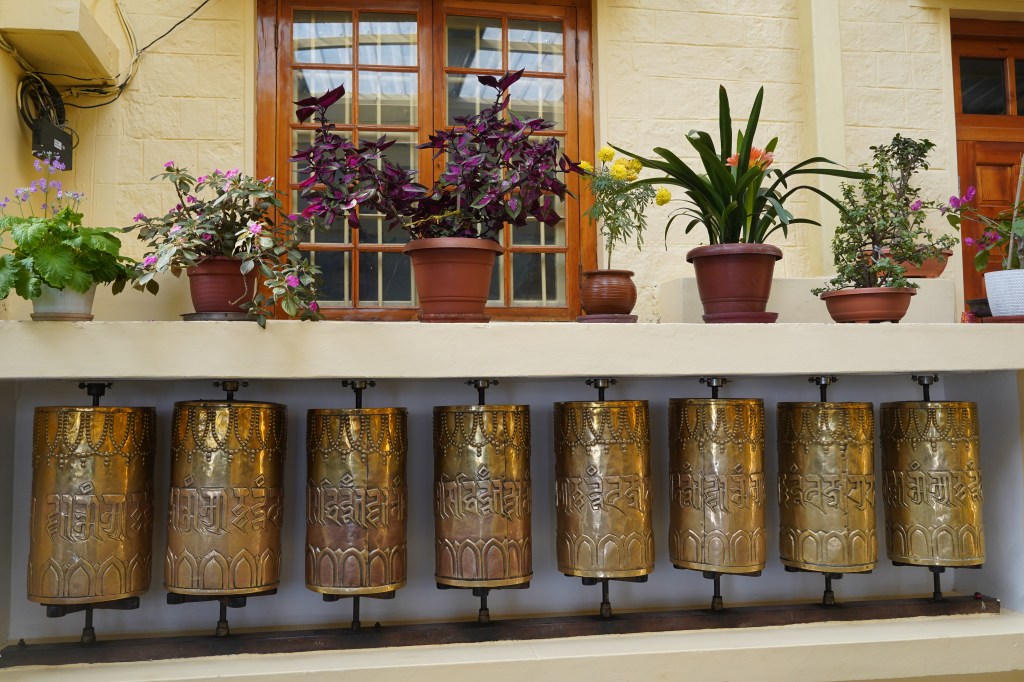
As we walked into the main temple, I saw a monk sitting on a cushion right next to the large statue of Buddha. The monk saw the camera around my neck and indicated to me that photography was not allowed. My description of the prayer hall is mostly based on my “photographic” memory 🙂 and my online research. The walls of the hall were adorned several Thangka paintings and there was scent of incense sticks in the air. There was a woman sitting on a cushion in front of the statue of Avalokiteśvara (the bhodisattva of compassion) deep in prayer. Chants of Om Mani Padme Hum could be heard in the background. This is the primary mantra of Tibetan Buddhism and is associated with Avalokitesvara. It is believed to encapsulate the essence of all Buddhist teachings, promoting compassion and wisdom– We walked around to the prayer wheels that were located on the outer wall of the temple. We spun the wheels while chanting the Buddhist prayer…. Om Mani Padme Hum (The Jewel in the Lotus). Prayer wheels are another key aspect of all Buddhist temples. These wheels are cylindrical devices that contain holy scrolls of Buddhist scriptures inside which are spun in a clockwise direction to generate merit and blessings.
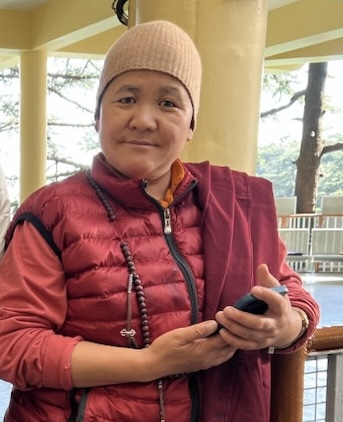
We sat down for a few minutes to moment of reflection, just observing various visitors and monks in the area. We spoke to one of the monks and she agreed to take a picture with us. She told us that the Dalai Lama participated in the prayer ceremonies three times a week and offered a sermon to all in attendance. We unfortunately missed an opportunity to see him as he is away in Bangalore at an event.
A monk at the monastery
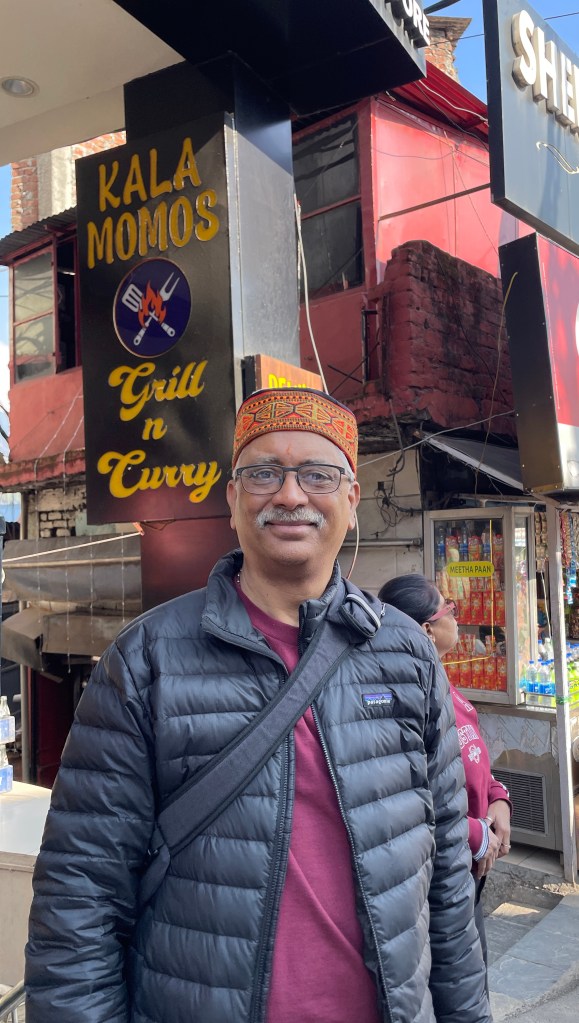
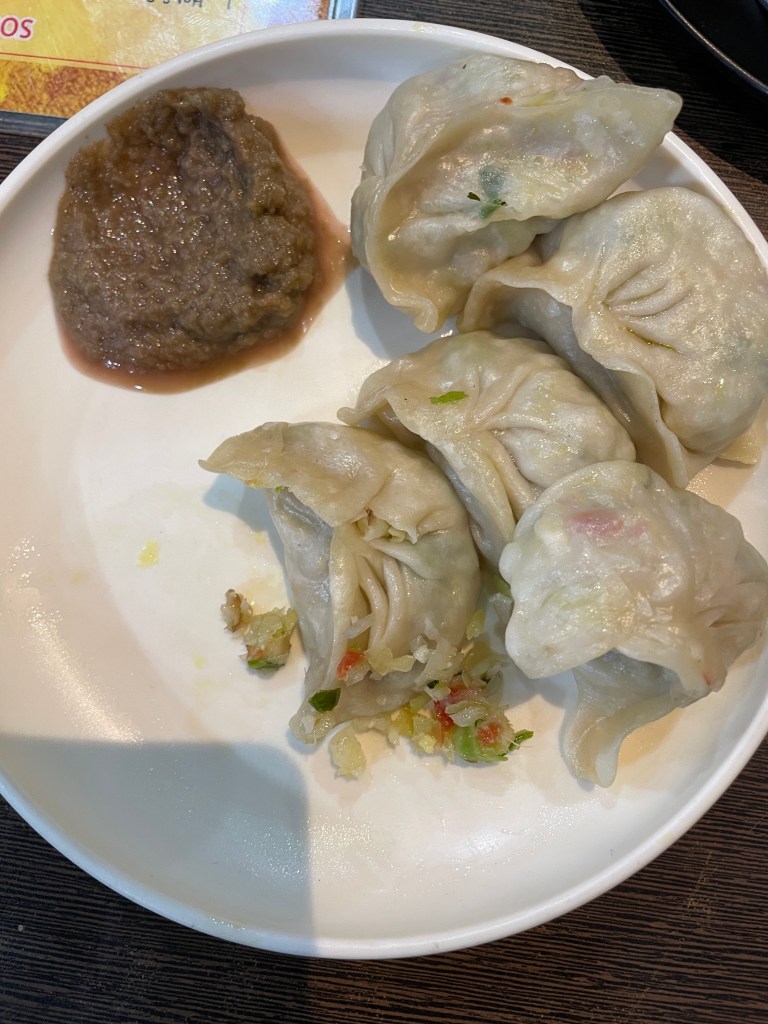
A visit to a tea plantation was next on the itinerary. As we were driving through the market area, we made a quick stop at Kala Momos to try out some Momos. The Momos lived up to the hype – they were amazing.
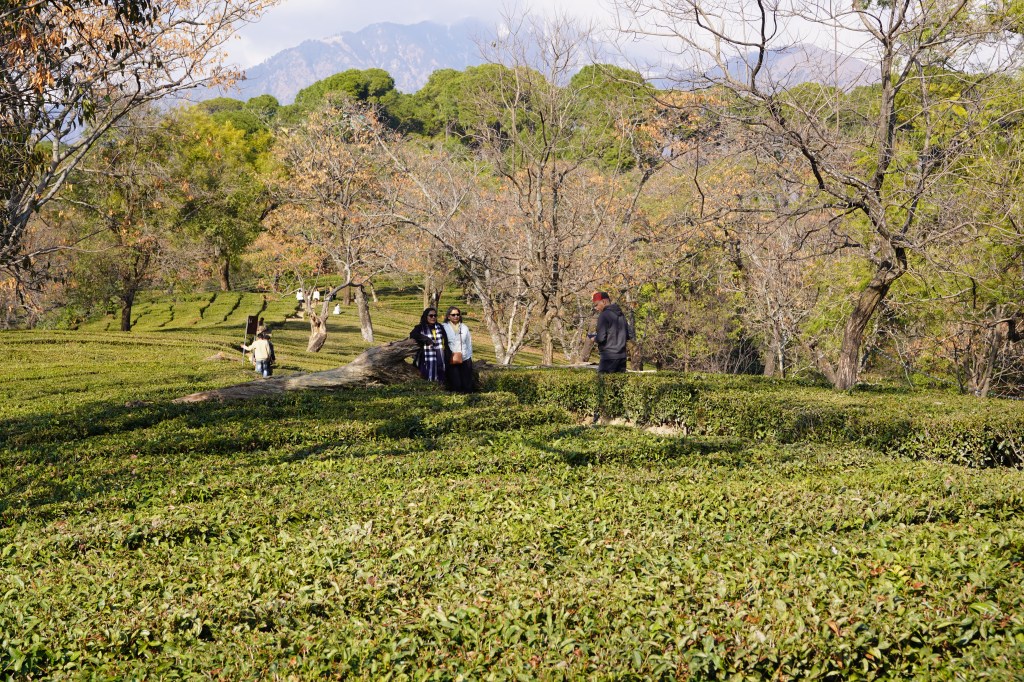
We arrived at the tea plantations of the Himalayan Tea Factory. We walked through the tea plantations and tried their Spice Tea Latte at the outlet. The guy at the store told us that Himachal Pradesh is not a very large tea producer, but they grow some premium quality teas here. After a couple of pictures and the Chai, we were on our way to our final stop for the day.
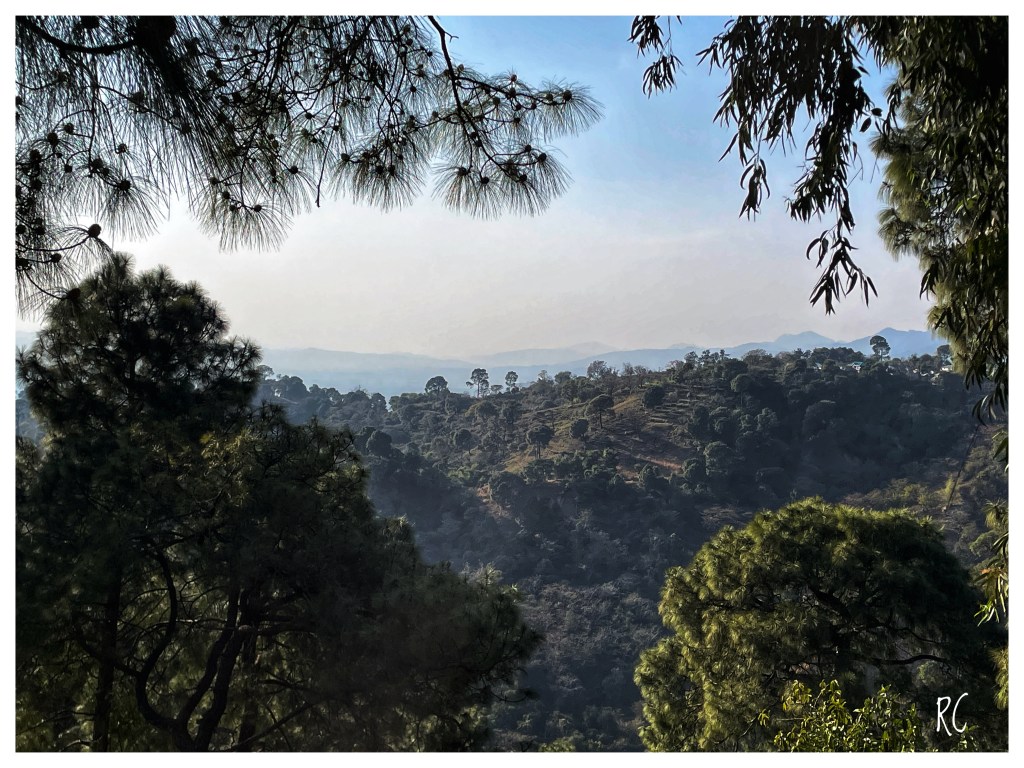
We went to the Shri Kunal Pathri Mandir – a small temple complex in the midst of the hills and the tea plantations. There is a very interesting story behind the origin of this temple. It is said that the stone in the temple always remains wet. As the legend goes, when the rock begins to dry, it starts raining. It is a lovely picture spot as well with a beautiful view of the mountains and the dense forests.
With this final stop, we wrapped our visit to Mcleodganj. We settled in for a quiet evening after a busy day of sightseeing and making some amazing memories.
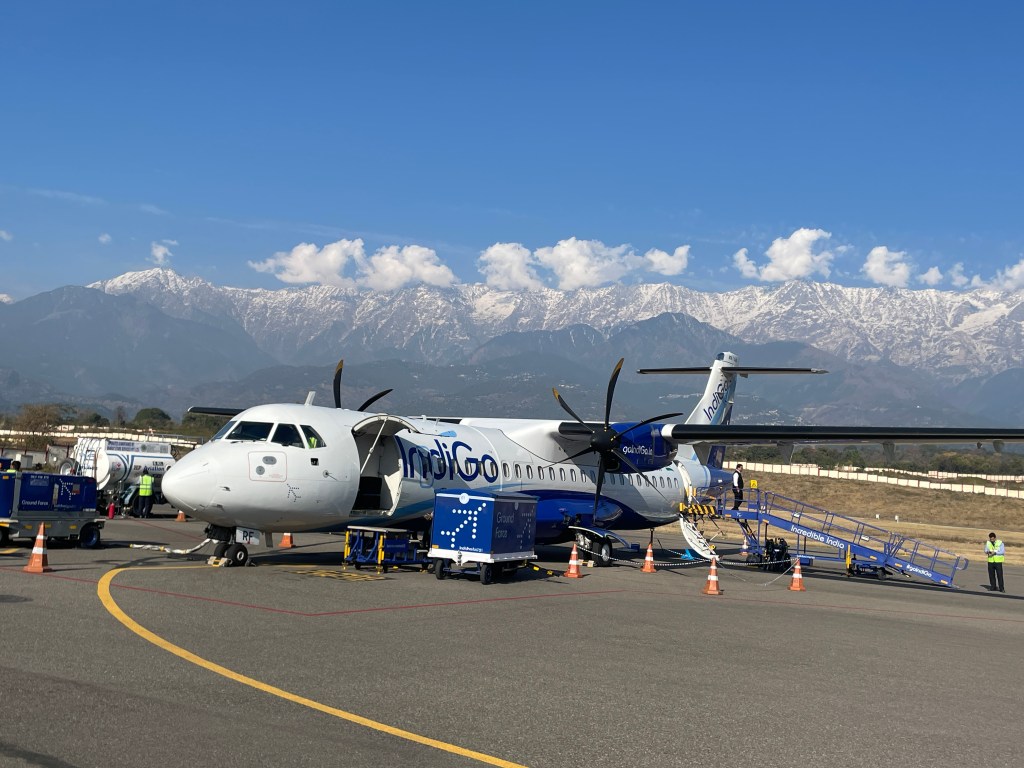
We flew out on Day 3 from the Kangra Airport to Delhi. As you would expect, it is a very small airport, but the setting was very scenic.
Scenic Kangra Airport
A superb visit to Dharmshala comes to an end… beautiful sights, spiritual experiences and we collected some blessings as well. .
We have been wanting to do a roadtrip in India for a longtime. On our recent visit to India, we decided that we would drive to Chickmagaluru in Karnataka. Most (many) folks may not have heard about Chickmagaluru (Coorg is more known and popular destination in that part of Karnataka). Well, Chickmagaluru did not disappoint…. it was an amazing roadtrip for so many reasons… Here goes….
Chickmagaluru is a beautiful unexplored hill station in Karnataka. Mountains, waterfalls and coffee plantations make it a paradise for nature lovers. The aromatic fragrance of coffee floats in the air incessantly and endless cups of filter kappi makes for a complete day. Chickmagaluru literally means “The town of the younger daughter” in the Kannada language. The town is said to have been given as a dowry to the younger daughter of Rukmangada, the legendary chief of Sakkarepatna and hence the name (Thanks Wikipedia). I also heard from locals that not too far away from Chickmagaluru is another town called called Hiremagaluru which means “The town of the elder daughter”. Clearly, Chief Sakkarepatna was a wealthy man, giving away small towns as dowry in the marriage of his daughters. The region of Chikamagaluru is the area where the rulers of the Hoysala Empire started and there are several monuments / temples that represent their reign.
Chickmagaluru is about 150 miles from Bangalore (now called Bengalauru) and is well connected now by an excellent highway (NH 75). NH 75 originates in the port city of Mangalore (now Mangaluru) and goes East about 350 miles into the state of Tamil Nadu (currently ends in the city of Vellore). We connected to NH 75 on the outskirts of Bangalore via the NICE highway. NICE (Nandi Infrastructure Corridor Enterprises) officially called Bengaluru–Mysuru Infrastructure Corridor, is a 4 to 6 lane private tolled expressway that connects the two important cities Bangalore and Mysore.
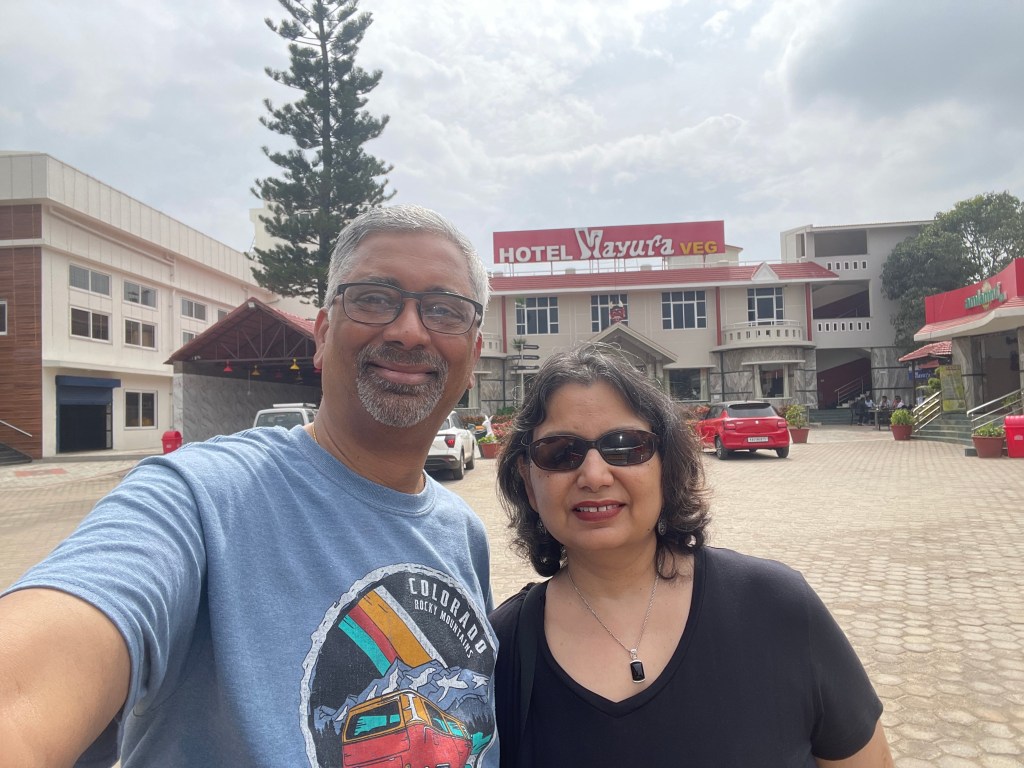
After an amazing breakfast of Khara Baath (it is kinda like Upma but it is not the same) and Masala Dosa at one of the famous “darshini” restaurants in Bangalore, we were on our way to Chickmagaluru. The drive on NICE was uneventful and after about an hour we were on NH 75. It was a very smooth ride on this four lane highway in our Toyota Innova Crysta. We had an experienced driver (Sivappa) who knew the the area well and had done the trek to Chickmagaluru many times. Sivappa made the fist pit stop at Hotel Mayura in Mandya (they had excellent rest area facilities). After a quick pit stop here, we were back on the road.
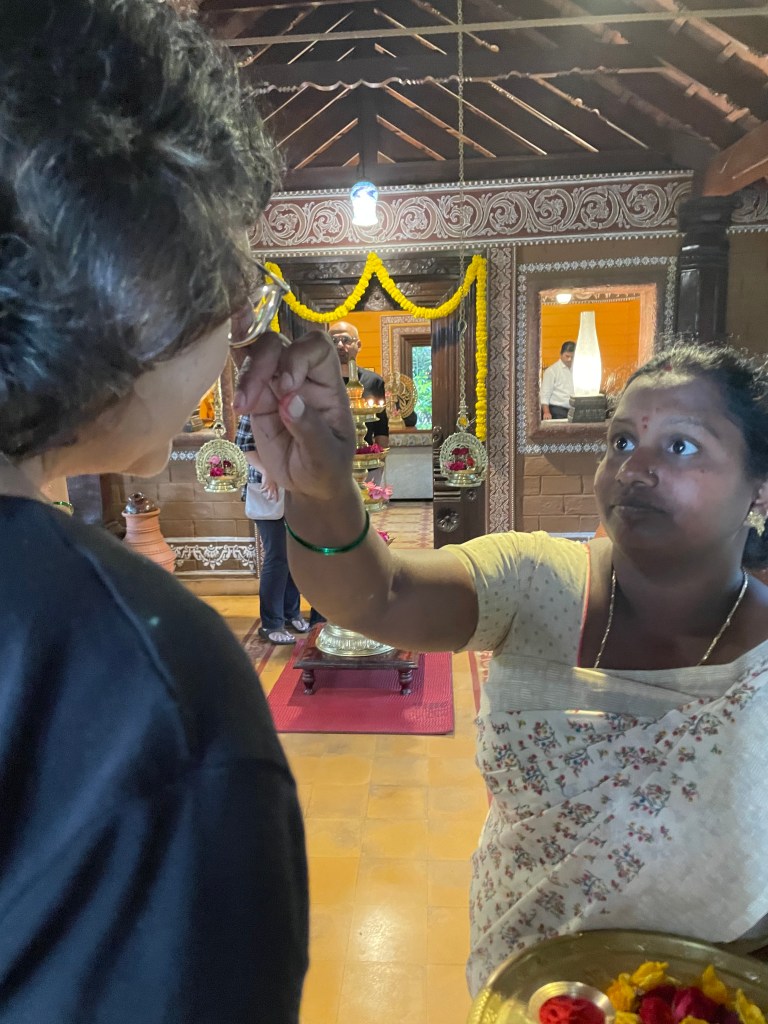
Our next stop was in the city of Hassan. I had many memories of visiting Hassan during the 90s when I was working in Bangalore. Sivappa took us to the Hoysala Village Resort, a beautiful enclave with a restaurant and several cottages for a stay as well. We were greeted with a traditional welcome and treated to sumptuous meal. We had several traditional Malnad dishes such as Akki Roti, Neer Dosa and Ragi Manni… more on Malnad cuisine later in this blog.
After an amazing lunch, we were back on the road to Chickamagaluru. We arrived at the Taj resort around 4 pm. We were greeted with a welcome drink… no surprise it was a coffee drink … coffee spritzer as we completed our check in formalities. Chai / filter kappi and pakoras followed…
We settled into our rooms, relaxed, showered and explored the resort. Excellent massage facilities, a game room, live entertainment all available at the resort. Booked our massage for the next day… a traditional Kerala oil massage. After an early dinner, we crashed for the night. We had a busy day planned for Day 2.
Day 2 started early with an amazing breakfast and endless cups of filter kappi. After breakfast we got back in the car with Sivappa at the wheel heading to Belur to see the historic temple there followed by the temple at Halebedu.
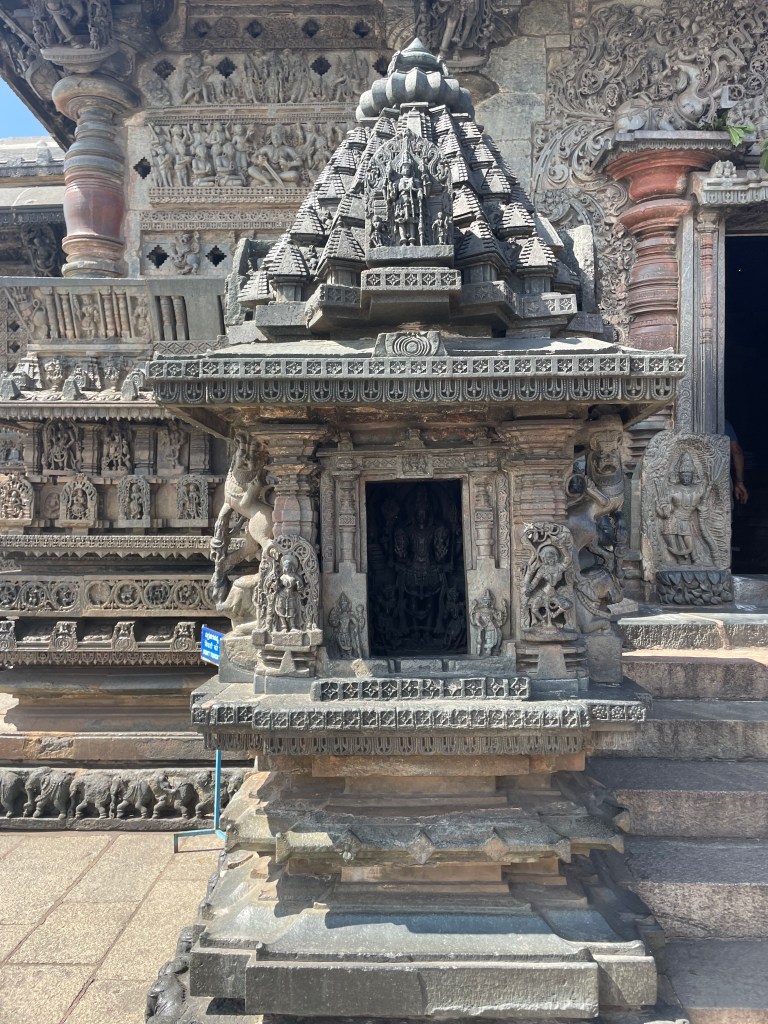
The twin cities of Belur and Halebidu are around 17 km apart and were home to the Hoysala dynasty for three centuries. Belur was the early capital of the Hoysala Empire in the 11th-century, before they built Dorasamudra (modern Halebidu). The main Chennakeshava temple at Belur was completed and consecrated in 1117 CE, though the temple complex continued to expand for several years. According to inscriptions discovered here, it was called Velur or Velapuri during the Hoysala era. It was built by the Hoysala ruler, Vishnuvardhana, under the guidance of the Hoysala architects.
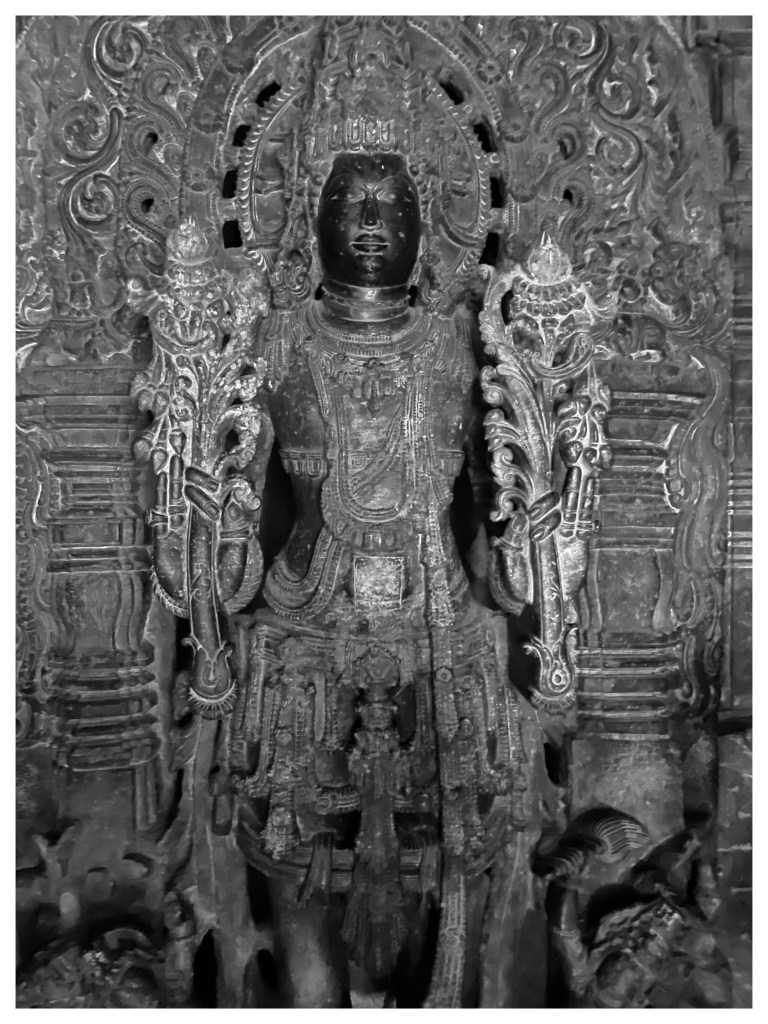
After a short 15-20 ride min ride, we reached the beautiful quaint little town of Belur set on the river banks of Yagachi. This was the capital of the Hoysala dynasty between the 11th and 13th centuries. We navigated our way through the crowded streets Belur to the temple complex. The temples of Belur are all situated inside a single complex enclosed by high walls making it a single stop for exploring the site in its entirety. Most of all the main sanctum and the magnificent shrine of Chenna Keshava Temple is dedicated to Lord Vijayanarayan, one of the twenty four incarnations of Vishnu.
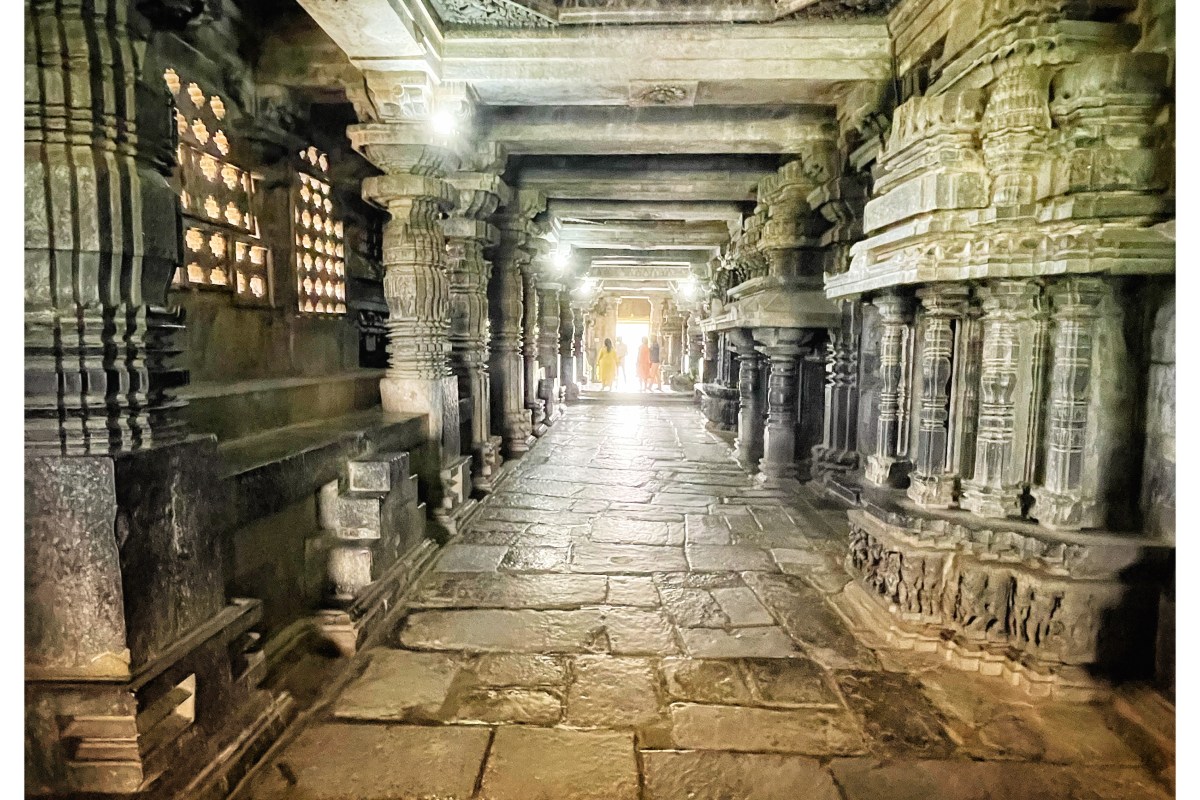
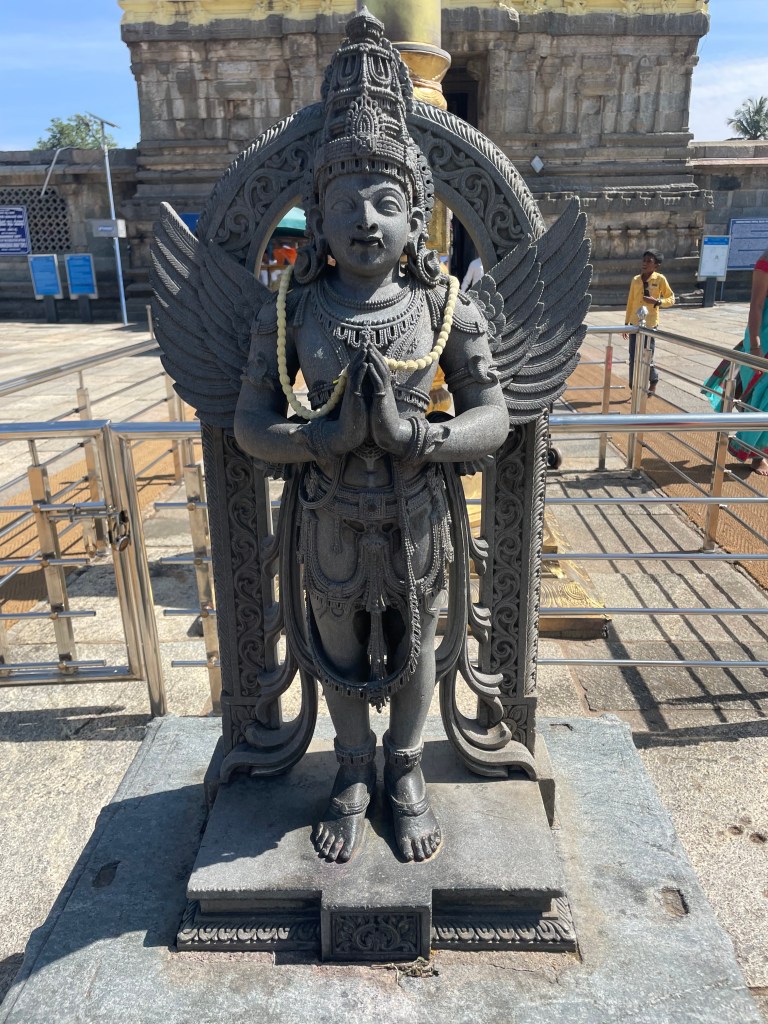
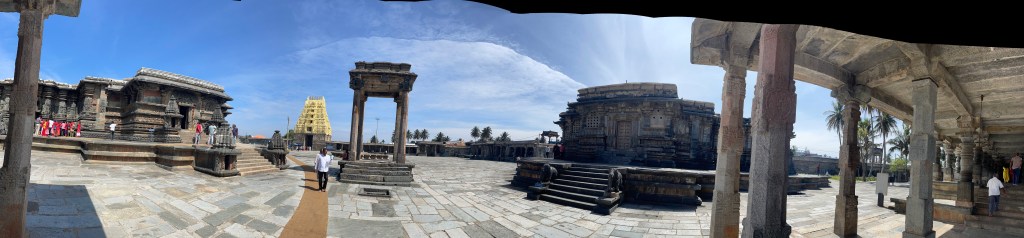
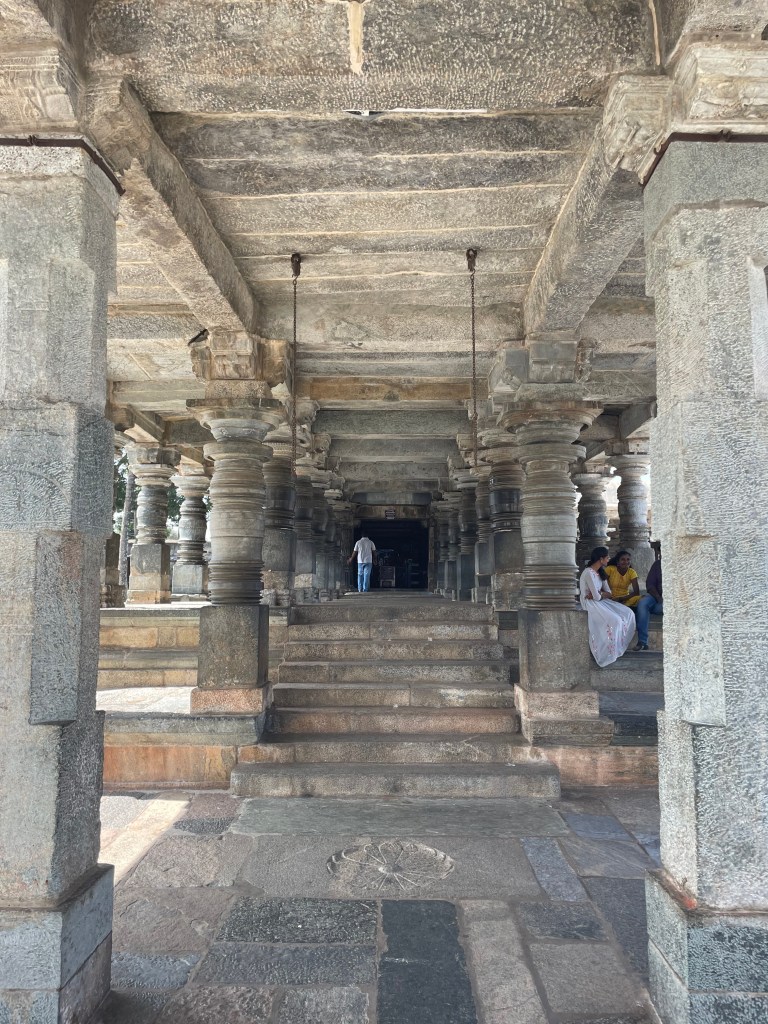
We walked in through the gopuram, a large ornate entrance, into the vast temple complex. As we entered, we saw the main temple sitting in the centre, on the right of the temple is the Kappe Channigraya temple and a smaller temple dedicated to a Lakshmi reincarnation, the goddess Sowmyanayaki, sits slightly behind the two. On the left of the Chennakeshava temple, is the Ranganayaki temple. We decided to hire a professional guide to take us through the temple. Our guide highlighted several details and nuances about the temple, the architecture, history and many more intricate details. He told us that Chenna Keshava Temple is the only functional Hoysala temple, and as of this day Pujas are performed both in the morning and evening. I will try to share a few details here, but it is impossible to capture it all in this blog.
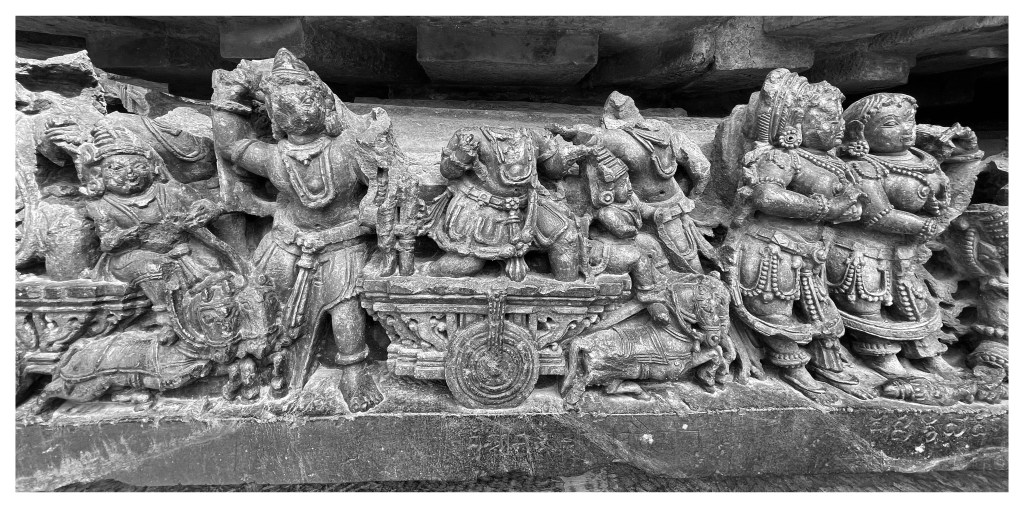
The main gopuramMadanikaThe frieze
“Sala” was the founder of the Hoysala dynasty in 950 CE. Legend has it at an early age he single-handedly fought and killed a rampaging tiger to protect his guru. The name Hoysala derives from “Hoy” which literally means to “Strike” and “Sala” the founder. the royal emblem of the dynasty reflects this brave act.
Kappe (Frog) Chennigaraya Temple, is a small shrine resembling the main temple lies directly to the South of the main sanctum. There’s an interesting legend to the Kappe temple.
The temple’s construction commemorated the victory of Hoysalas over the Cholas in the great battle of Talakkad.
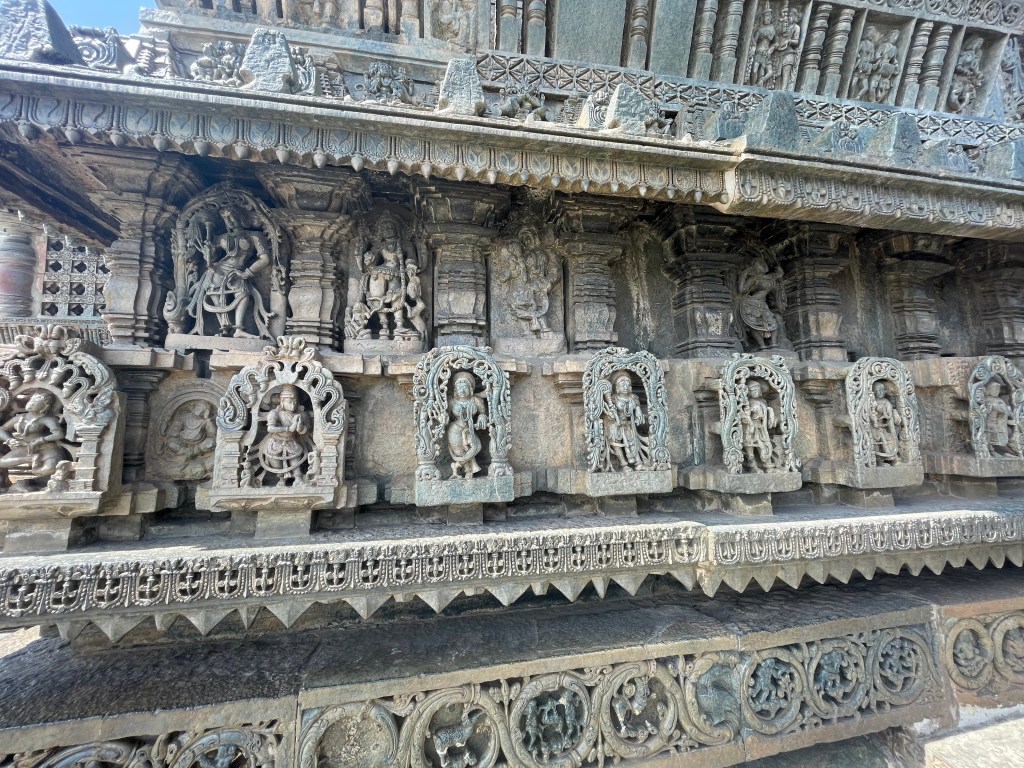
The lowest friezes of the main temple features 650 carved caparisoned elephants in various moods, some charging, some playful and some just peacefully standing.
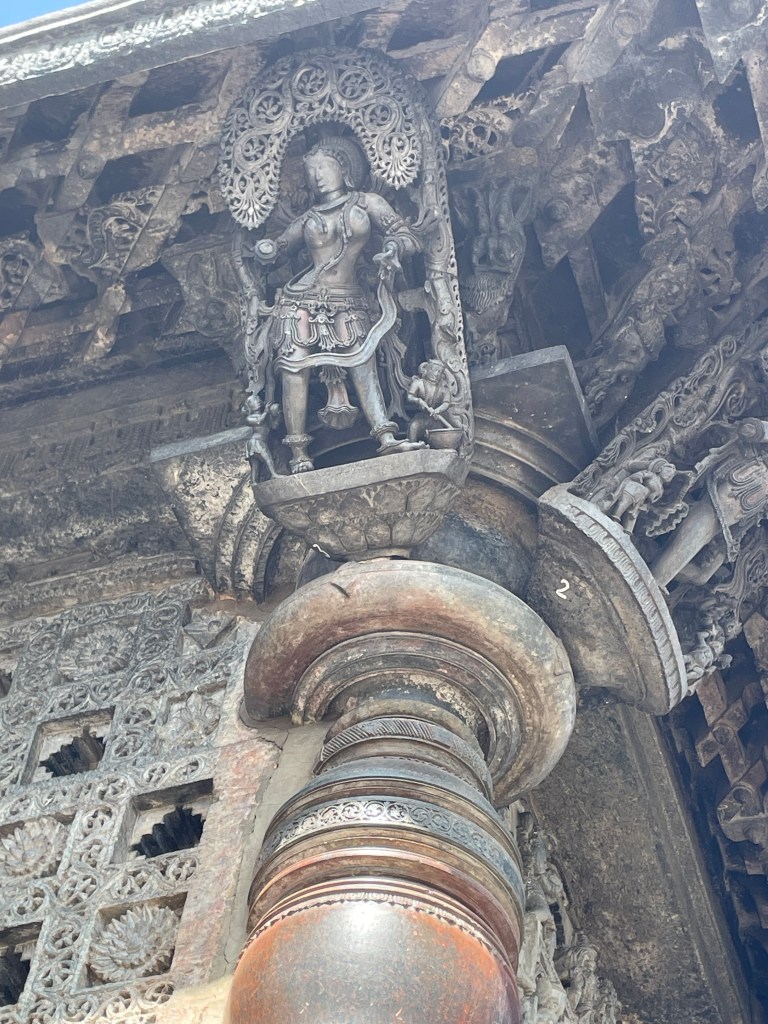
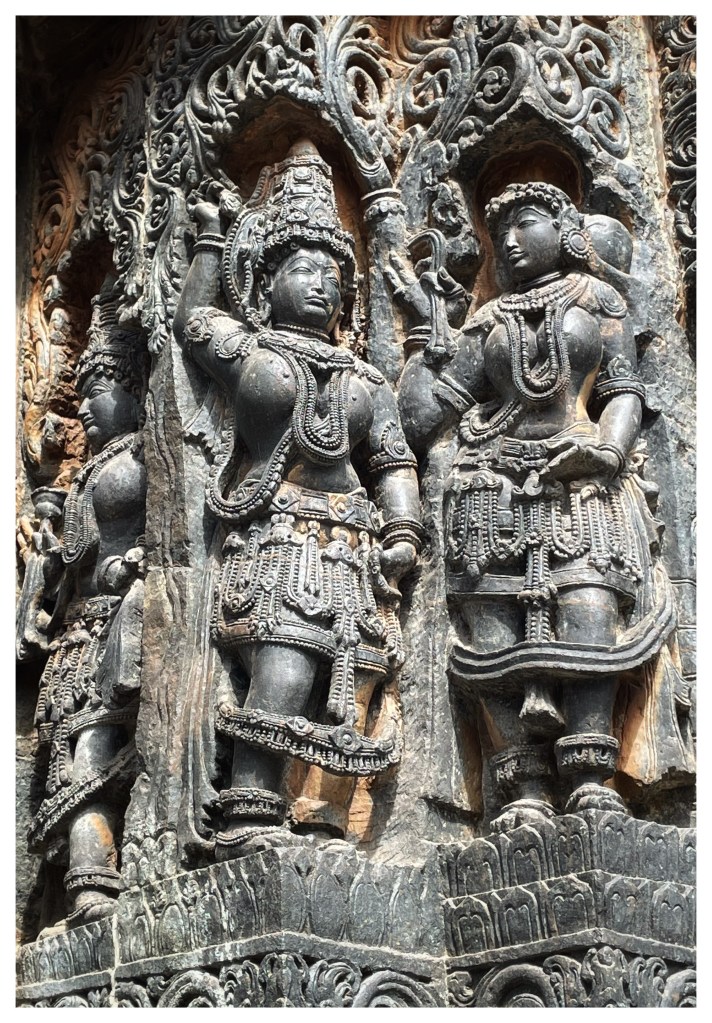
There are 38 beautifully carved freestanding bracket figures accenting the upper walls and the overhanging eaves around the outside of the temple and pillared hall. Voluptuous beauties known as Madanikas adorn these brackets in various dancing and ritual postures.( I have a picture of one of these Madanikas)
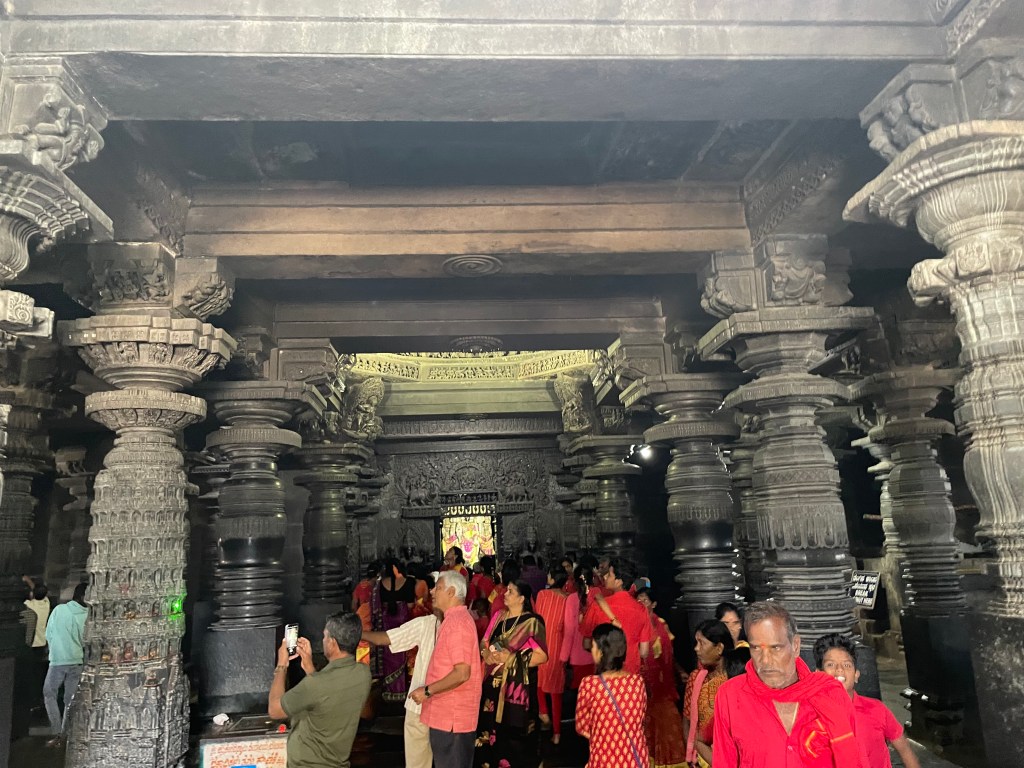
The pillars of the temple show some of the best details and finishing of sculpture and art work in the entire complex. The Narasimha pillar is one of the most popular of these temple pillars. There are a total of 48 pillars, all uniquely carved and decorated. The four central pillars were hand chiseled by artisans and feature madanikas or celestial damsels.
Panoramic view of the temple complexInside the temple
The temples at Belur are cut from chloritic schist – a soft stone (soap stone) allowing for intricately carved temple walls.This stone is extremely easy to chisel, but attains iron-like firmness when exposed to the elements. Additionally to maintain the shine of the temple the stone is treated with a chemical wash and then wax polished once every ten years.
After about two hours exploring the temple complex and taking in the beauty, the splendor and the magnificence of it all, we left for Halebidu.
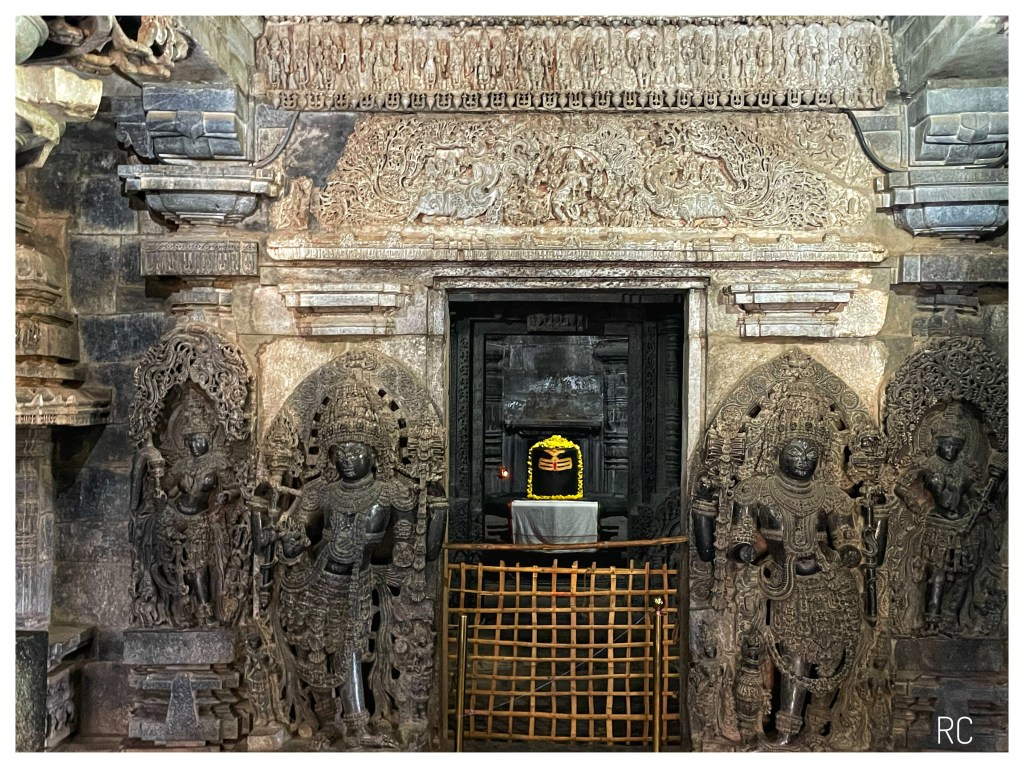
Halebidu is about 20-25 min drive from Belur. We drove through a lush and still countryside and navigated narrow streets to arrive at the temple complex. Dedicated to Lord Shiva the 12th-century Hoysaleswara temple is also referred simply as the Halebidu temple. The unique temple complex built with soapstone has four porches for entry. We entered from one of these entrances and again hired a guide to help us navigate the temple complex and learn about the history, architecture and intricate details of the various sculptures.
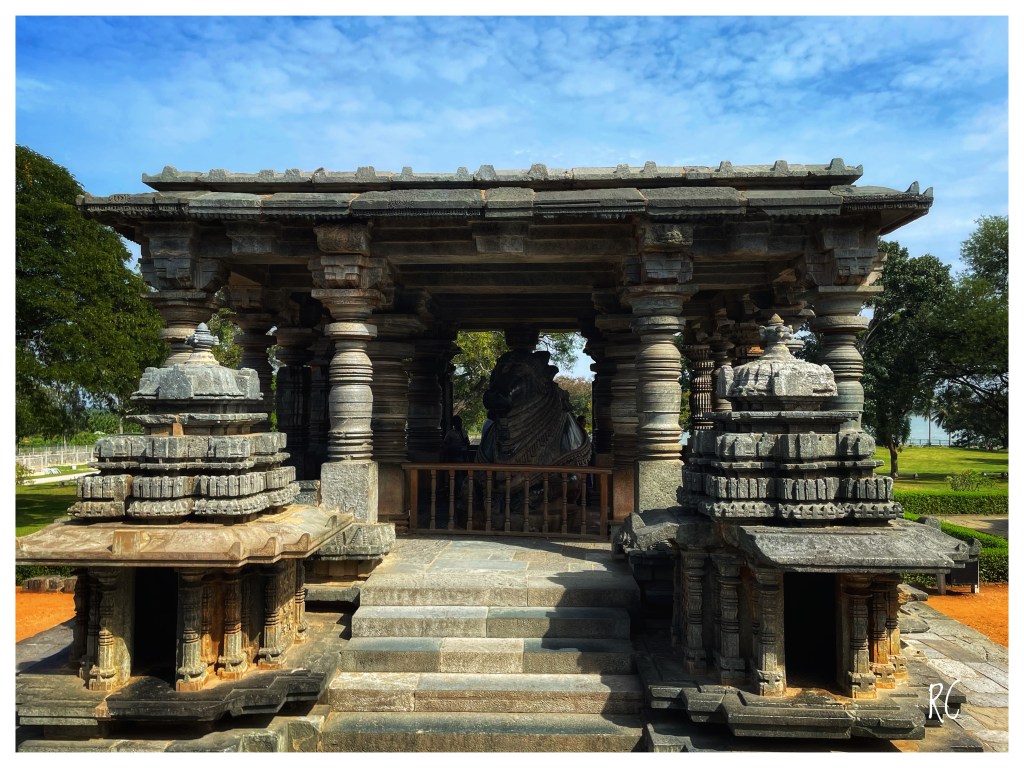
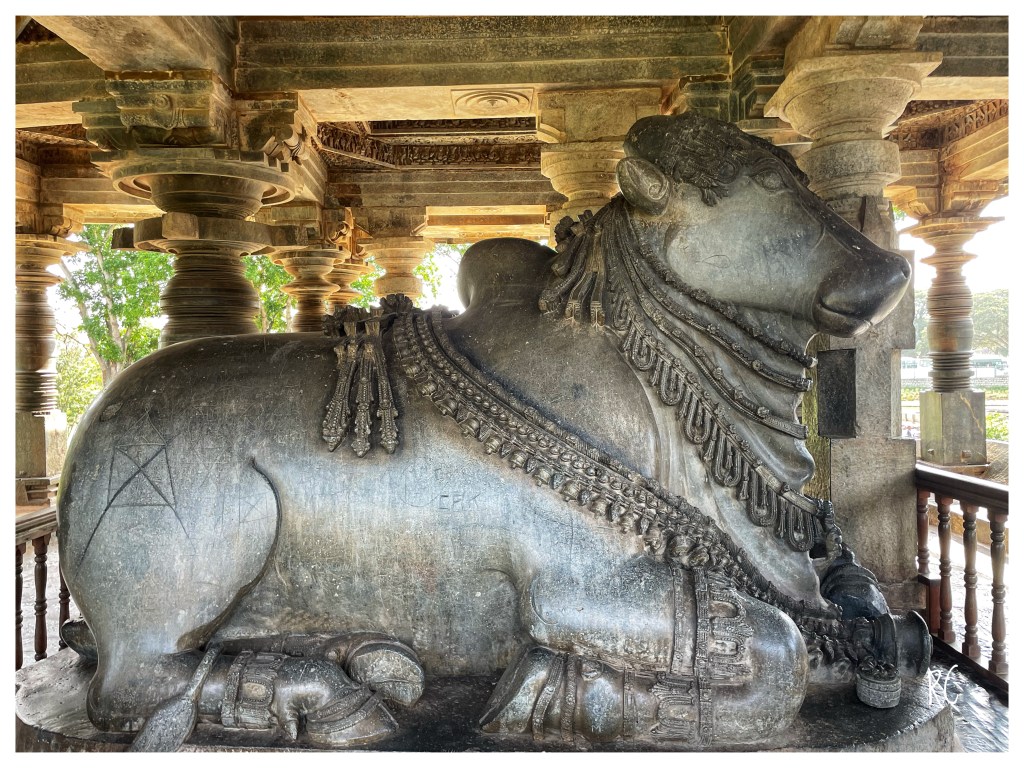
The temple resembles the Chenna Keshava temple at Belur, except for the more profusely carved, exquisite figures adorning the shrine. This temple exemplifies sculptural extravaganza. There are two very large Nandis (Nandi is a bull and the vehicle of Lord Shiva) – our guide told us that these were the 6th and 7th largest in the country. The horizontal and vertical friezes create a marvelous interplay of light and shadow. There are sculptured friezes that run along the lower portion of the temple walls which feature elephants , lions, charging horsemen, scenes from the epics Ramayana and Mahabharata as well. There were some mythical beasts and some erotic sculptures as well.
Nandi at Halebidu
After spending a couple of hours here at Halebidu, we were ready to leave, feeling overwhelmed with the experience of seeing these two magnificent temples (and we were dizzy all the fine details and stats shared by our two very learned guides). Our driver Sivappa had suggested that we also visit another lesser known temple at Belavadi. This Belavadi temple completes the trifecta, we were told. We decided to go along with Sivappa’s recommendation.
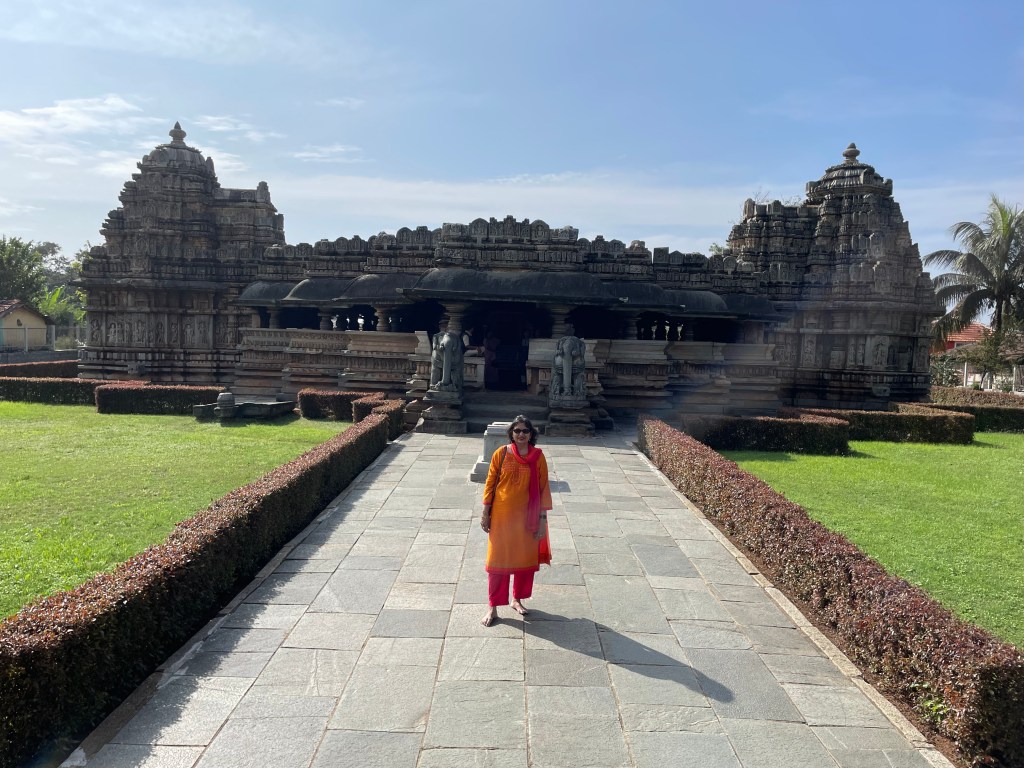
The Veeranarayana Temple at Belavdi is known as the triple Hindu temple. The temple has three separate square sanctums connected through an unusually large square ranga-mandapa. The main shrine is dedicated to Viranarayana (Vishnu). The other two shrines are dedicated to Gopala, and Yoga-Narasimha. The temple was deserted, we were the only visitors here. The security guard doubled up as a guide and explained some of the details of this temple. We spent 15-20 min at this temple and were ready to head back to the hotel
Sivappa brought us back to the hotel right on time for the pakodas and you guessed it.. more filter kappi (yes, there was chai too). We had booked appointments for Kerala massage at the hotel. The Kizli (pronounced killi) oil massage was amazing and like all massages put me to sleep. I needed 3-4 showers to shake off the oil from the massage.
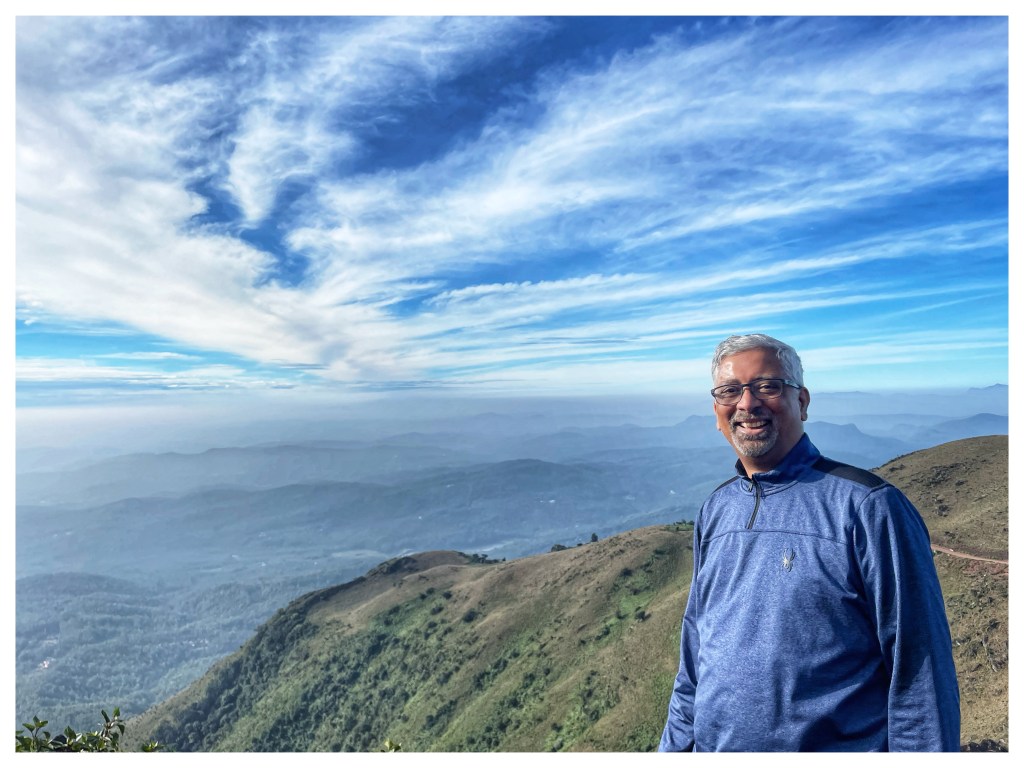
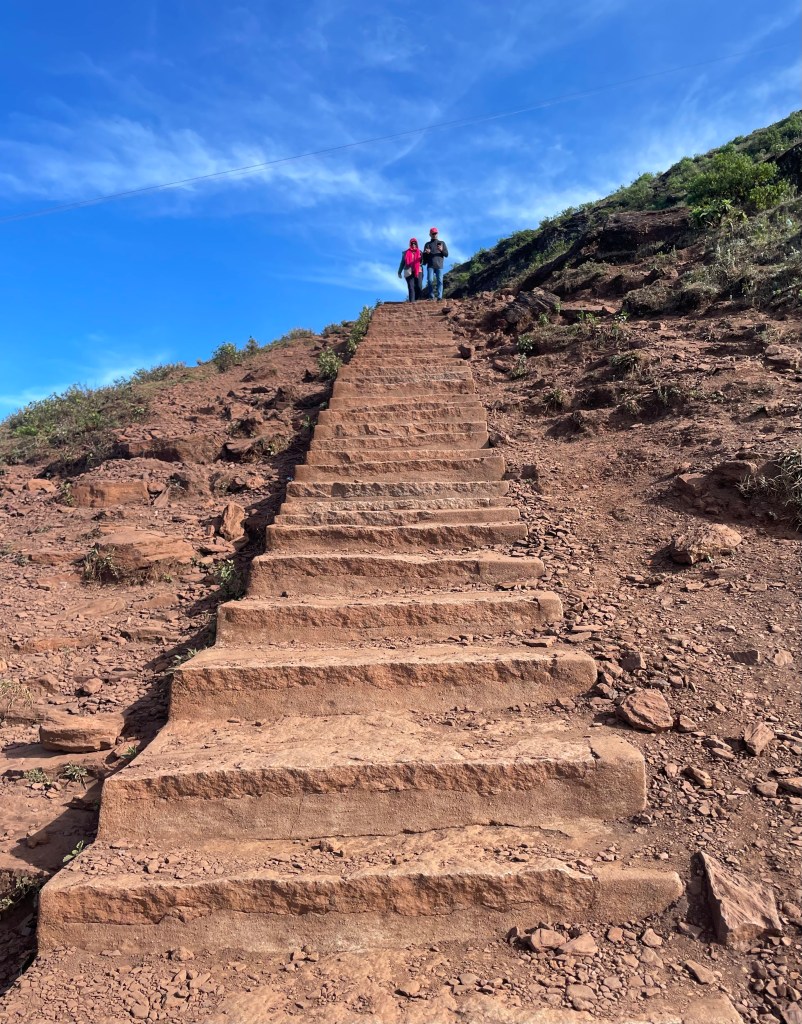
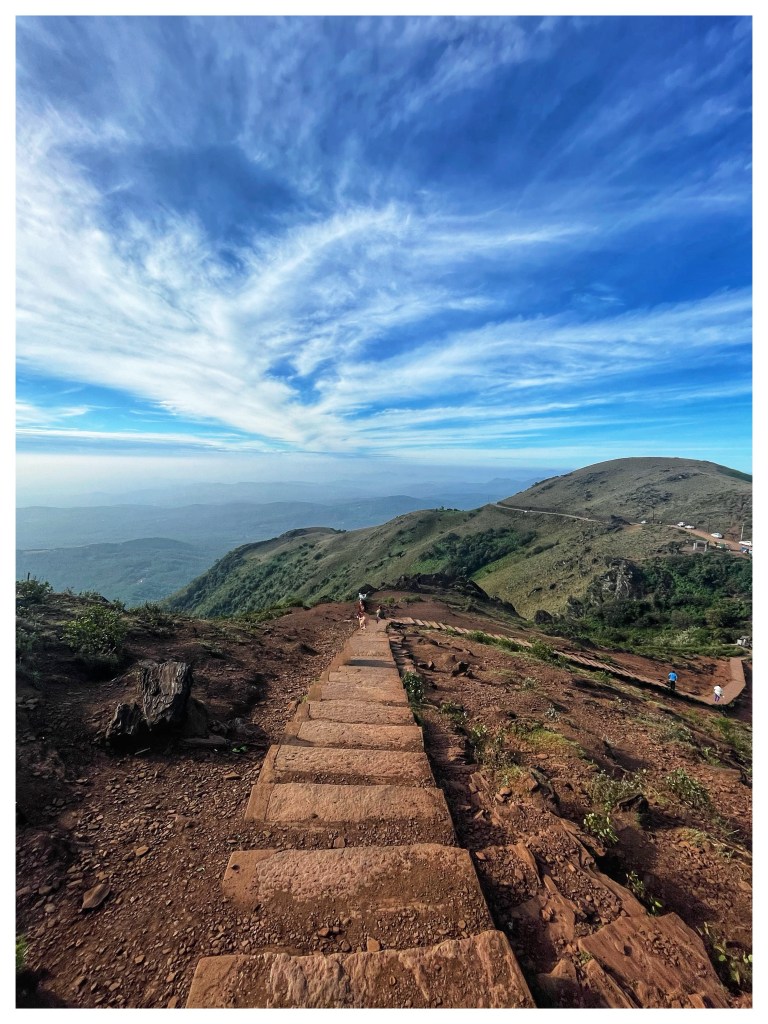
Day 3 was going to be more outdoor experiences. We decided we get an early start and headed to Mullayangiri, the tallest peak in Karnataka (6300 feet). Mullayangiri is located in the Chandra Drone Hill ranges part of the western ghat near Chickamagaluru. The peak gets its name from a small temple at the summit, which is dedicated to a sage “Mulappa swamy” who is believed to have meditated at the caves only a couple of feet below the summit. The drive up to Mullayangiri was very scenic, a winding narrow road that took us the top (actually to the parking lot at the top). There are 464 “ steps” that take you to the top of the peak. Then there are another 10 steps that take you up to the temple. The views from the top and along way up are breathtaking. It was as expected much cooler at the higher altitude, and extremely windy. There is not much to do at the top other take in the views and experience that the “top of the world” moment. We had a cutting chai in the parking lot before heading back to the hotel.
“Top of the world” momentCutting Chai after the trek
The rest of the day was spent visiting a few of the natural lakes in the area. One of the lakes was very close to Bhadra Natural Game Sanctuary. We also we went to MG Road (yes, Chickamagalur also has one) to some shopping for coffee and spices.
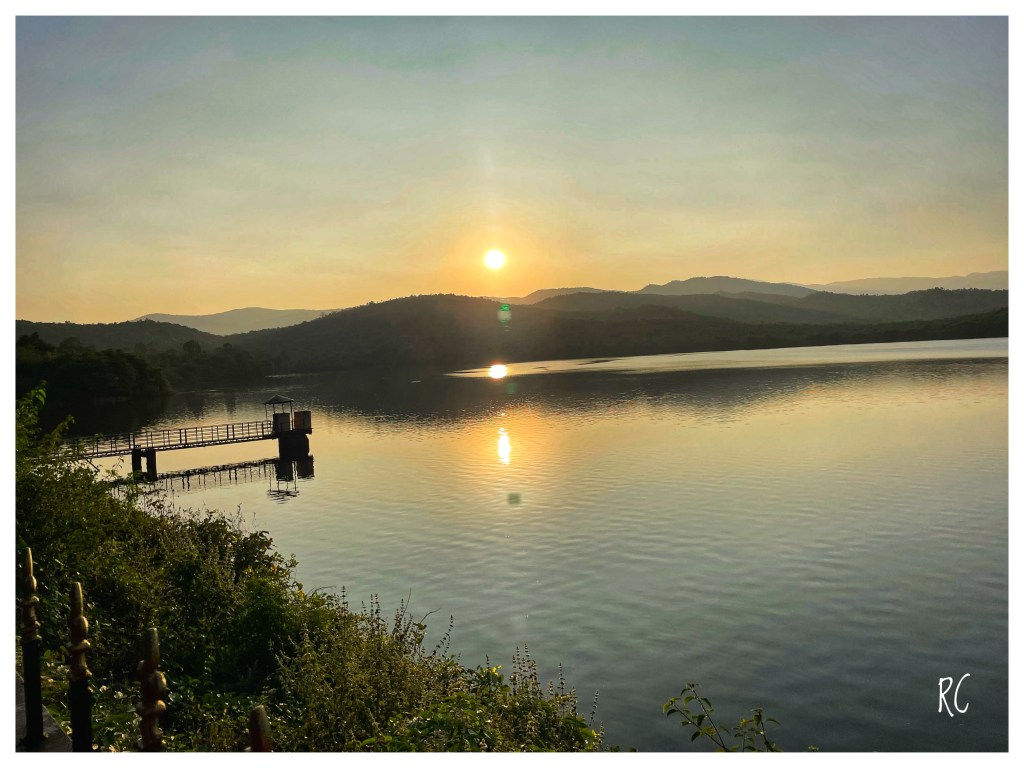
Sunset at Hirekolale Lake
Day 4 was our final day in Chickamagalur. The final item in our agenda was a visit to a coffee plantation. Karnataka is the leader and produces more than 70% of the total coffee produced in India. Coorg and Chickamagalur have the largest number of plantations in the region. Rich soil and favorable weather in the area make it the best place to cultivate coffee beans. Coffee from this region is famous for its distinctive flavor and scent.
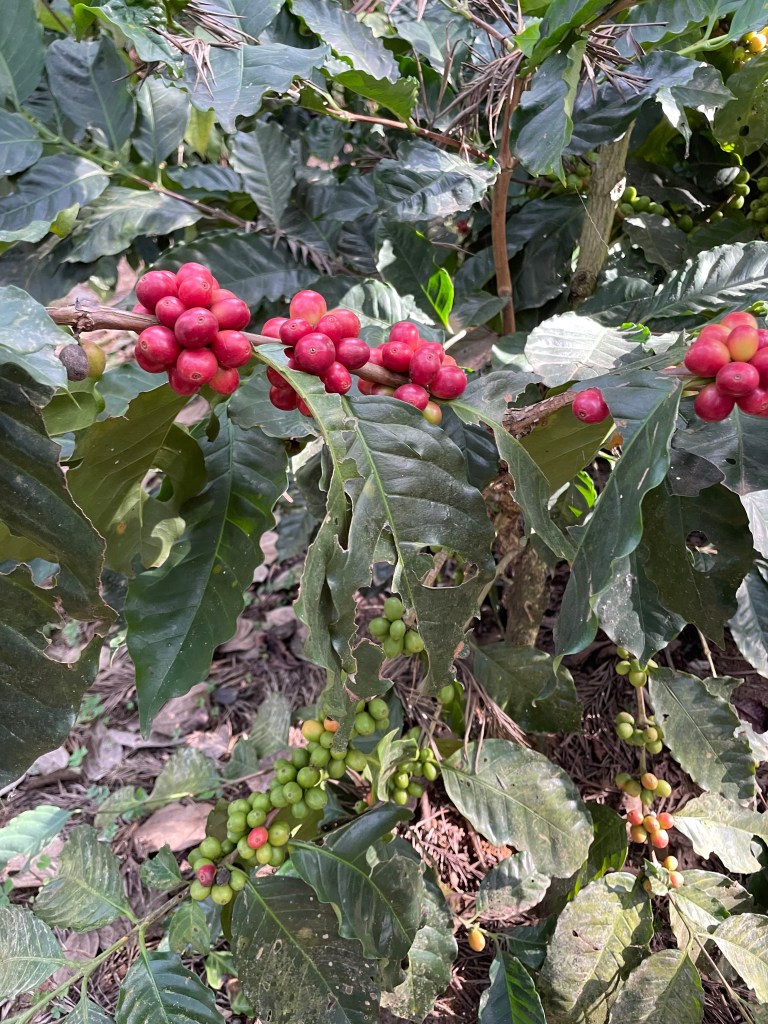
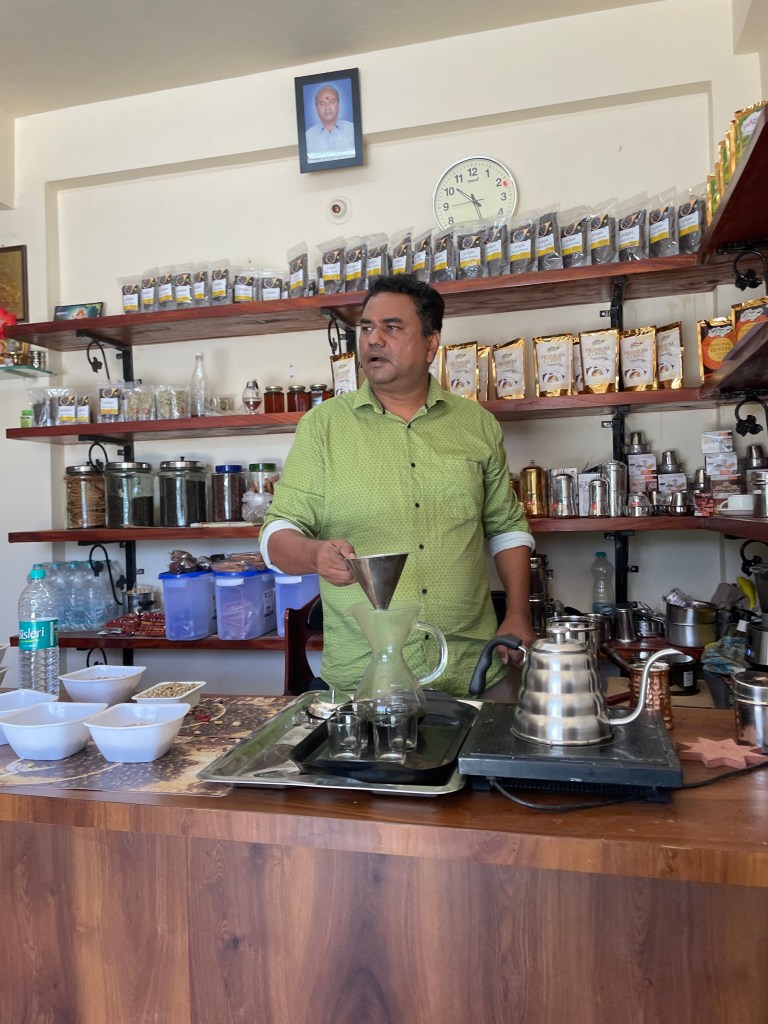
Coffee BeansPrasad in his Coffe “lab”
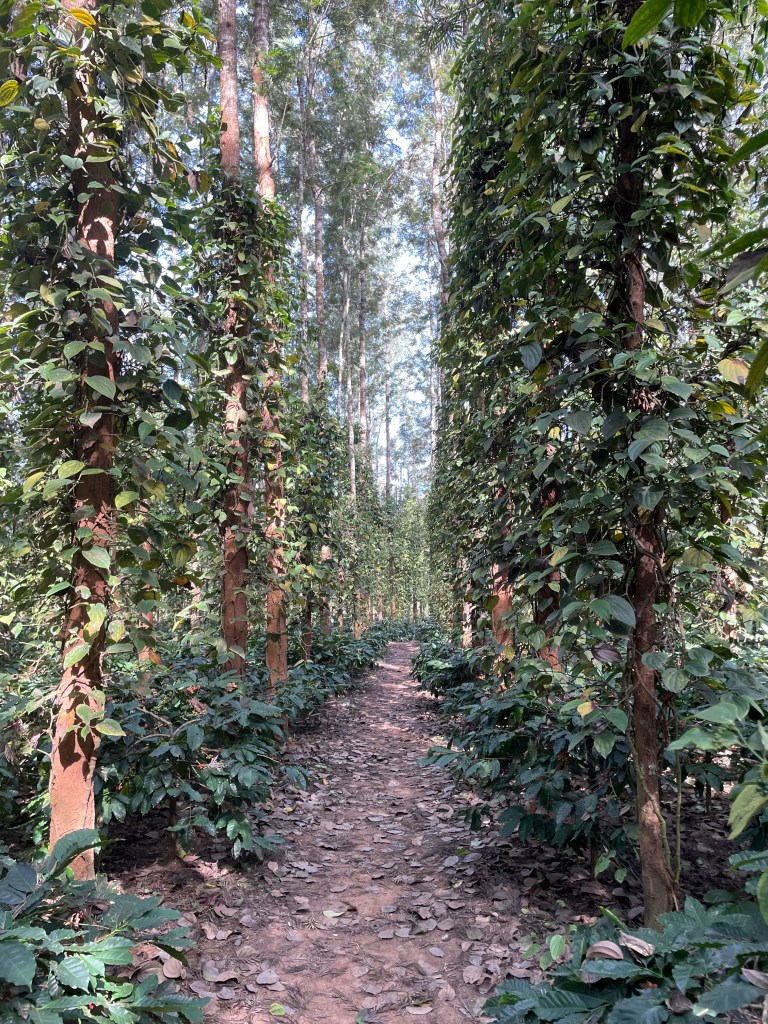
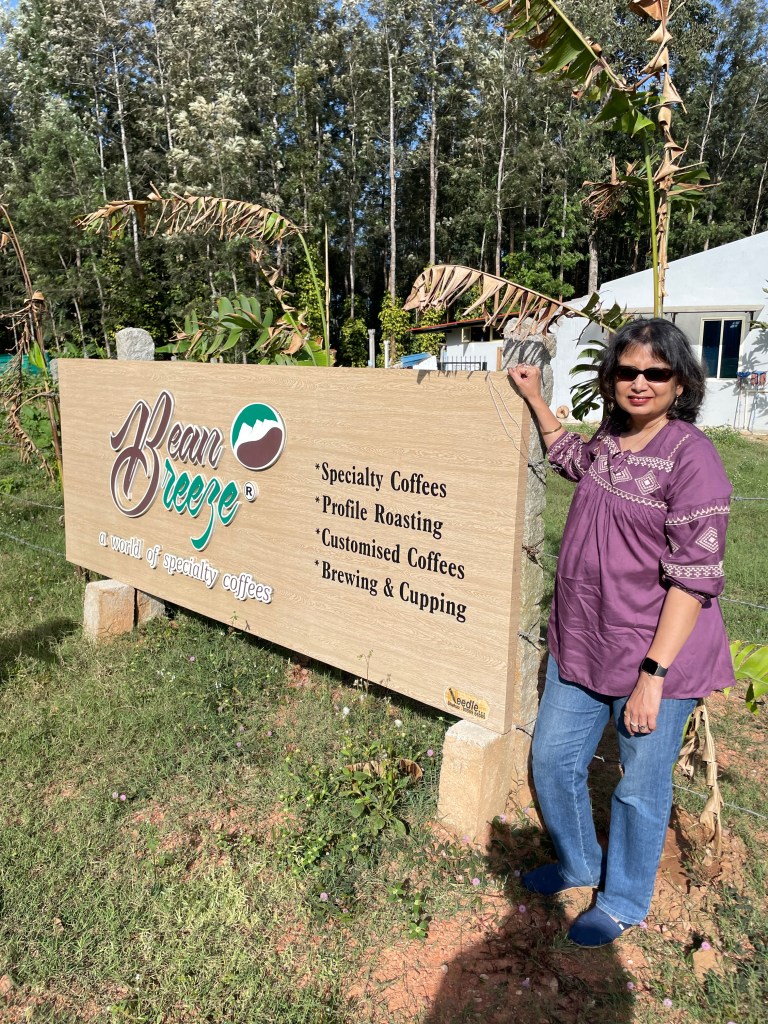
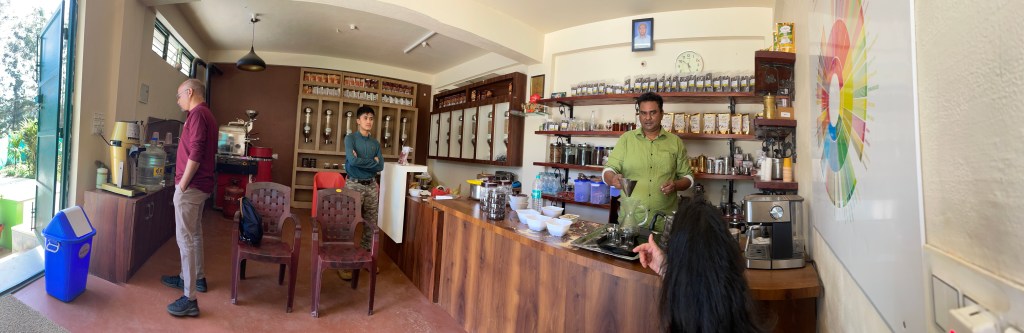
We arranged a “bean to mug” experience through the hotel’s concierge service. It was short drive to the plantation. We were greeted by Prasad, the owner of the Bean Breeze plantation. Prasad focuses on speciality coffee and his enthusiasm for coffee is infectious. His explanation of the history of coffee, and the process of growing and making coffee was interesting and informative. Prasad walked us through his plantation as he was explaining the origins of coffee and talking about the varieties of coffee grown in the region. He brought us back to his coffee “lab” and offered samples of coffee that he made for us. Here are a few nuggets of information that we picked up from our interactions with Prasad;
The origins of Chikmagalur’s coffee can be traced to a Sufi saint named Baba Budan, who brought seven coffee beans from Yemen and planted them on the region’s hills in the 17th century.
Robusta and Arabica are two varieties of coffee in the region – (99% of the world coffee is Arabica or Robusta). While Robusta beans are renowned for their robust flavor and high caffeine concentration, Arabica beans are noted for their rich aroma and moderate flavor.
The flavor of the coffee is improved by hand-picking and sun-drying the beans.
Coffee is an annual crop – it takes about 9-10 months from flowers to fruit. Harvest is usually in Nov/Dec. They have 2-3 rounds of harvesting.. The average age of the plants is 15-20 years.
We enjoyed the “bean to mug” experience. We bought some coffee beans and spices at the plantation before we left. ( I found out later that this tour is available on Trip Advisor and is very highly rated).
I cannot end this blog without writing about the Malnad cuisine and the various treats that we enjoyed on his road trip. The Malnad region refers to parts of Karnataka near Mangalore and Tamil Nadu. The cuisine is well known for its distinct flavors and features locally grown herbs and spices. Many of the dishes are made with rice, lentils, jaggery and coconut milk. There are many dishes that we tasted during our stay in the region… here are a few;
Akki Roti – It is a thin crispy rice flatbread made from a mixture of rice flour. It is usually served with a generous dollop of ghee and some chutney. Can be eaten with vegetables or daals
Neer dosa – It is a variation of the traditional dosa, except that the batter is not fermented. It is usually had with a spicy gravy. We had with coconut coriander chutney
Holige Mane – these are flat dosas stuffed with a mix of jaggery and coconut. They are flavorful, sweet and a must try delight. They are also known as Obbattu in Andhra and Puran Poli in Maharashtra.
Rage Manni – It is a soft steamed cake made of, no surprise, Ragi (a type of millet). It is soft, spongy and fluffy. It is served as breakfast dish and eaten with (you guessed right) ghee and chutney.
Malnad Curry – It is a traditional curry that showcases the region’s love for bold spices (pepper, cloves, cinnamon, etc), herbs and other local ingredients. It can be had as vegetable curry or with meat. The other spices included are cumin, ginger, coriander and yes, coconut and jaggery. We ate this with regular wheat roti (phulkas)and akki roti.
Ragi ManniNeer Dosa
I am sure there are many other delights in the region which we did not get a chance to taste. We will be back in the region soon and will enjoy them next time.
The Taj Resort
We had an amazing time on this road trip. Everything was just perfect. Our driver Sivappa (not his real name) was excellent, the resort was terrific (hospitality of the Taj is unparalleled), the temples were magnificent, the splendor of nature was incredible and the food was a delight. Many many thanks to our friends who organized this road trip and gave us amazing company.
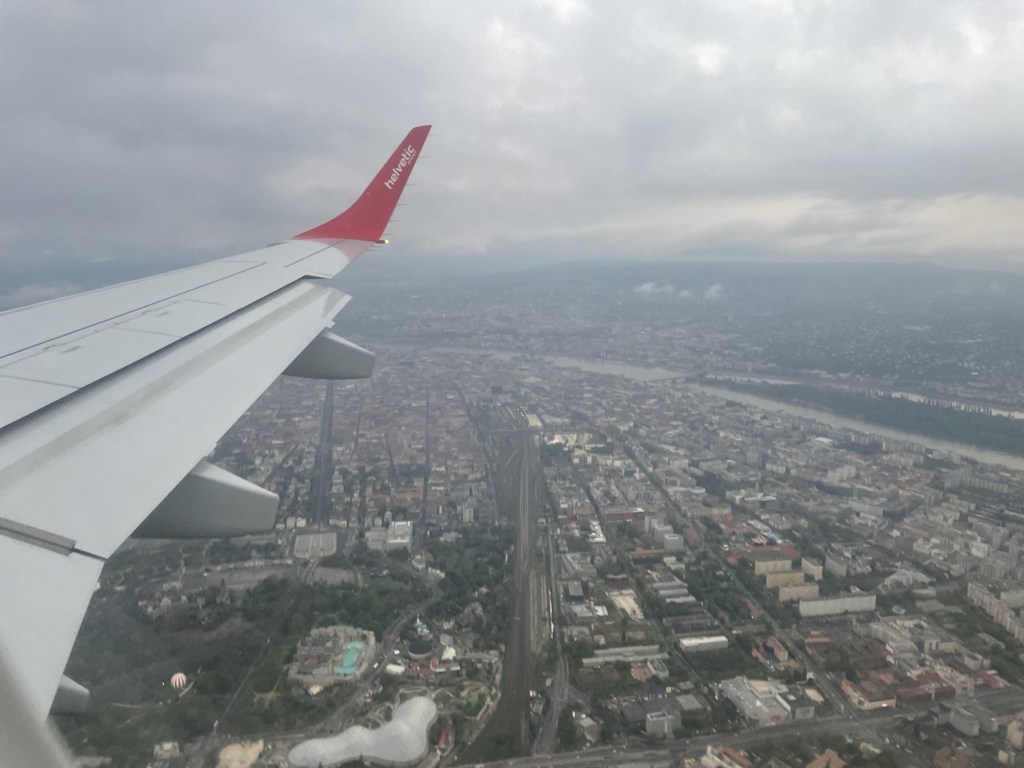
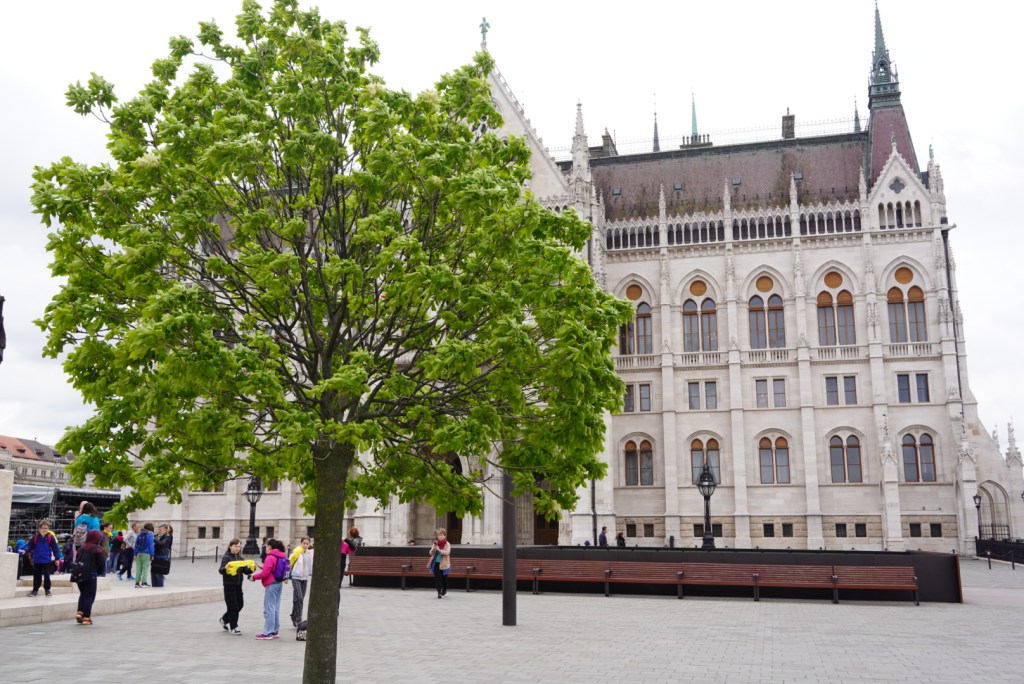
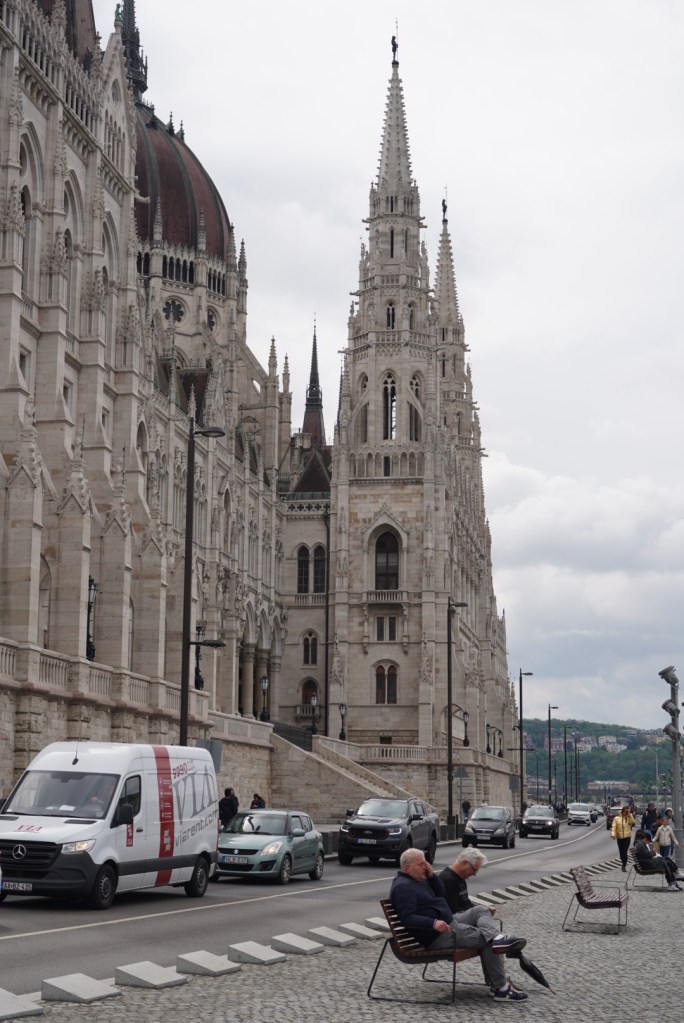
We came to Budapest on a short holiday…. many asked us, “why Budapest ?” I’d say why not !! We never been to Eastern . Central Europe and wanted to check it out.. It was a fascinating experience, the history, sights, the people, food and so much more.. We arrived from Zurich at the Budapest international airport around 6 Pm. It was a small airport, actually very small for a capital city. We had a pre-arranged ride to take us to our AirBnb. Thanks to WhatsApp we were able to quickly find our ride and were our on our way. Language is a bit of an issue, but thanks to Google Translate, we were able to converse with the driver. Our Airbnb is in Pest very close to the Parliament building. We were literally 2 min away from the Danube River and so close to a lot of sights and activities on the Pest side.
Before we get into our Budapest story, let’s cover the history, the back story… it is quite fascinating.
The medieval Kingdom of Hungary was conquered by the Ottoman Turks in 1526 and was liberated by the Austrian Empire in 1699. At the end of WW I, Hungary lost more than 70% of its land under the Treaty of Trianon. It is said that many Hungarians still suffer from the “Trianon Syndrome”. There is a feeling that Hungary suffered more than its fair share (and more than Austria) at the end of WW II – more destruction, more losses. (we actually heard these sentiments while chatting with a cab driver)
During the World War II, Hungary fought on the side of Germany, tried to switch sides and fell under German military occupation in 1944. The Communist takeover happened in 1949 and remained such until 1989. After 1989, Hungary rebuilt its economy, adopted a capitalist system, rebuilt their banking / financial system, redeveloped their education system and built a strong economy. Hungary is part of the EU and has adopted the Euro, but seem to prefer their local currency Forint.
Fun / interesting facts about Hungary / Budapest
Hungary is a completely land locked country – surrounded by Austria, Slovakia, Romania, Croatia, Slovenia, Ukraine and Serbia
Hungary is known as the “Land of the Magyars”
Until the Communist takeover in 1948, Hungary had a functioning parliament with a multi-party system. (Soviet era ended in 1989)
Hungarians speak in Magyar, a language not related to any other European language.
Buda and Pest are twin cities on either side of the Danube river
No official religion in Hungary, Roman Catholic is dominant. During the communist era, it was officially an atheist state.
Urban Hungary is dominated by Budapest which is several times larger of any other major city.
Budapest is known as the Paris of the East or the Pearl of the Danube
Danube is the second longest river in Europe (after the Volga in Russia)
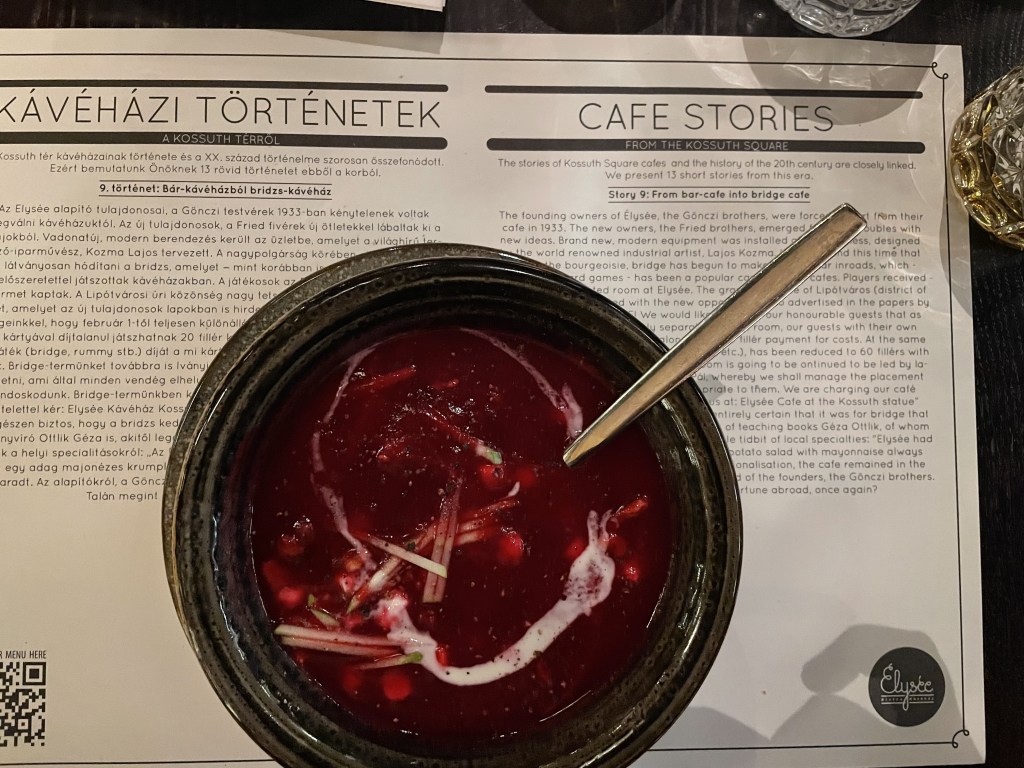
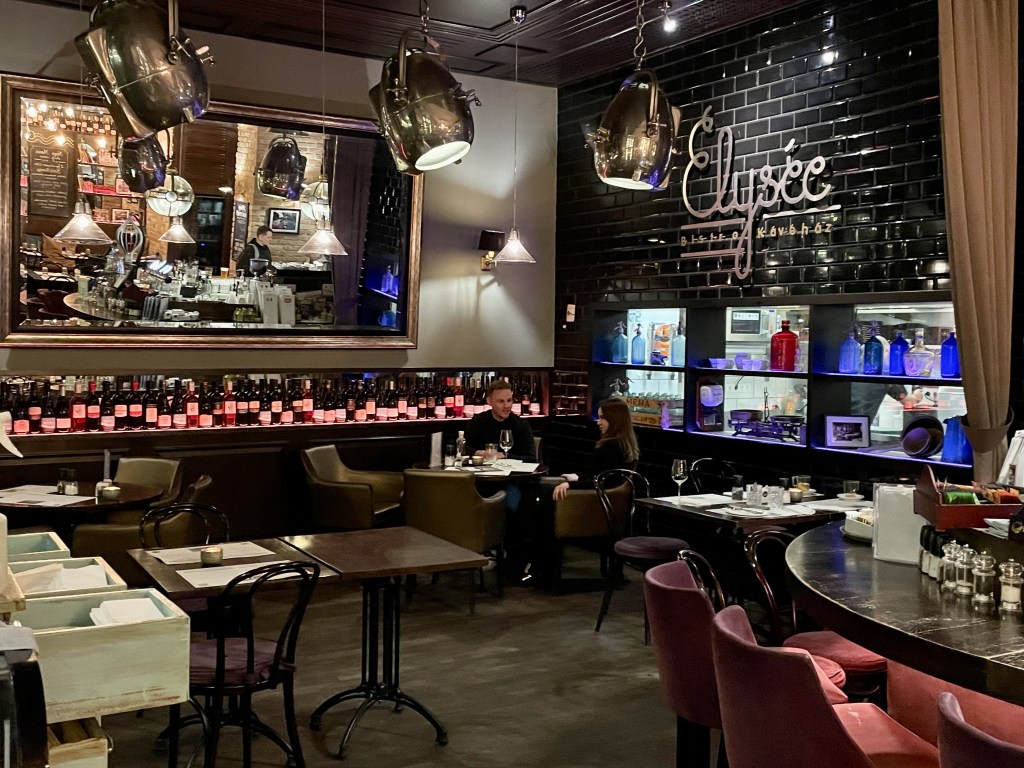
Back to our Budapest story… After checking into the AirBnB, we had dinner at the Elysee Cafe right next door. The Elysee Cafe has a bit of history…the restaurant in Kossuth Ter was started by 3 brothers who worked in various restaurants in London, Paris, and other European cities. They returned to Hungary after WW 1 and started Elysee in Oct 1931. The menu was quite an eclectic mix of traditional Hungarian dishes and the broader European flavors.
After a good night’s rest, I stepped out in the morning to local cafe to satisfy my morning caffeine craving, get my first cup of coffee or ‘Kave as Hungarians prefer to call it. I read that coffee is the national drink of Hungary… they drink a strong mocha, kind of an Italian espresso. I tried the presszo’kave, did not like it. Finally, I ordered an Americano (black coffee) actually a local version called Fekete. That woke me up. It is STRONG black coffee.
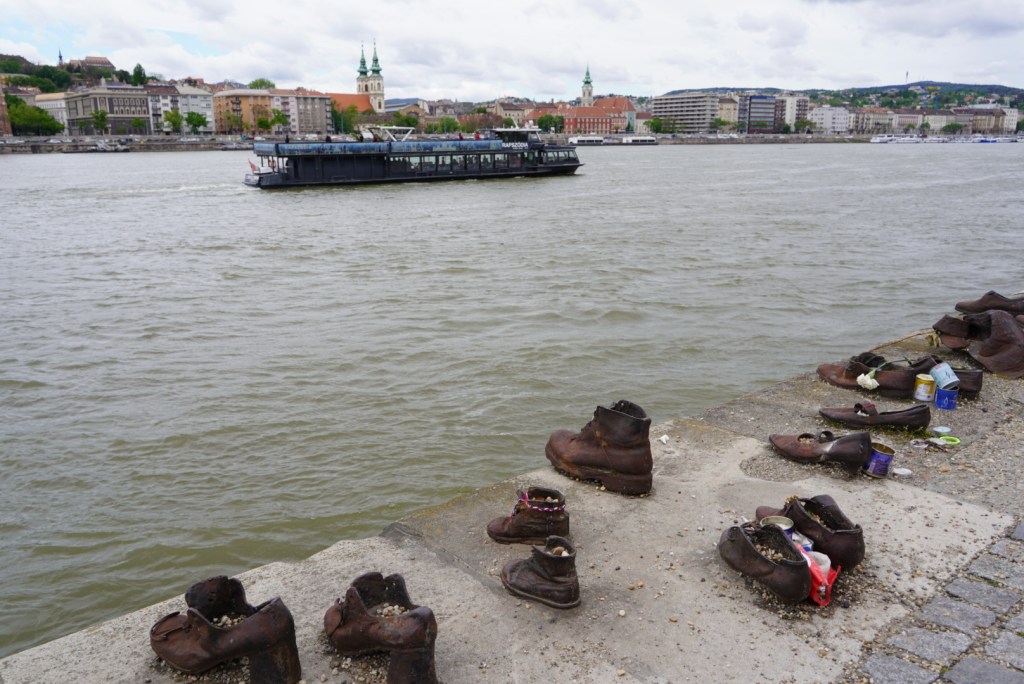
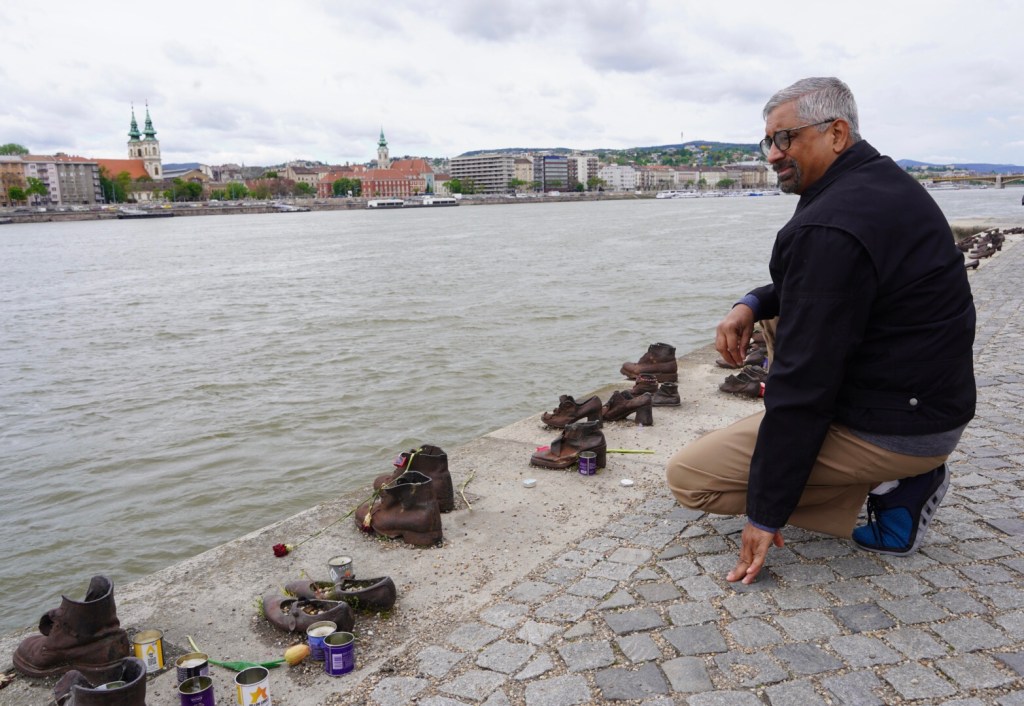
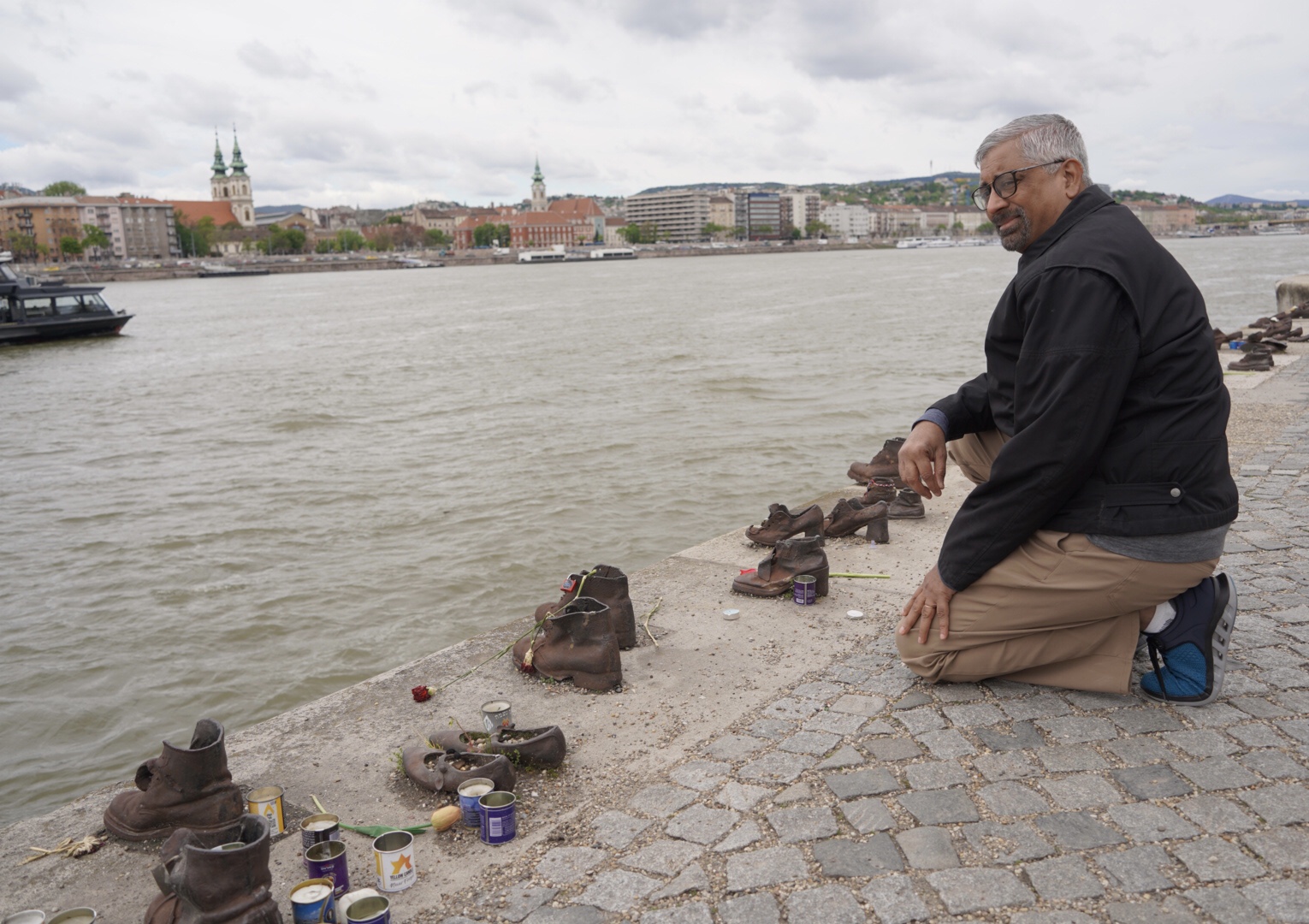
We started the day deciding to take a walk along the Danube. It was a chilly morning, in the low 50s (10deg C). We walked across the Parliament bldg and across the road reach the Danube. Despite the clouds and chill in the air, it was really pretty. We walked up to the Shoes on the Danube memorial. It was a very poignant to be there and experience the moment. There were 60 pairs of shoes pointing towards the river telling the story of several hundreds may be thousands of Jews who lost lives here, brutally killed by militiamen in 1944-55 during WW2. The Jews who were rounded up in the city were brought to the river, shot dead and their bodies thrown into the river. Often times, they were forced to take off their shoes, which were valuable commodities during that time.
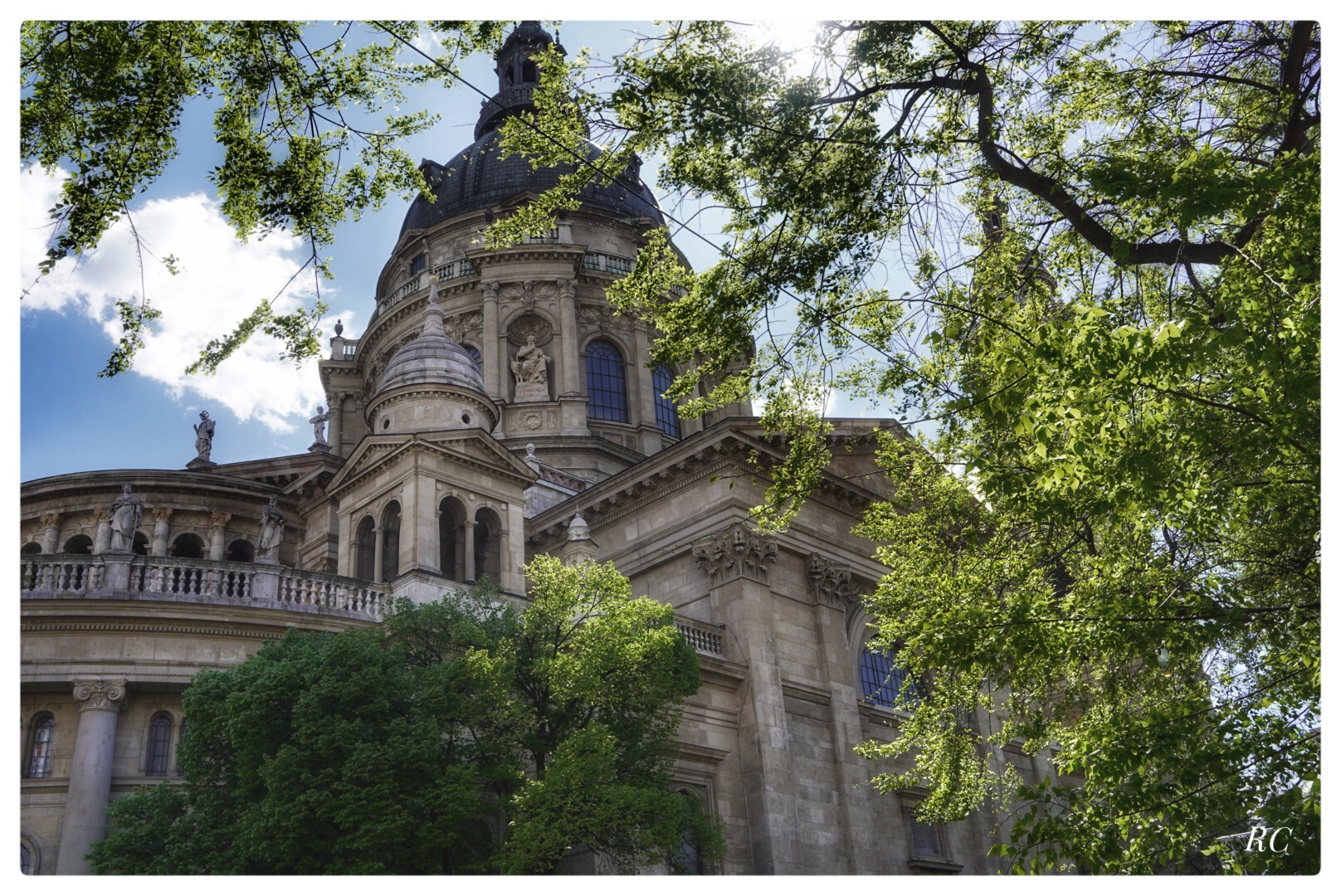
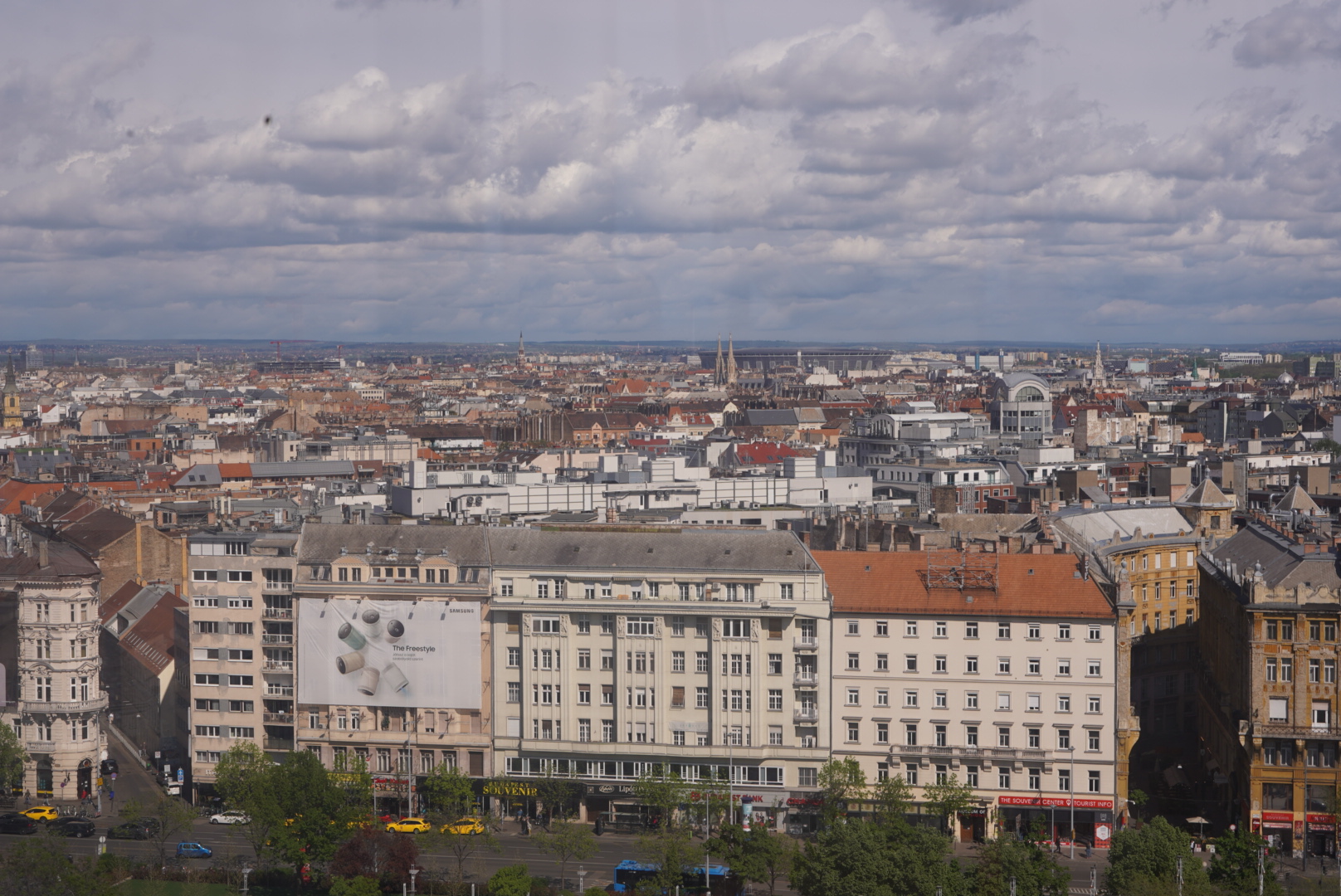
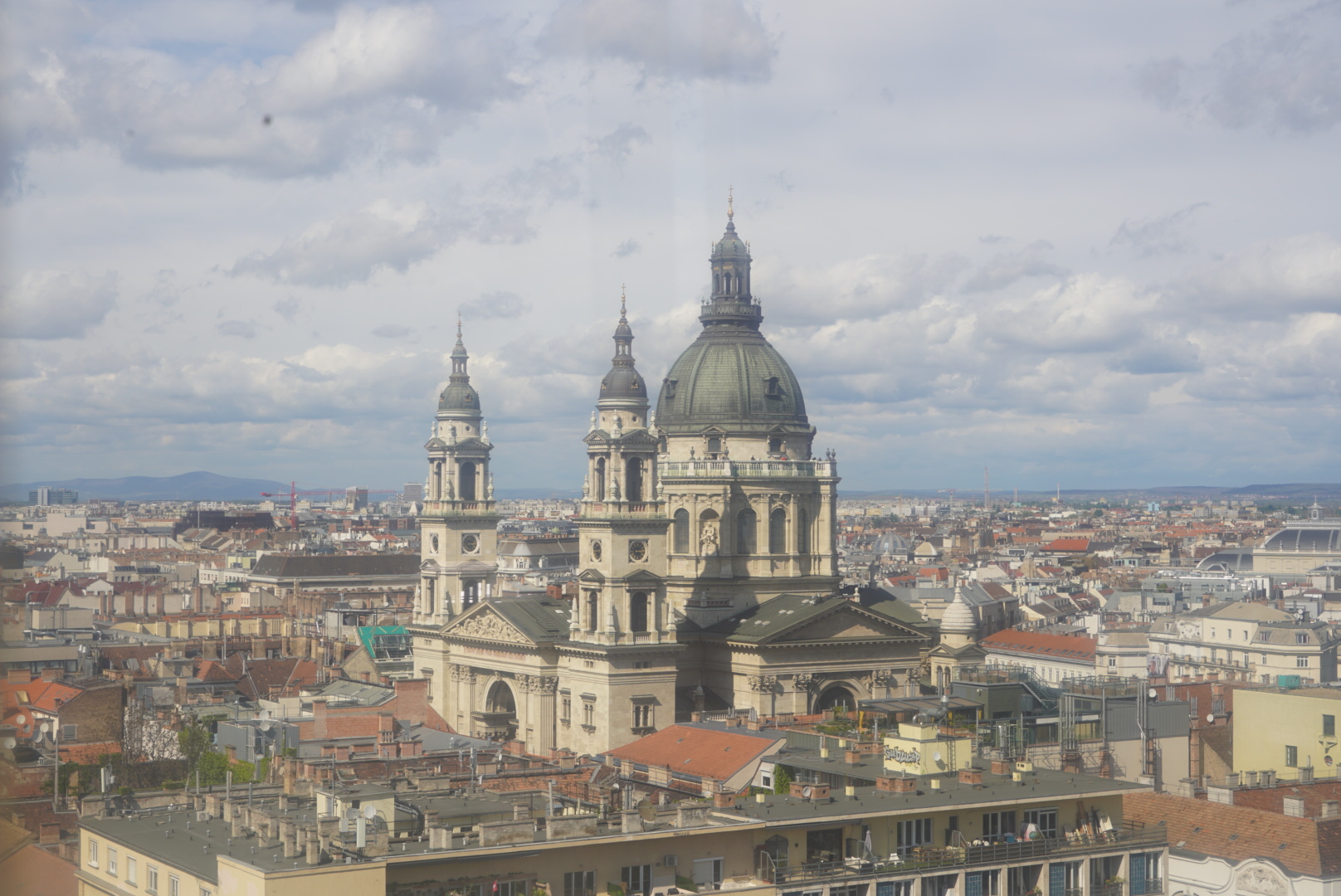
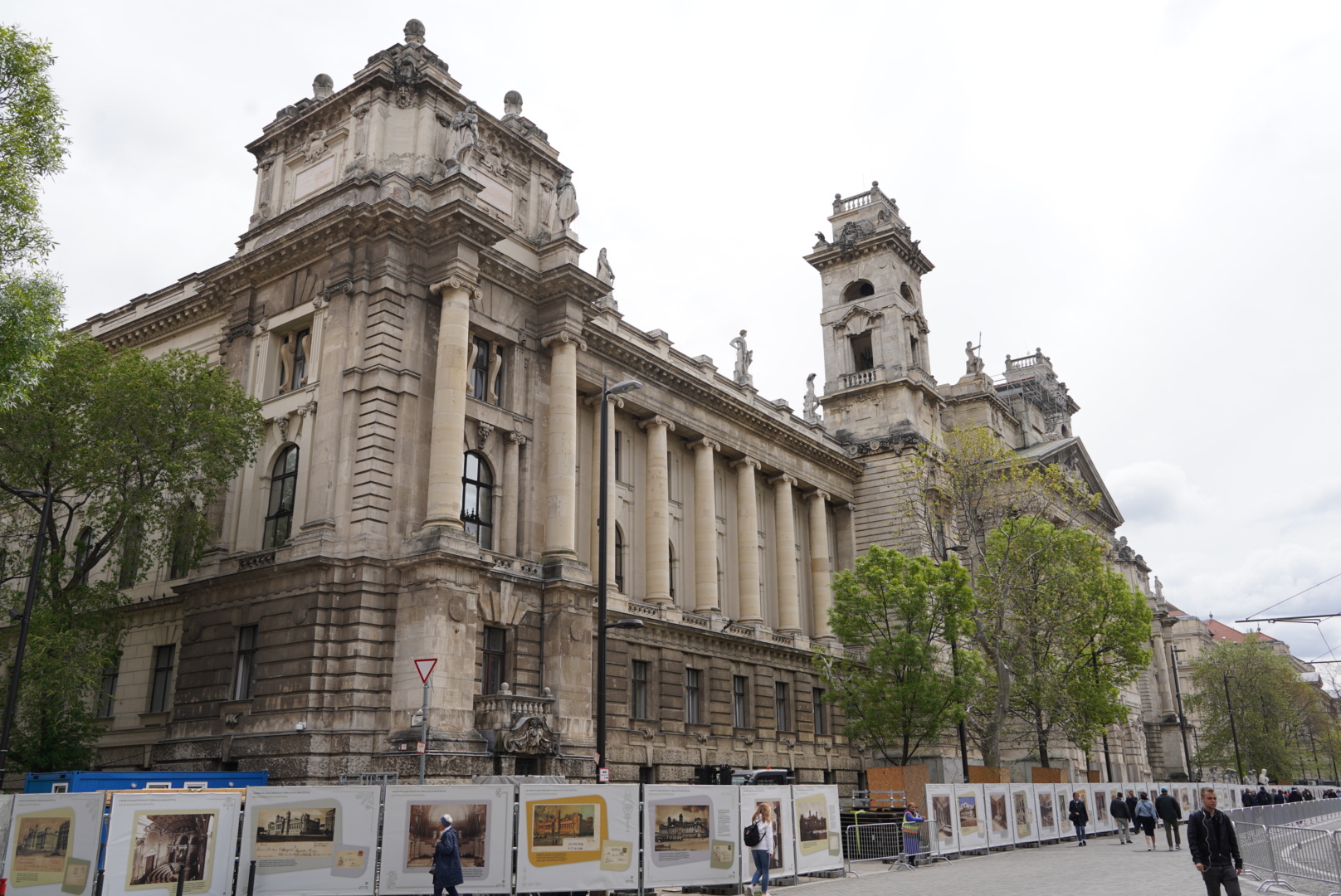
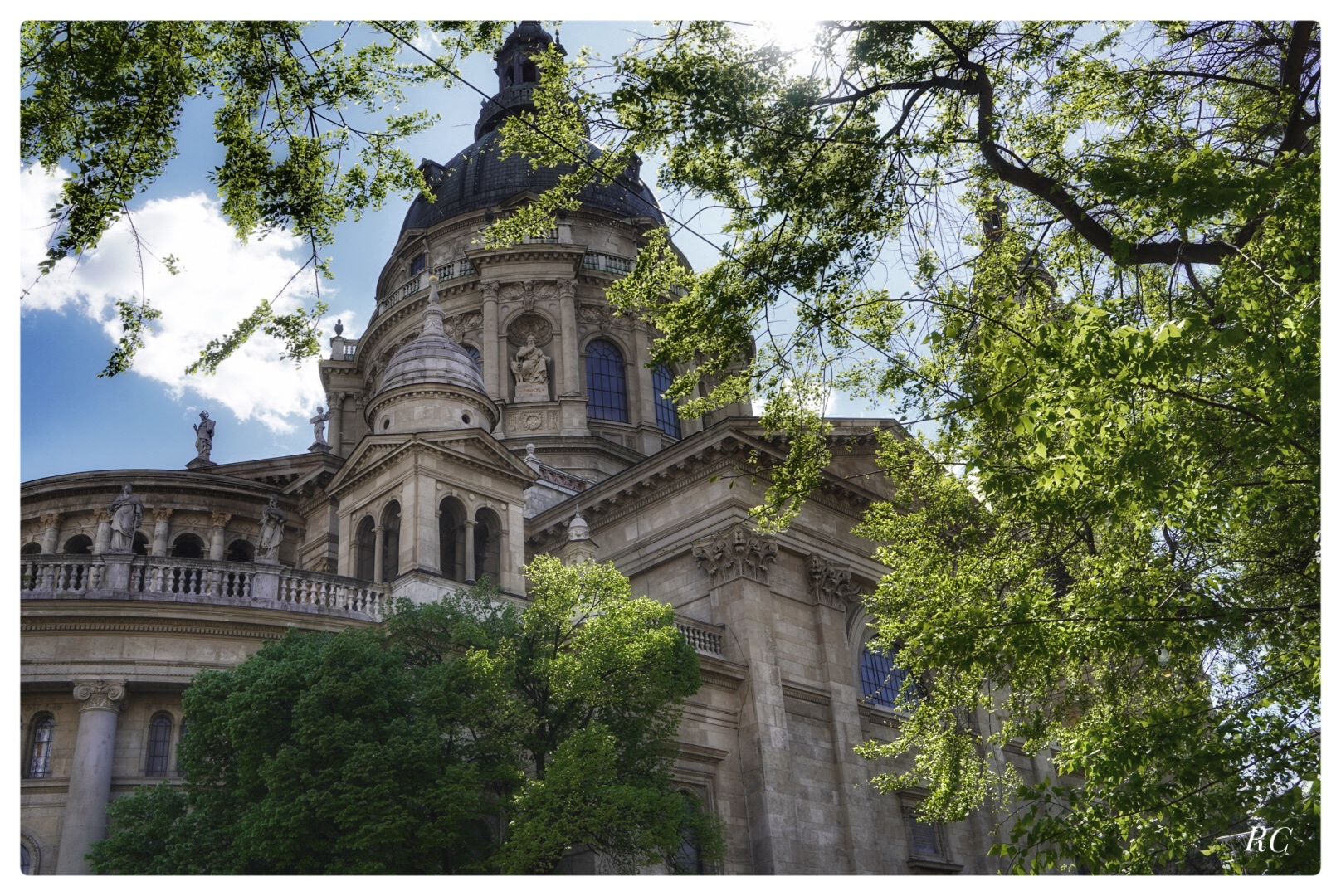
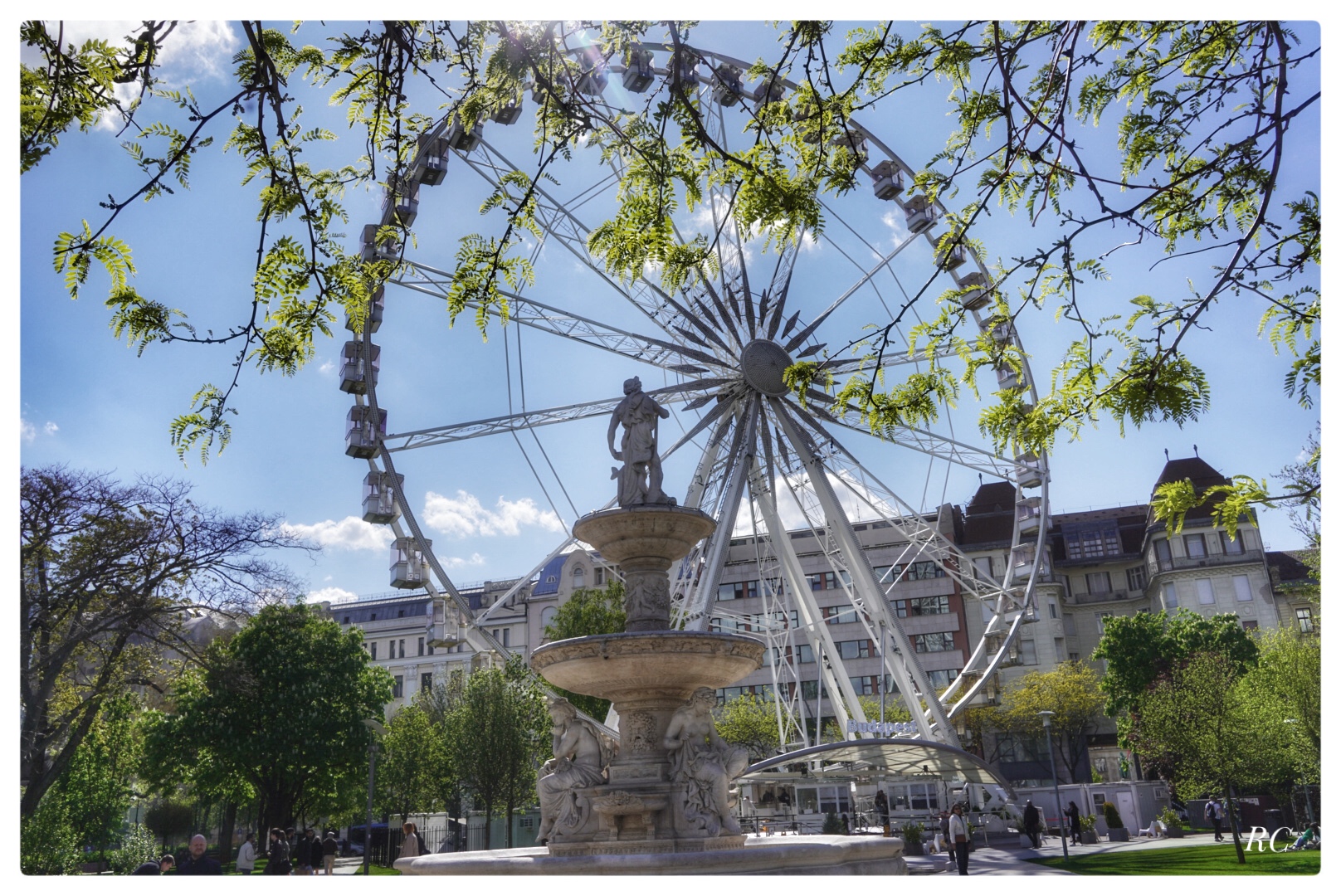
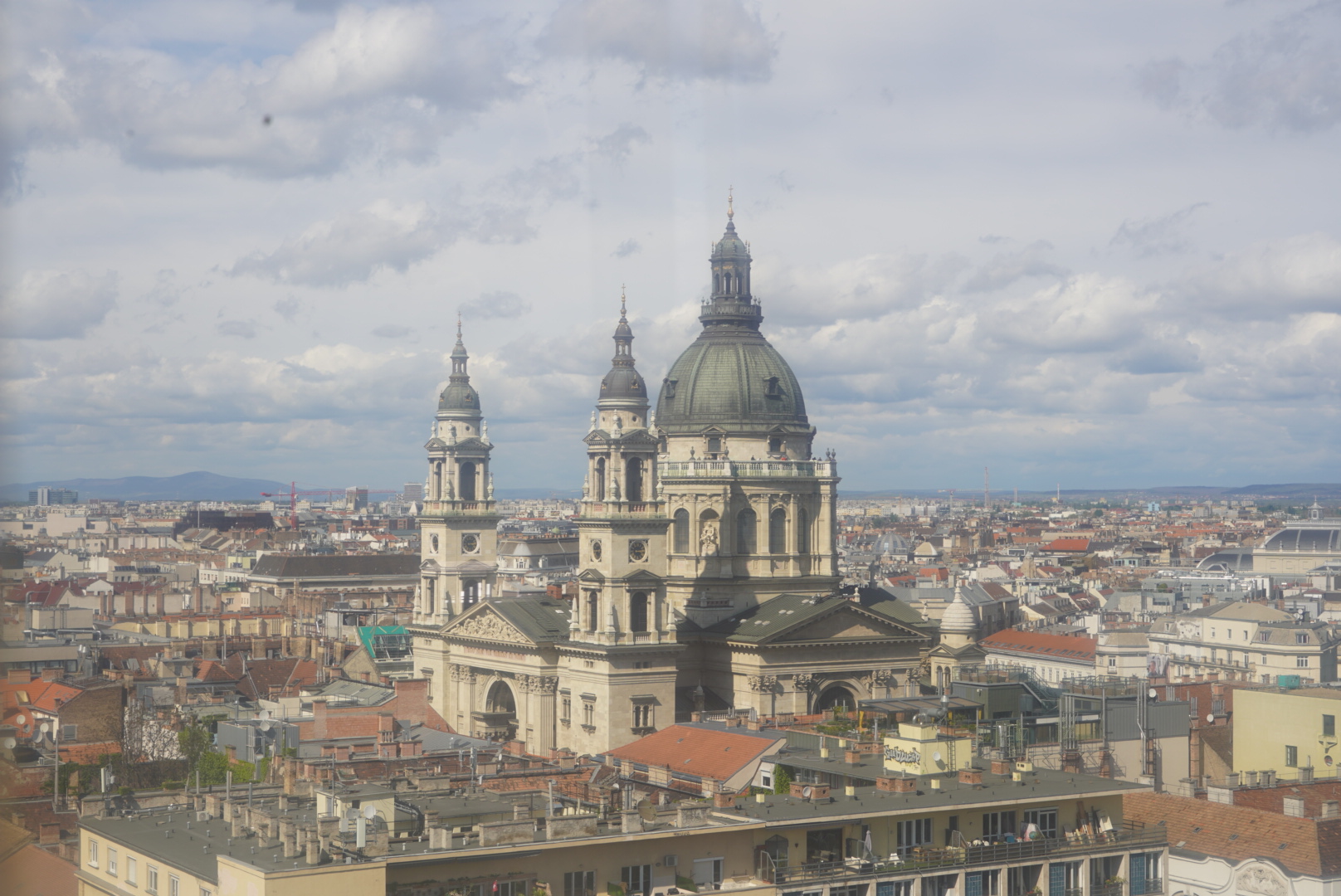
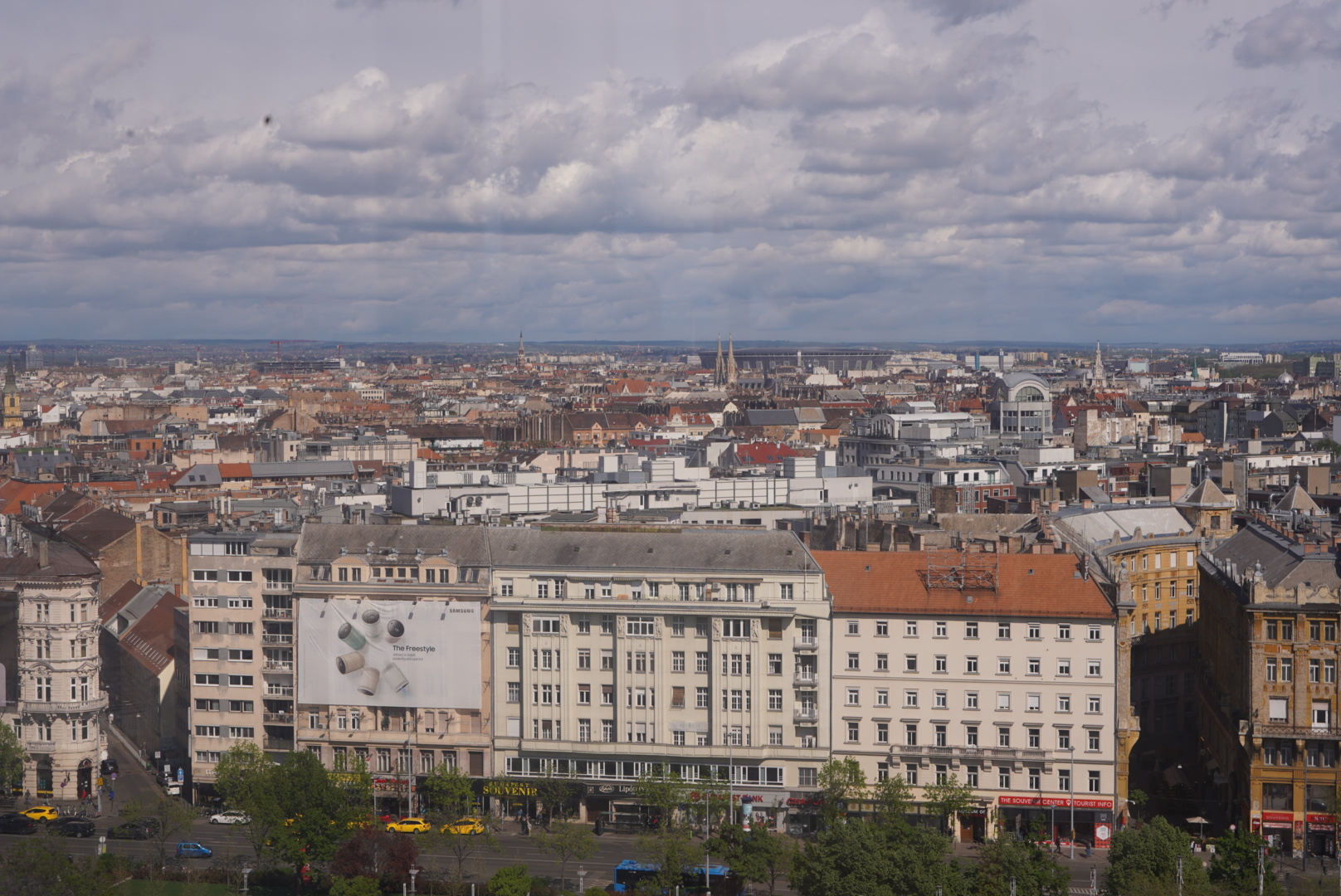
After the Shoes on the Danube, we headed out to find a place to get brunch on our way to the St. Stephen’s Basilica. We wandered around a little bit and ended up at the Pointer Pub. After a quick meal, we walked over to St. Stephen’s Basilica. It was built / consecrated in 1905 in honor of the first King of Hungary, King Stephen. The Pope is visiting Hungary this week and one of his public events will be here at St. Stephen’s Basilica. After some time at the Basilica We walked towards the city park and stopped at the Budapest Ferris Park Wheel. The views of the city from the top of the wheel were quite stunning.
After the Ferris wheel, we decided to head back to the apartment and planned to take the metro back. The guy behind the ticket counter at the metro station told us we could only buy tickets in Forint which is the local currency. He seemed to have a very violent reaction when I offered him Euros. (I don’t know if it had anything to do with the ongoing currency heartburn between the Hungarian Govt and the European Union. I read reports that Hungary plans to exit the Euro by 2030). We ended up taking a cab and that was a fateful decision as I lost my phone in the cab. I somehow think the guy behind the ticket counter had something to do with this… it was part of a diabolical plan to kidnap my iPhone (forcing me to eventually remotely eliminate the phone from my world). It was quite torturous to see my “kidnapped” iPhone moving around the city ( on the “find my iPhone app) … so near yet so far.. Okay, enough about my iPhone which I still dearly miss … 😣
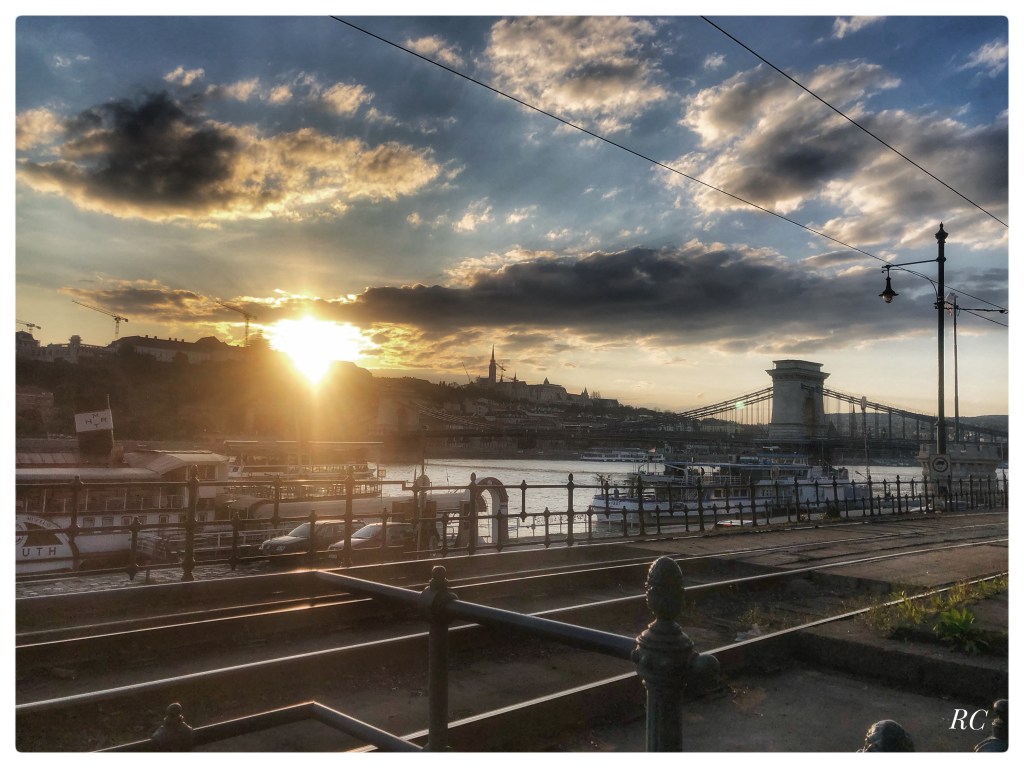
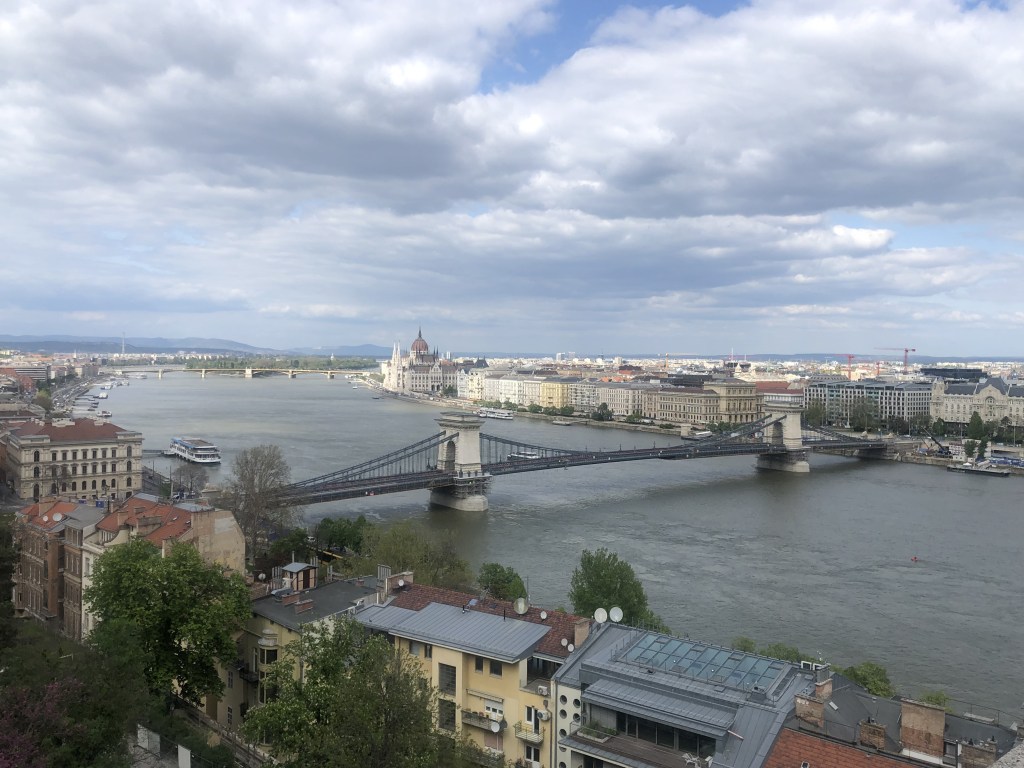
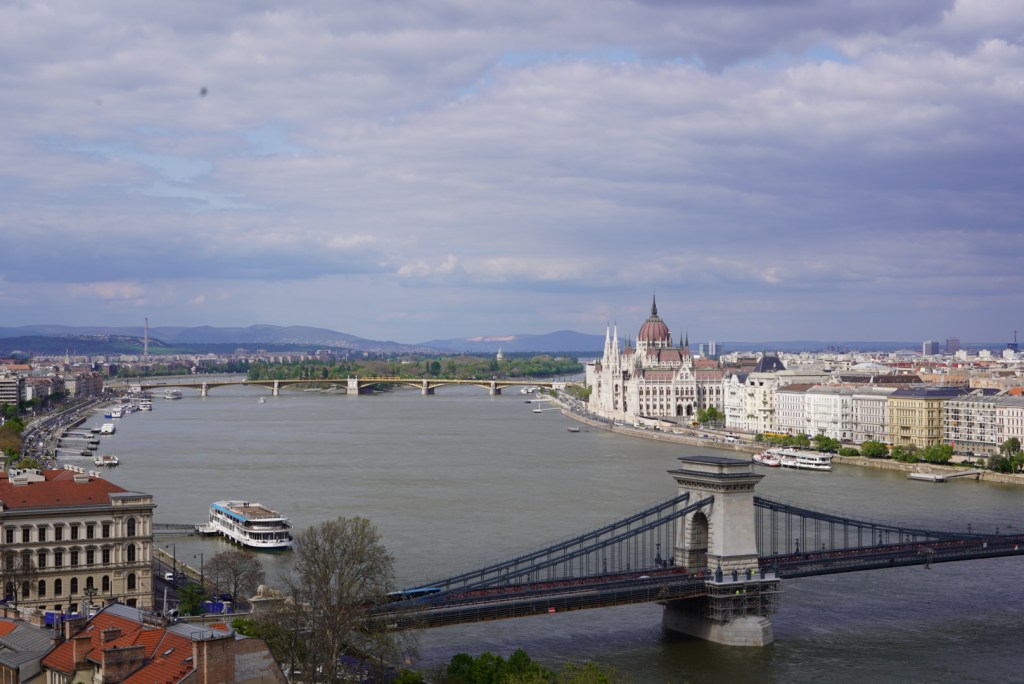
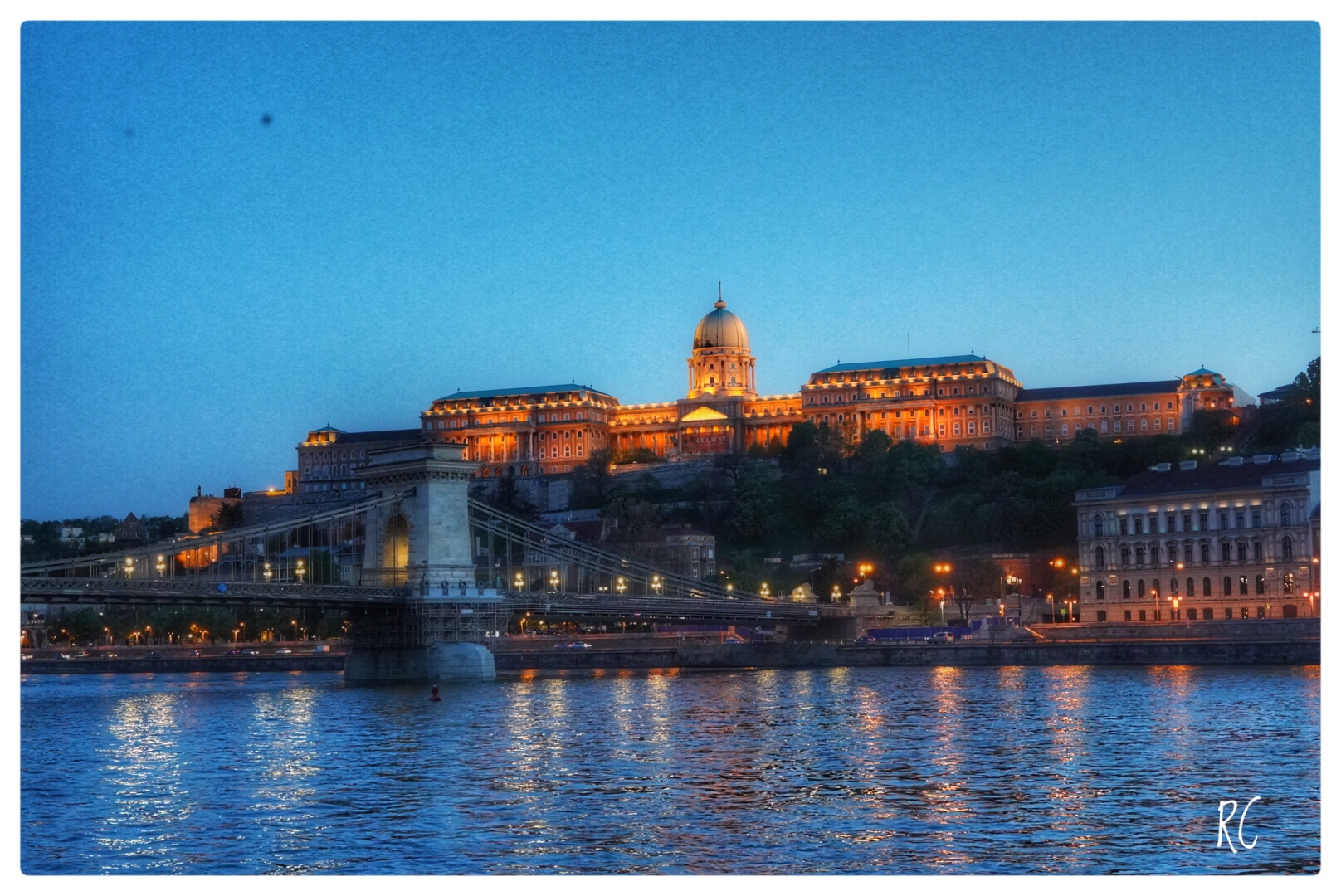
Dinner reservations were made at a really fancy Lebanese restaurant called Arz. We were treated to an amazing culinary experience. The food, the plating, the cocktails, desert and the service were awesome. Must visit if you like the Lebanese cuisine. The views of the Chain Bridge from the restaurant were quite amazing. One of the must do things in Budapest is taking a ride on the Number 2 Tram that rides along the Danube River. During your dinner, we saw the Tram go back and forth several times and made a mental note that we need to go on this ride, possibly at night when all the riverfront is all lit up and colorful.
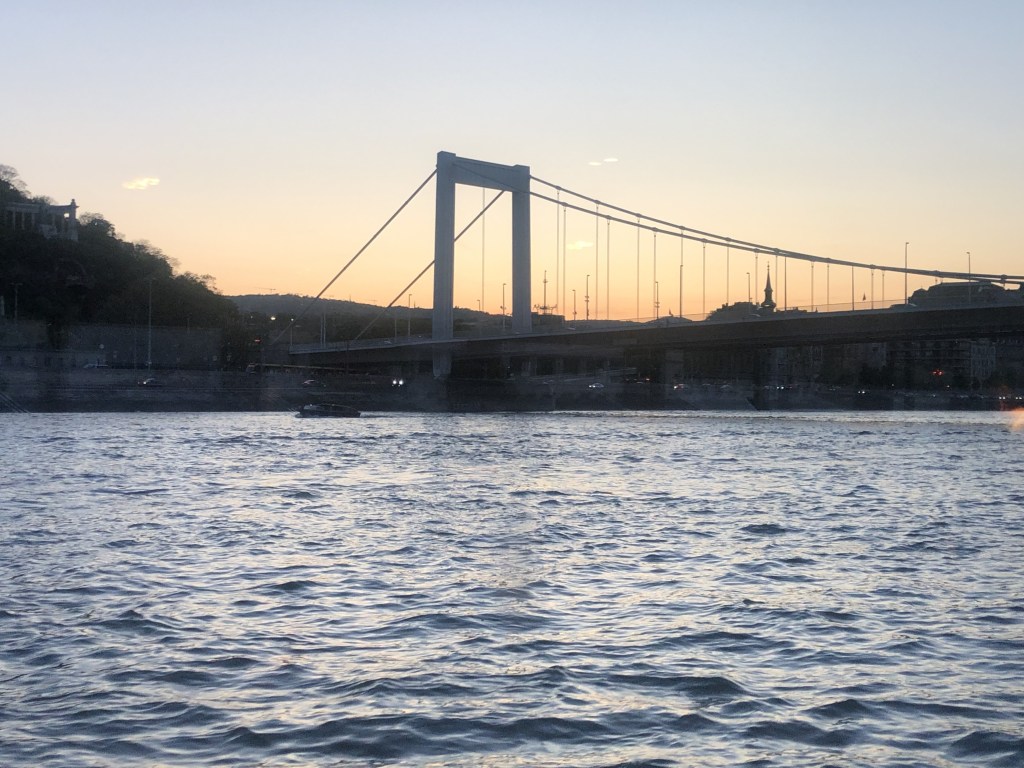
View of the Chain Bridge at sunset
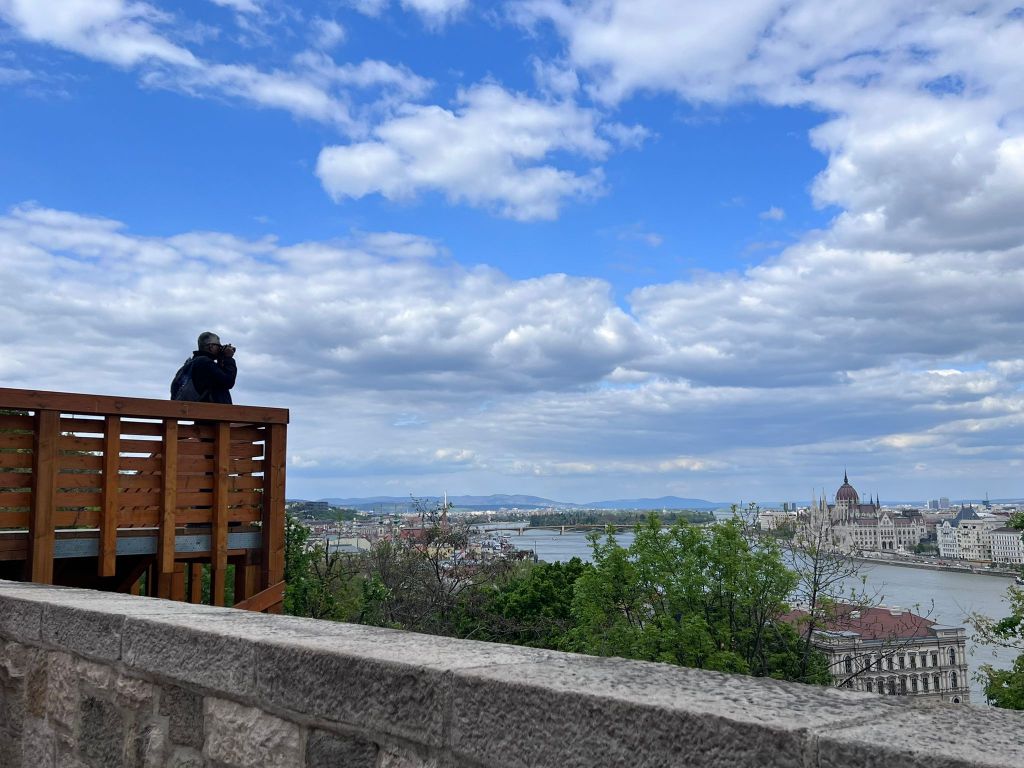
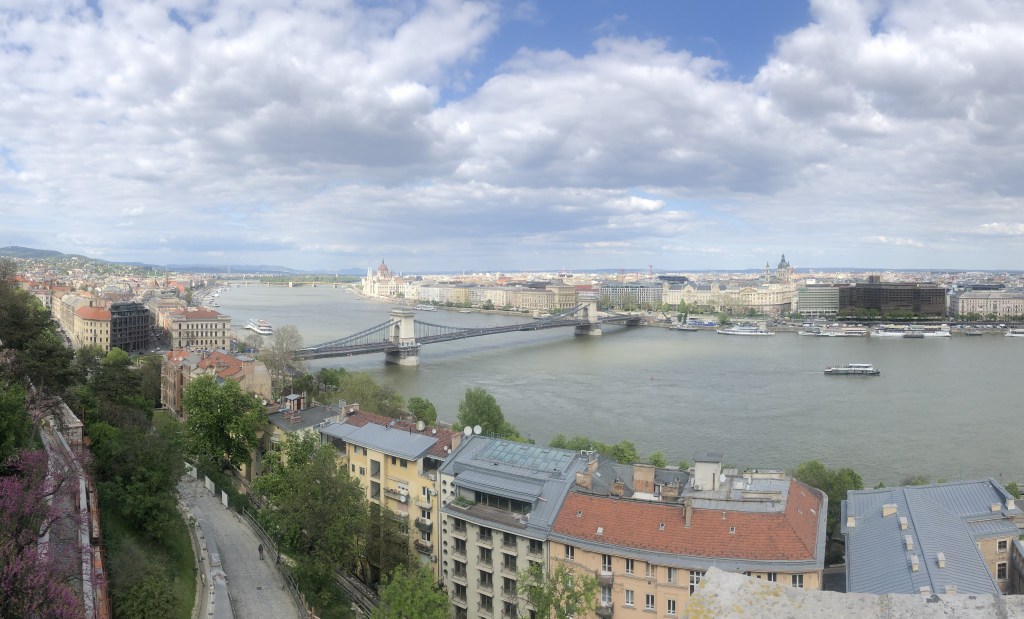
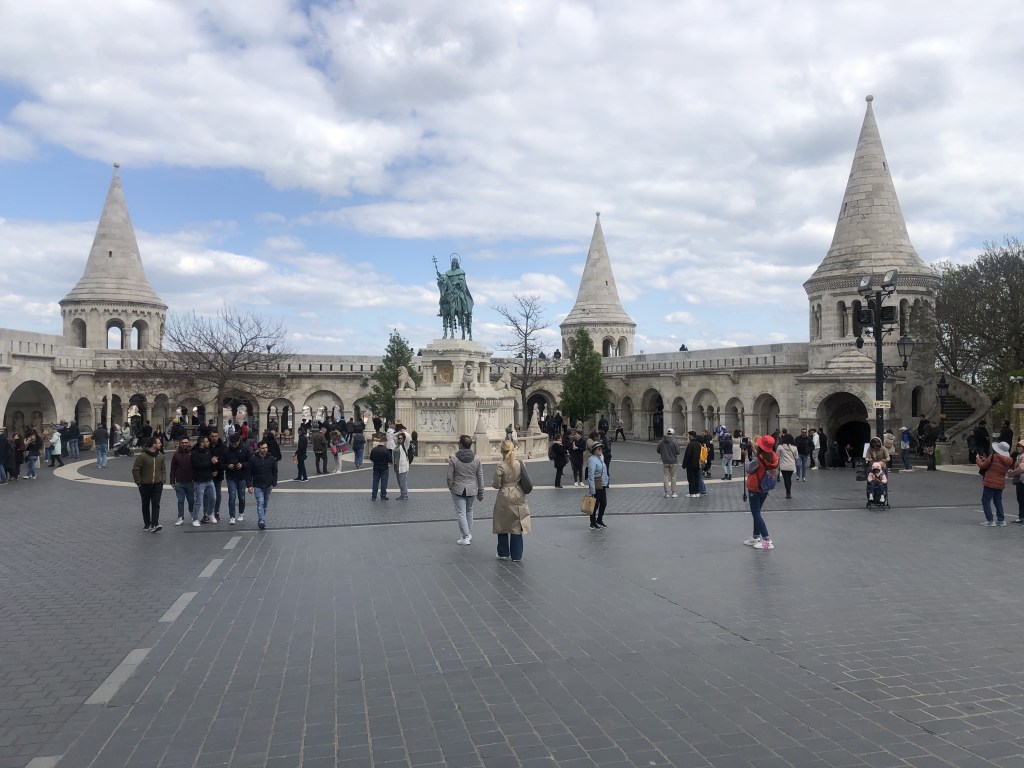
Day 3 ( yeah… Day 2 really) we were off to a brisk start. We were going to the other side… other side of the Danube to Buda. We cabbed it to the Funicular station, this took us across the historic Chain Bridge. The Szechenyi Chain Bridge was built in 1849 and was the first bridge to connect Buda and Pest. It is currently undergoing renovation and does not allow for a pedestrian crossing of the bridge. It is regarded as an ancient symbol of Budapest. We planned to take the Funicular to Fisherman’s Bastion and the Buda Palace. Well… the Funicular was out of service… we bought tickets to the hop-on / hop- off electric cart service that would take us to all the key spots – Fisherman’s Bastion, Mathias Church, Buda Palace, etc. Fisherman’s Bastion (locally known as the Halasbastya) is one of the top attractions in Budapest. It is largely a viewing terrace with lookout towers. It was built around 1900 to commemorate the 1000th birthday of Hungary. The Bastion offers dramatic views of the Pest side of the city. The Mathias Church right next to the Bastion and is a very ornate medieval structure. It was built in the 13th century and the site of many royal weddings and coronations. We took a few pictures from the outside and proceeded the Buda Castle. The Castle is a historic building, a castle and a palace. It is the royal palace built on the top of the Varhegy Hill and offers a majestic views of the Danube River and Pest side of the city.
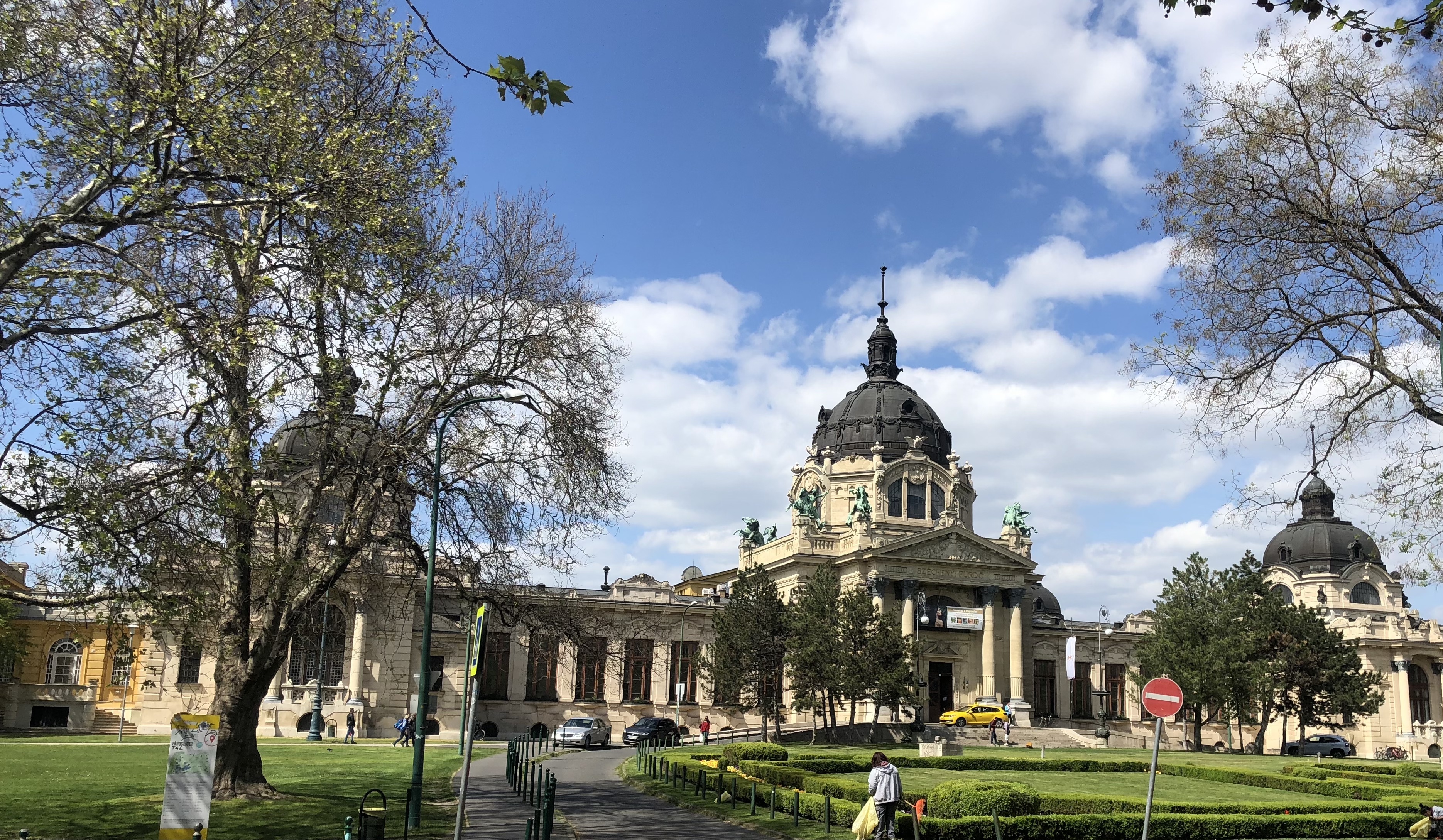
Budapest is famous for its hot springs and thermal baths and is known as the City of Spas. There are several many natural warm spring waters along the Danube and feed these thermal baths and spas. The highlight of Day 4 was the visit to the Szechenyi Thermal Bath which was built in 1880s. It is the oldest and most popular Bath. The structure looks like a neo-baroque palace with 2-3 large baths in the center. As we were in the bath amidst several hundred strangers, I could not help but think about COVID and how far we have come along since the dark days of the pandemic. It was a relaxing and fun experience. I read that bathing in these hot springs has medicinal effects as well ( I am still waiting…)
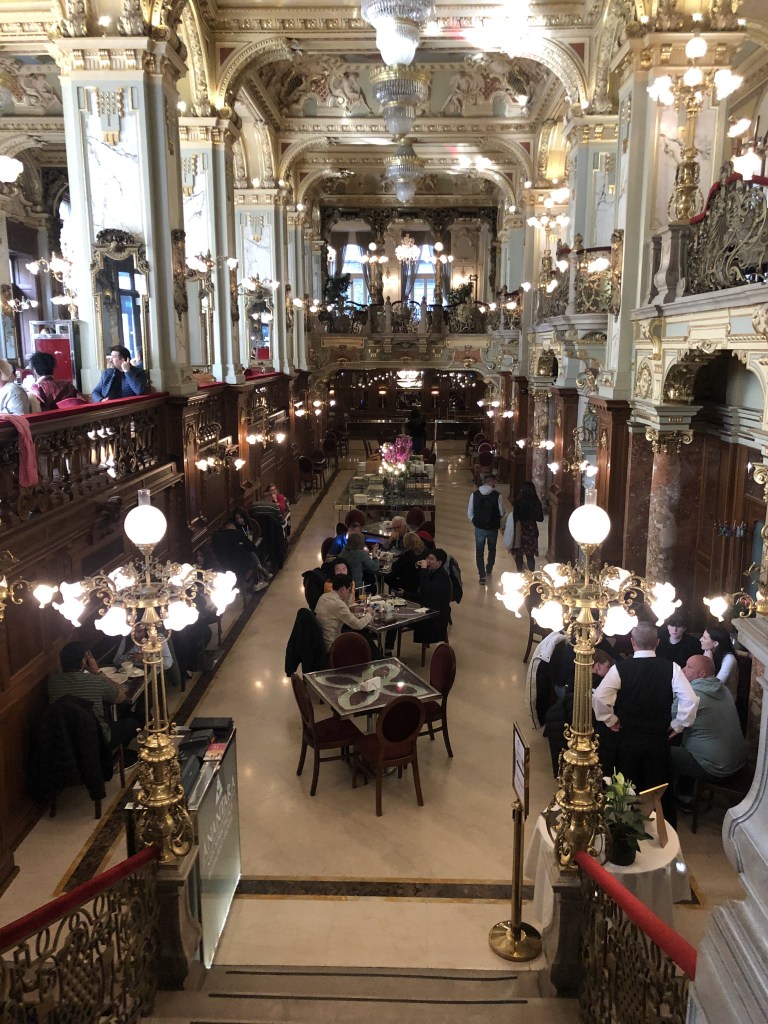
Before we came here, we read about The New York Cafe in Budapest, proclaimed as the most beautiful cafe in the world and on the must visit list for Budapest. I don’t know if that means beautiful cafe with delicious food or just a cafe with beautifully interiors. Well, there was only one way to find out… we decided to visit the “most beautiful cafe in the world”. The cafe originally opened in 1894 and was a hot spot for writers, poets, artists… like many other structures in Budapest it got damaged in WW 2. It was rebuilt in the 1950s by an Italian group and restored to it’s original glory. The interiors of the Cafe look like one of the palaces we saw in Versailles, very ornate and rich. The chandeliers are very grand and there’s live orchestra in the cafe. The food was quite ordinary, prices extra-ordinary and service underwhelming. That was that…
New York Cafe… “the most beautiful cafe in the world”
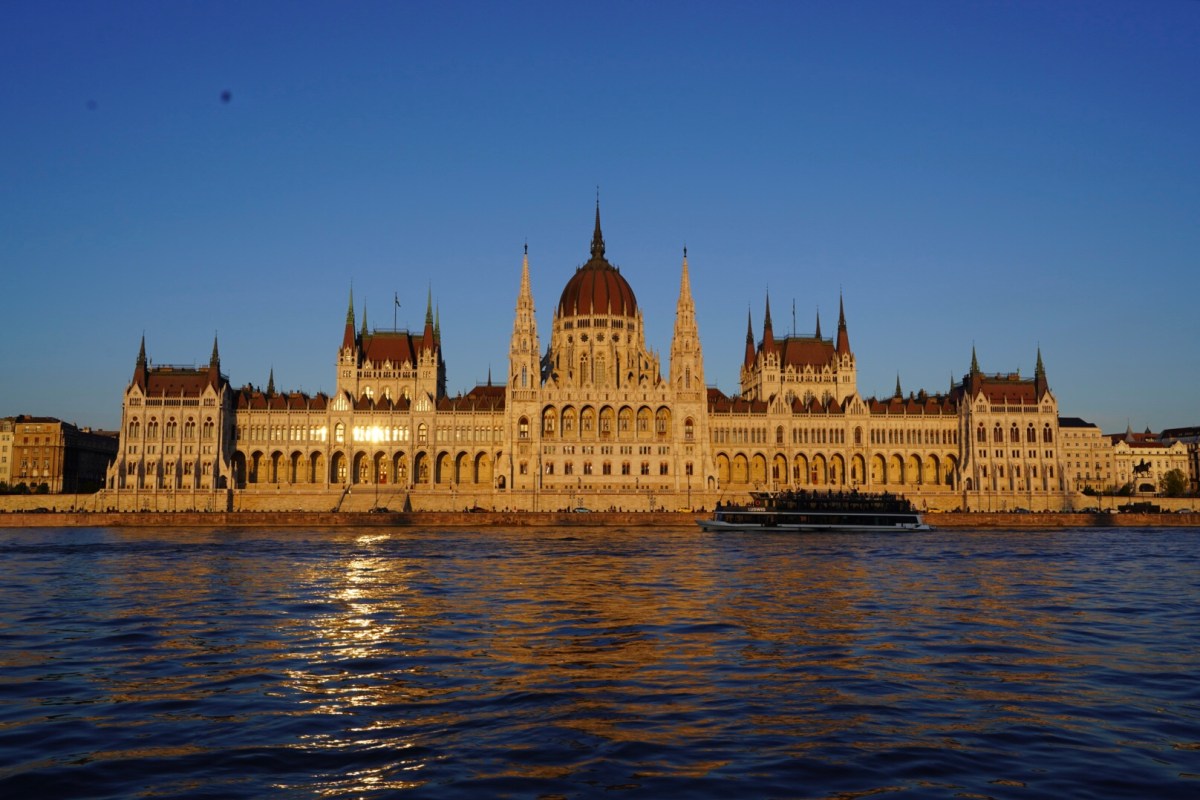
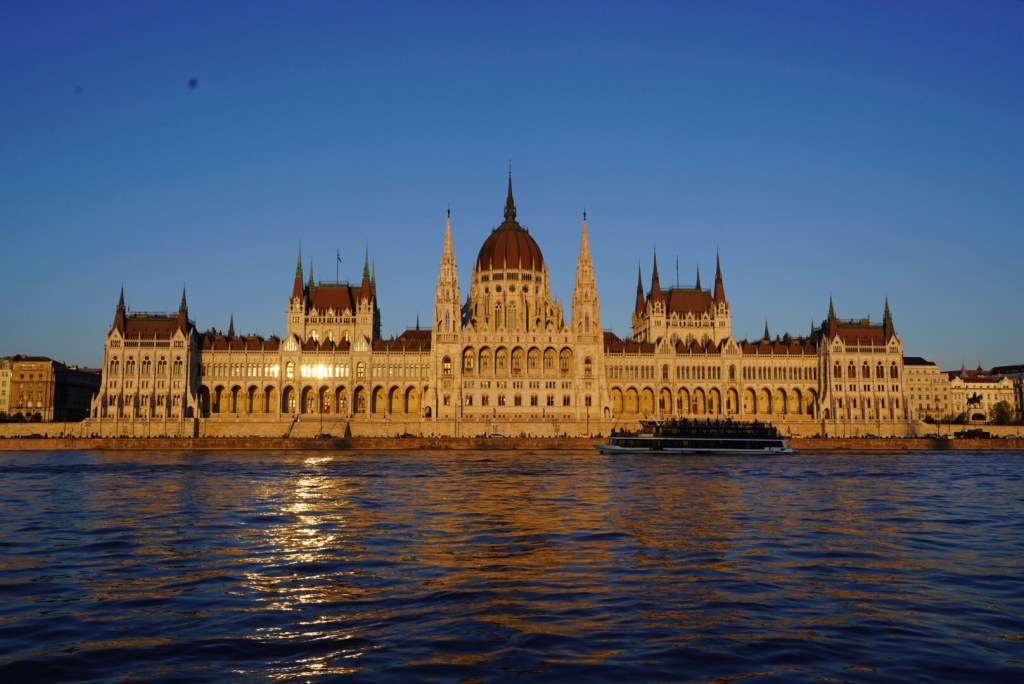
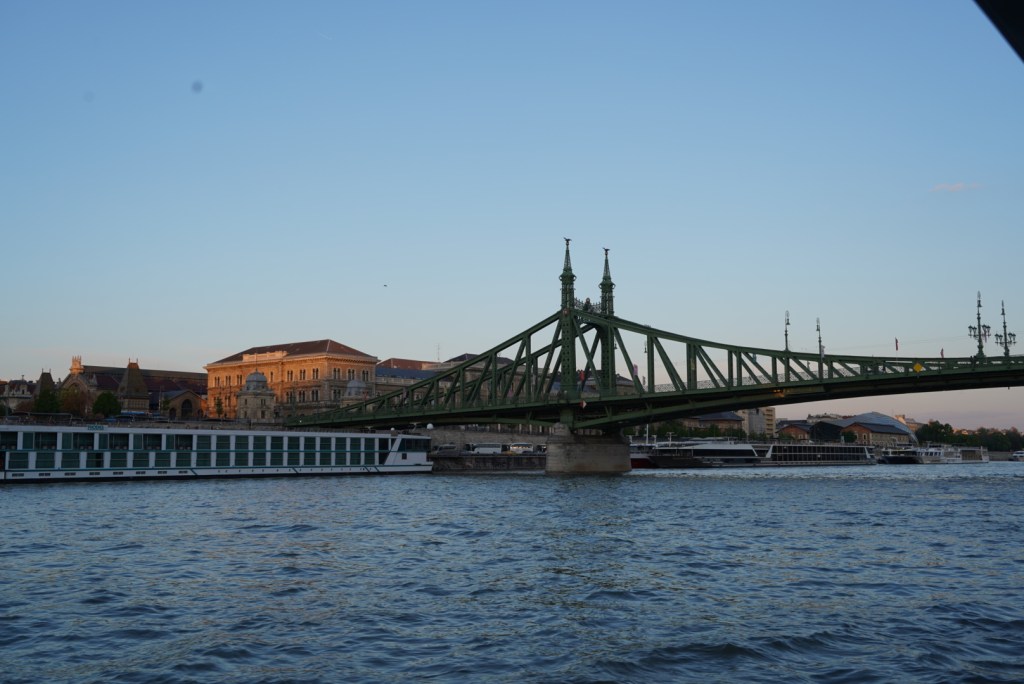
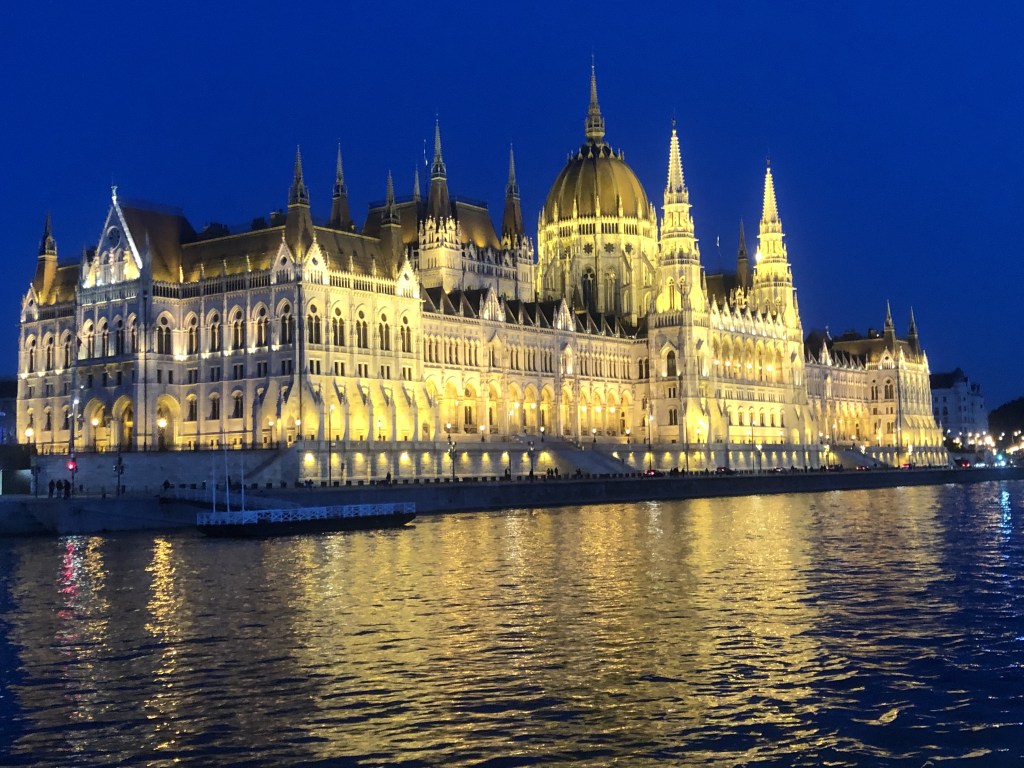
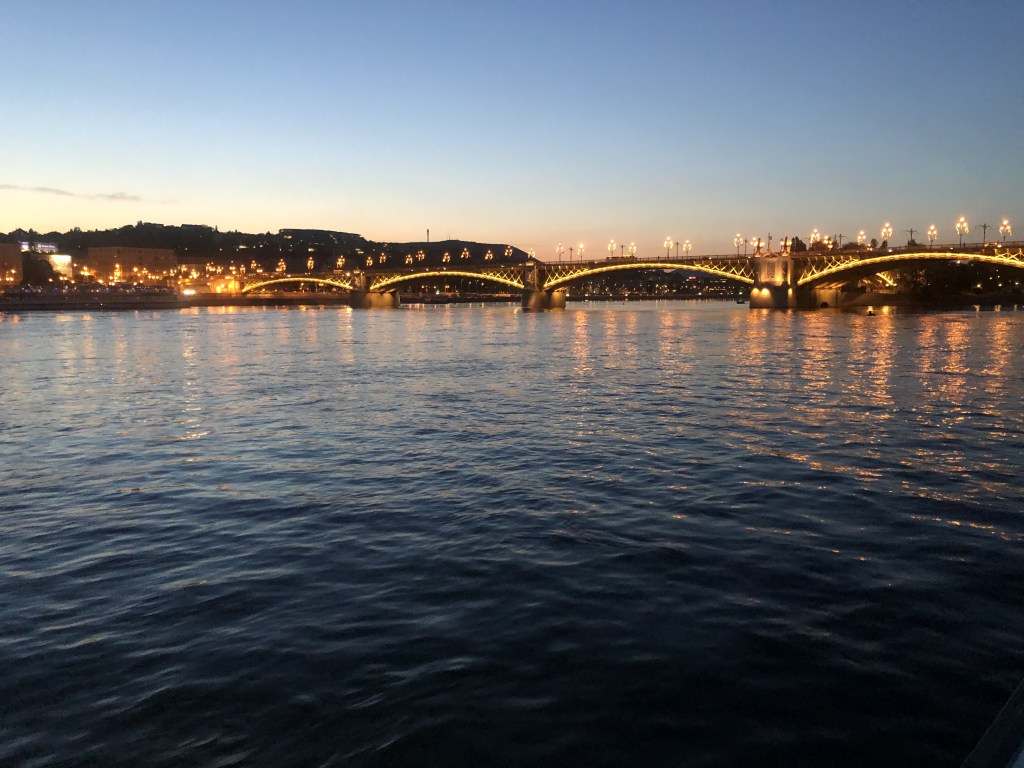
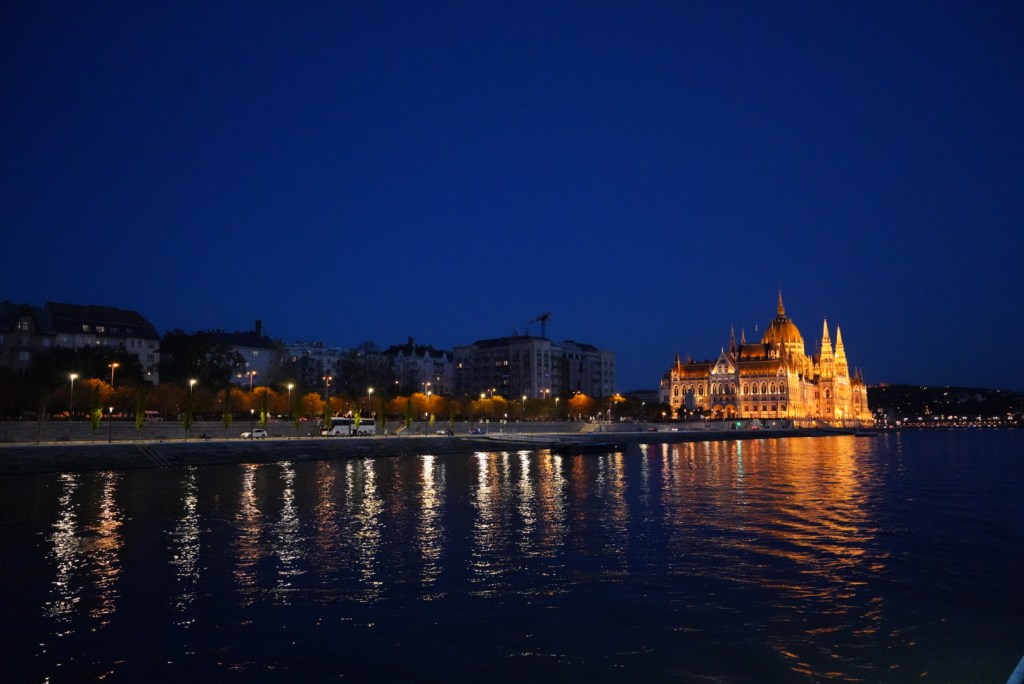
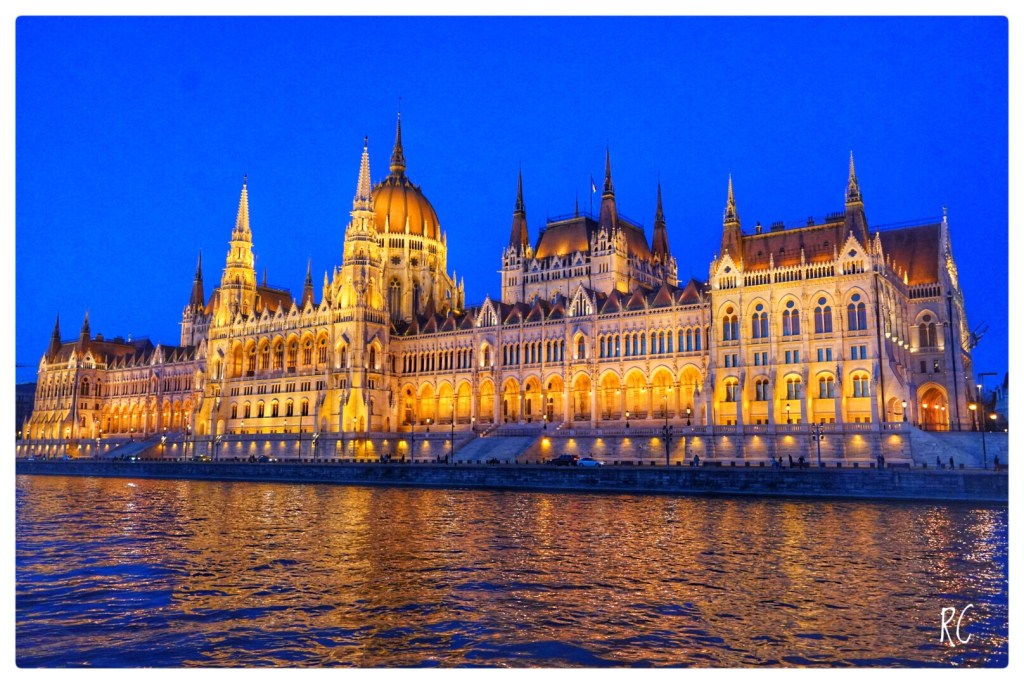
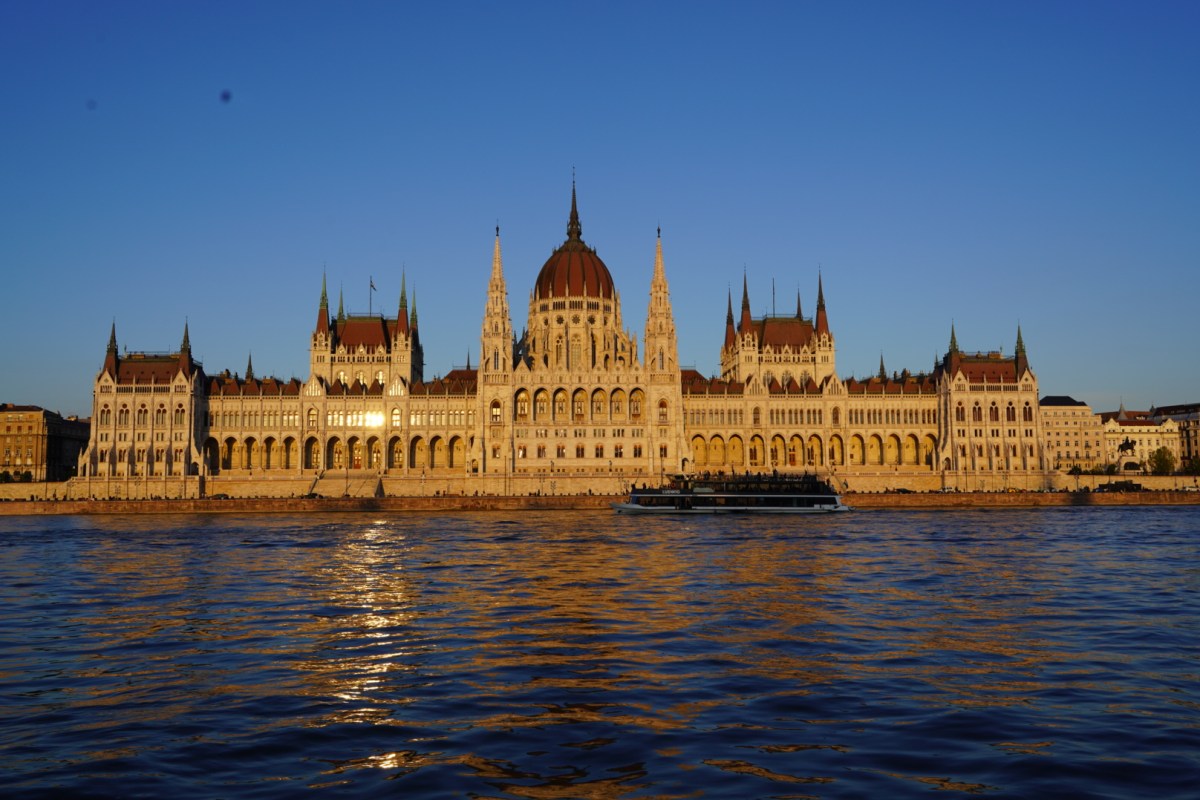
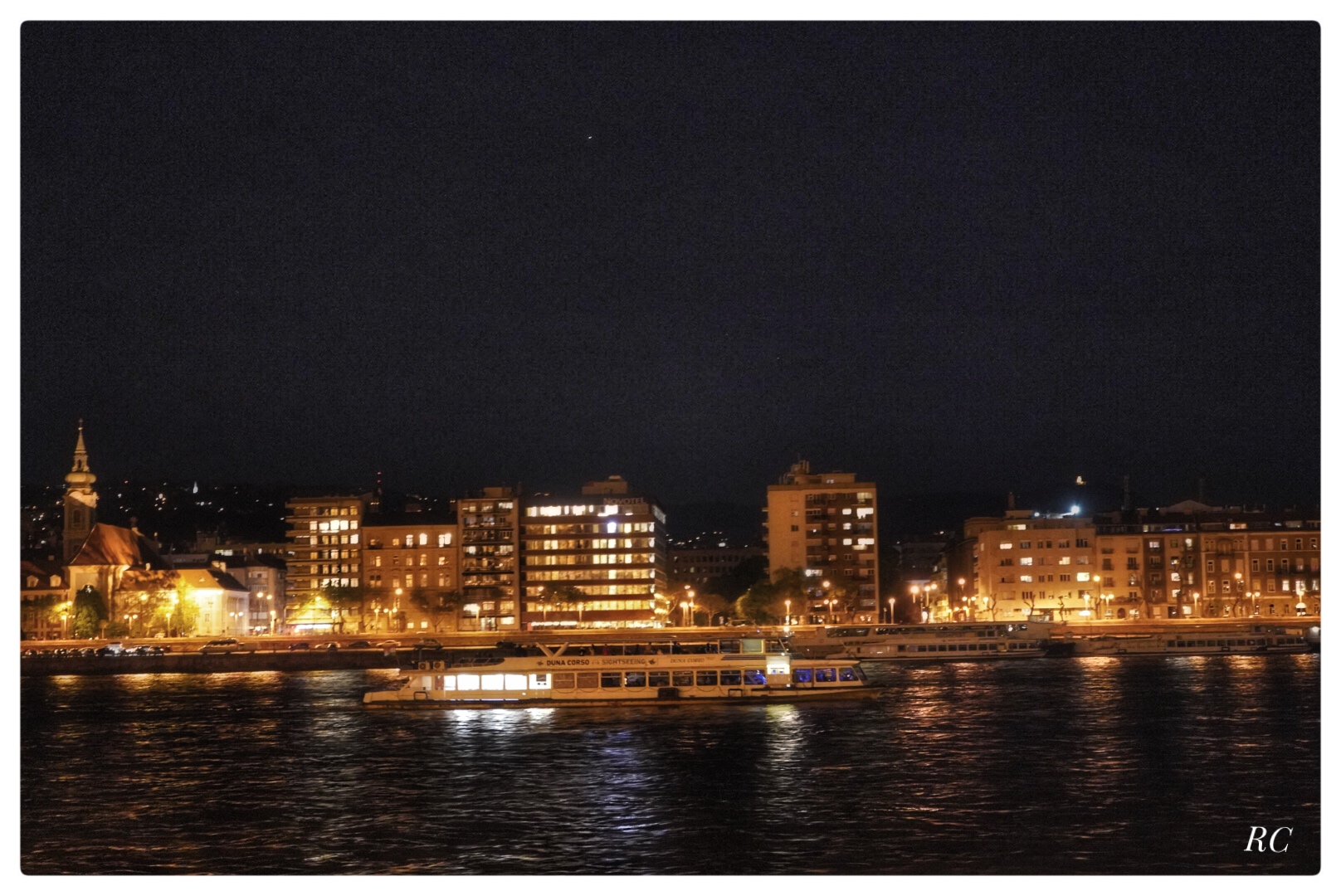
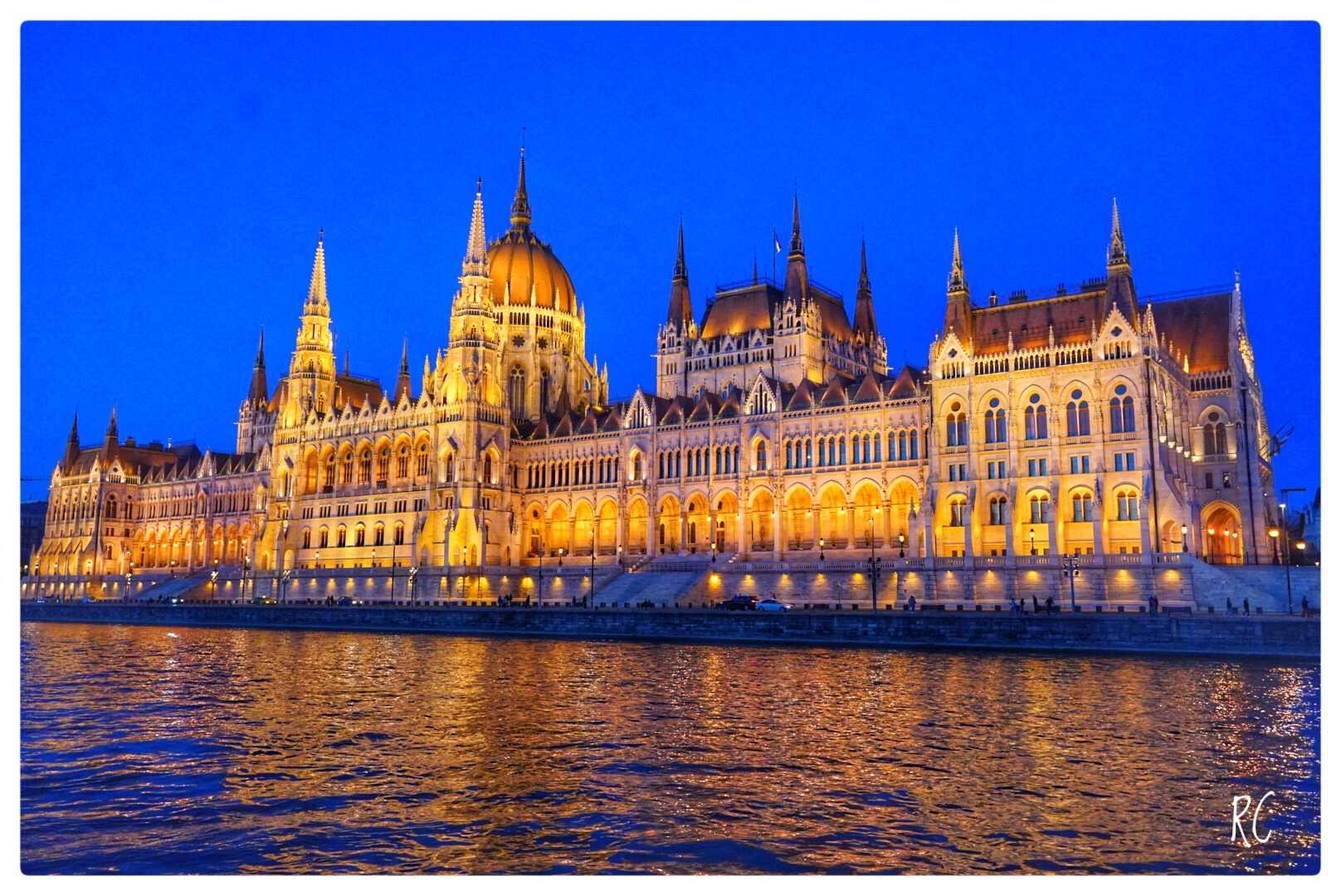
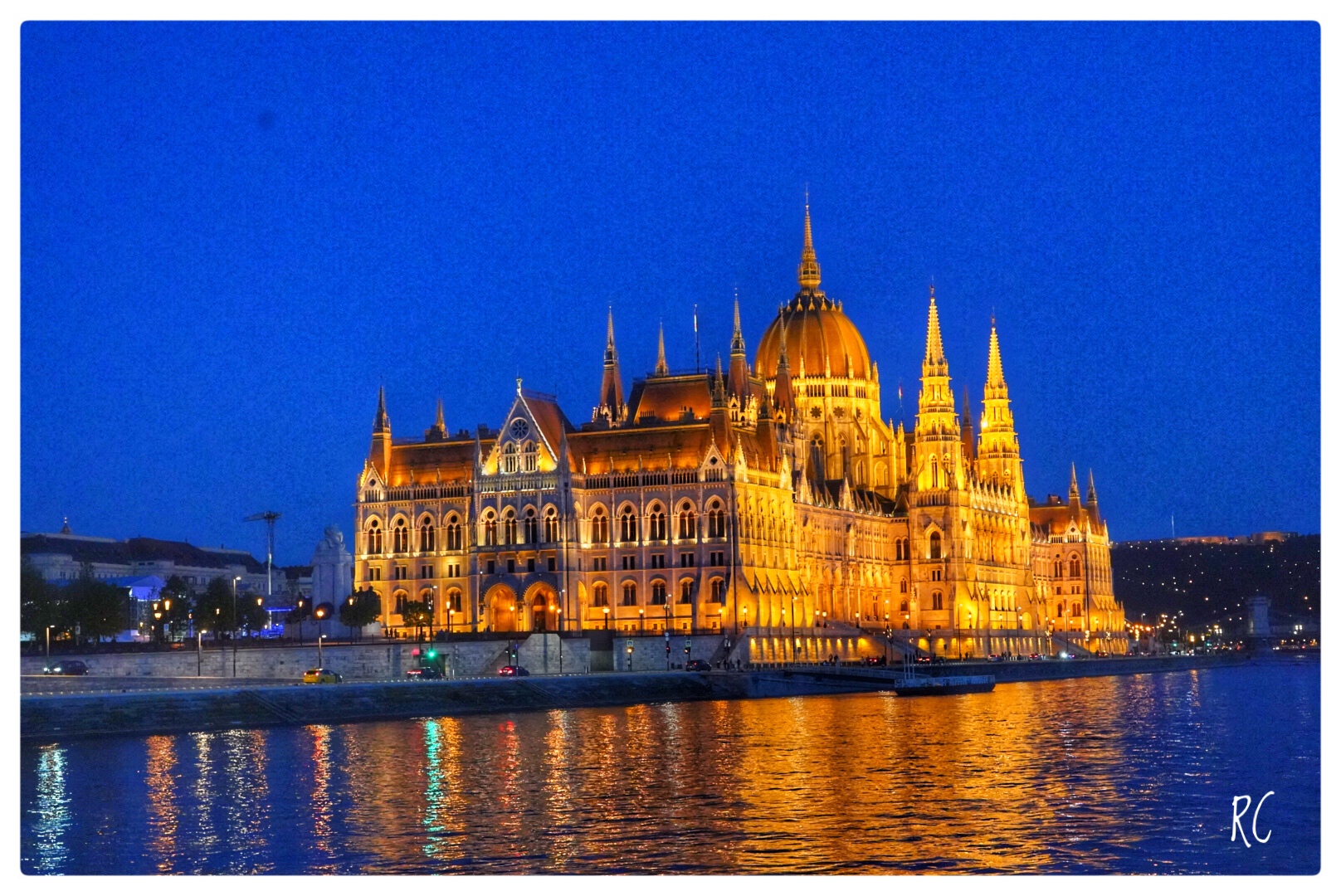
After the rather underwhelming experience at New York Cafe, we cabbed to the pickup point for evening Danube River Cruise. This was a highly anticipated experience for all of us for many reasons (unlimited Prosecco was I think on top of the list for a few folks). It was a fantastic evening, no hint of the rain that was in the forecast, the sun shining bright as set sail. I wondered if we would get to see get the splendor of Budapest at night when the parliament and other buildings on both sides of Danube fully light up. We got to see all the landmarks, buildings and bridges on both sides of the river from the open air terrace of the boat. As we sailed past the parliament, the rays of the setting sun lit up the magnificent building creating a spectacular sight. After about 45 min sailing up the Danube river, the boat turned around and heading back towards the parliament. The sun had gone down by now the the buildings on both sides of the river were now lit up. It was an amazing sight as we sailed by the parliament… just sensational.. see below..
The next morning we headed out to Vienna for a couple of days and returned on Saturday afternoon. Vienna is a 2 hour train ride from Budapest. More about that in my next blog…
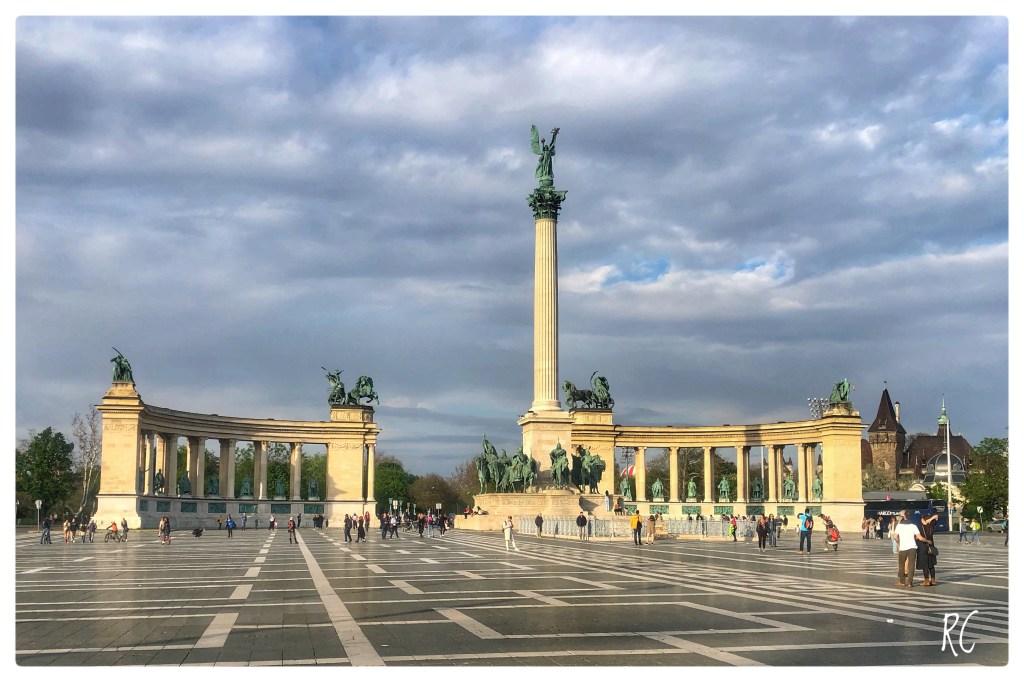
We had one last item on our list in Budapest was to visit the Heroes’ Square.. it is one of the major squares in Budapest. It is also known as the tomb of the unknown soldier and considered a tribute to Hungary’s national identity. This is a large, open plaza with the large column that dominates the square. The column has Gabriel Archangel holding St. Stephen’s crown. The equestrian statues of the seven Magyar tribes chieftains encircle the column. We walked around the square took a bunch of pictures and headed back to our apartment.
Souvenir shopping was our last activity.. we walked back to the St. Stephen’s Basilica area and got a bunch of souvenirs. As we walked back to our apartment, we walked into this street lined with restaurants on both sides. We found several interesting choices for our last meal in Budapest and finally decided to eat at the hummus bar. Dinner was again amazing… we were treated to several delightful items on the menu..we “found our inner chickpea” at the Hummus Bar.
Our flight back home was the next day (Sunday afternoon). We had prearranged a taxi to take us to the airport. Since the Pope was in town and was going to address a large gathering near the parliament (right across from our airbnb) we decided to head out to the airport early . We did not want to get caught up in road closures or traffic delays. As we stepped out of the building to head to the airport, we were immediately surrounded by a few secret service agents. They asked us a bunch of questions and then escorted us out of the protected zone. We were able to find out taxi and were on our way back to the airport.
Bye bye Buda Pest… thanks for an amazing week and many many memories….
We spent an amazing weekend in the Shenandoah Valley region recently. We stayed in Waynesboro, a small town at the southern end of the Skyline Drive (about 30 miles from Charlottesville). We spent the two days going out on scenic drives, a few hikes and visiting many of the wineries and breweries in the area.
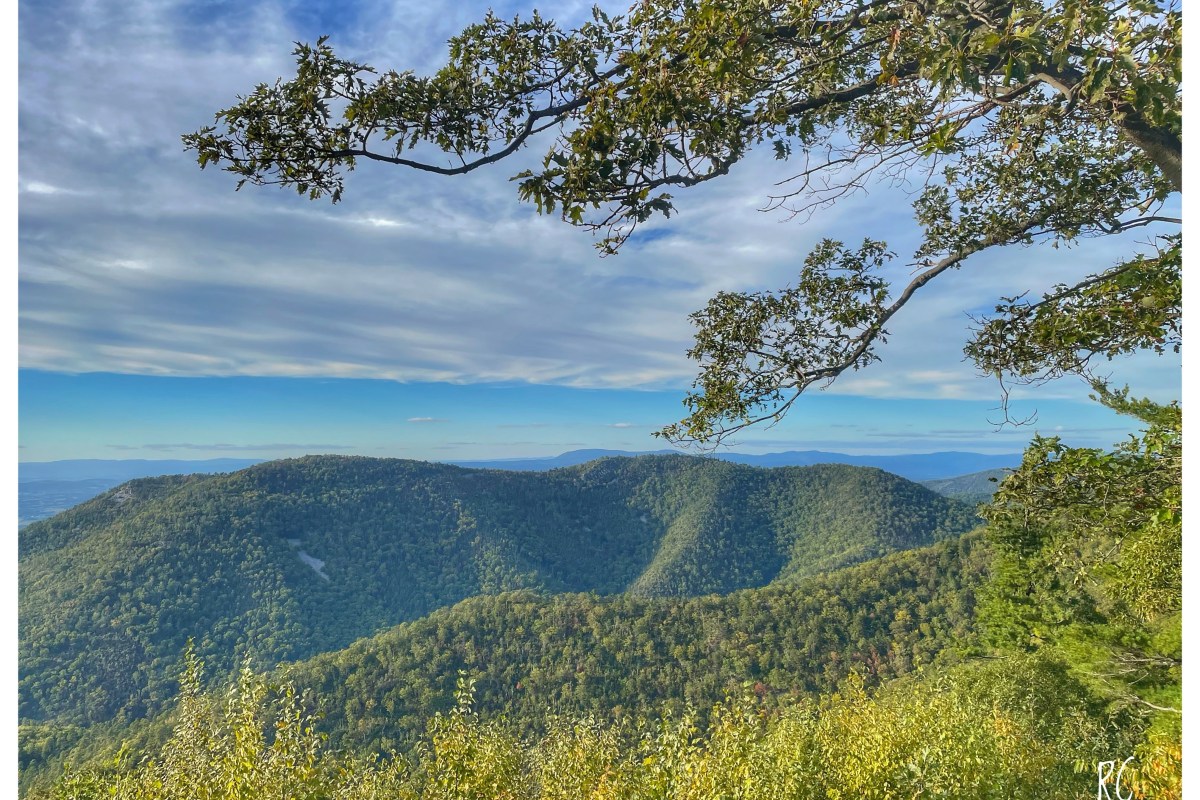
Shenandoah National Park extends along the Blue Ridge Mountains in the U.S. state of Virginia. The Skyline Drive runs its length, and a vast network of trails includes a section of the long-distance Appalachian Trail. Mostly forested, the park features wetlands, waterfalls and rocky peaks like Hawksbill and Old Rag mountains. Shenandoah is home to many bird species, plus deer, squirrels and the elusive black bear. The park’s southernmost access point is just three miles from Waynesboro.
Spanning the southern and central Appalachians, the Blue Ridge Parkway offers an exceptional glimpse of the regional flora and fauna. It is world-renowned for its biodiversity. The Parkway covers a wide range of habitats along the Appalachian Mountains, and some of these habitats are exceptionally rare. Visitors encounter unsurpassed diversity of climate, vegetation, wildlife and geological features. The Blue Ridge Parkway also boasts some of the oldest mountains in the world, the highest mountain peak in the Eastern United States and the oldest river in North America.
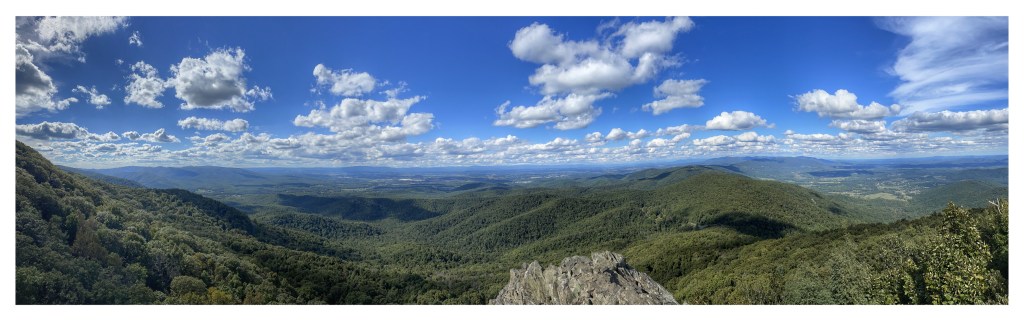
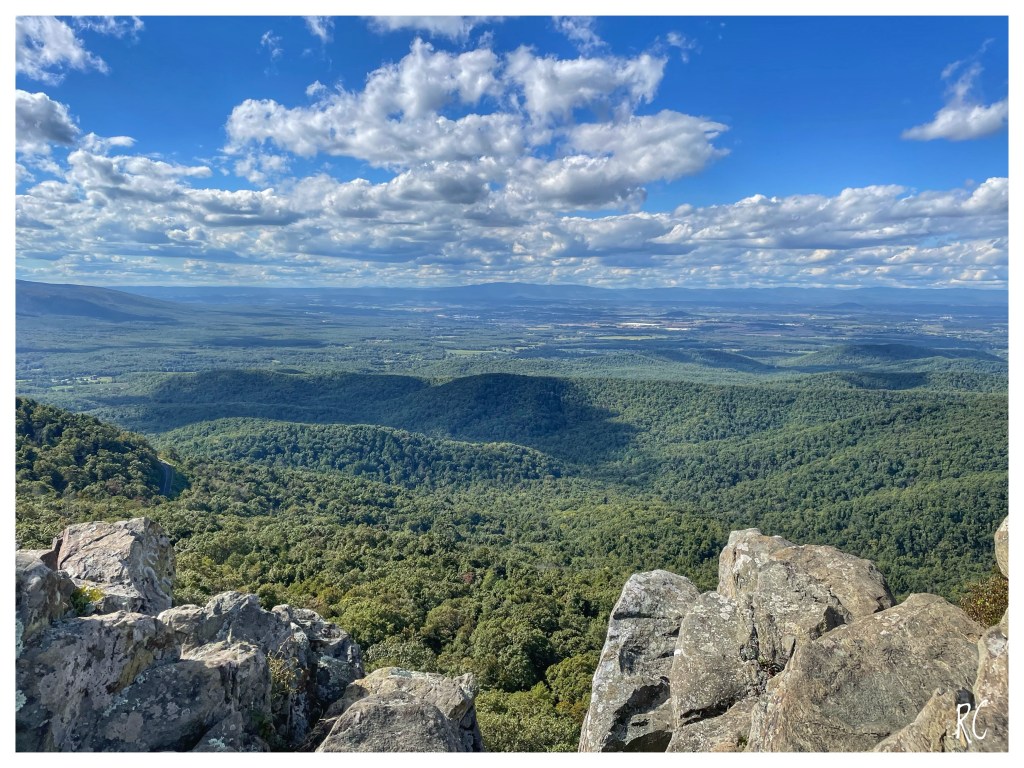
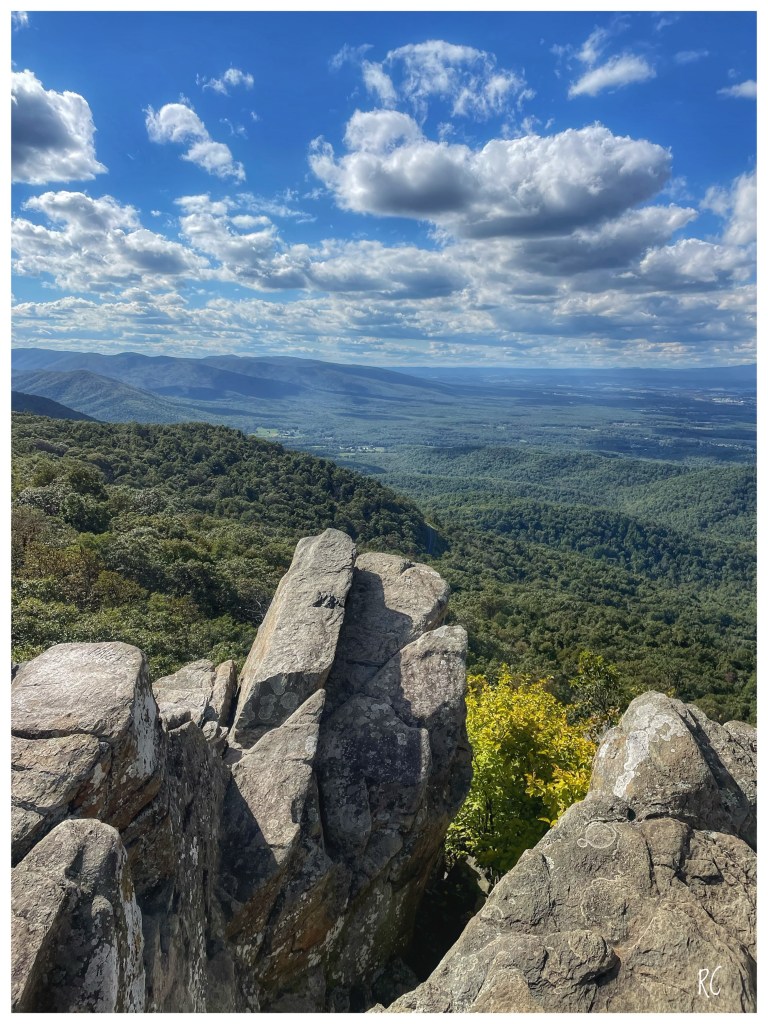
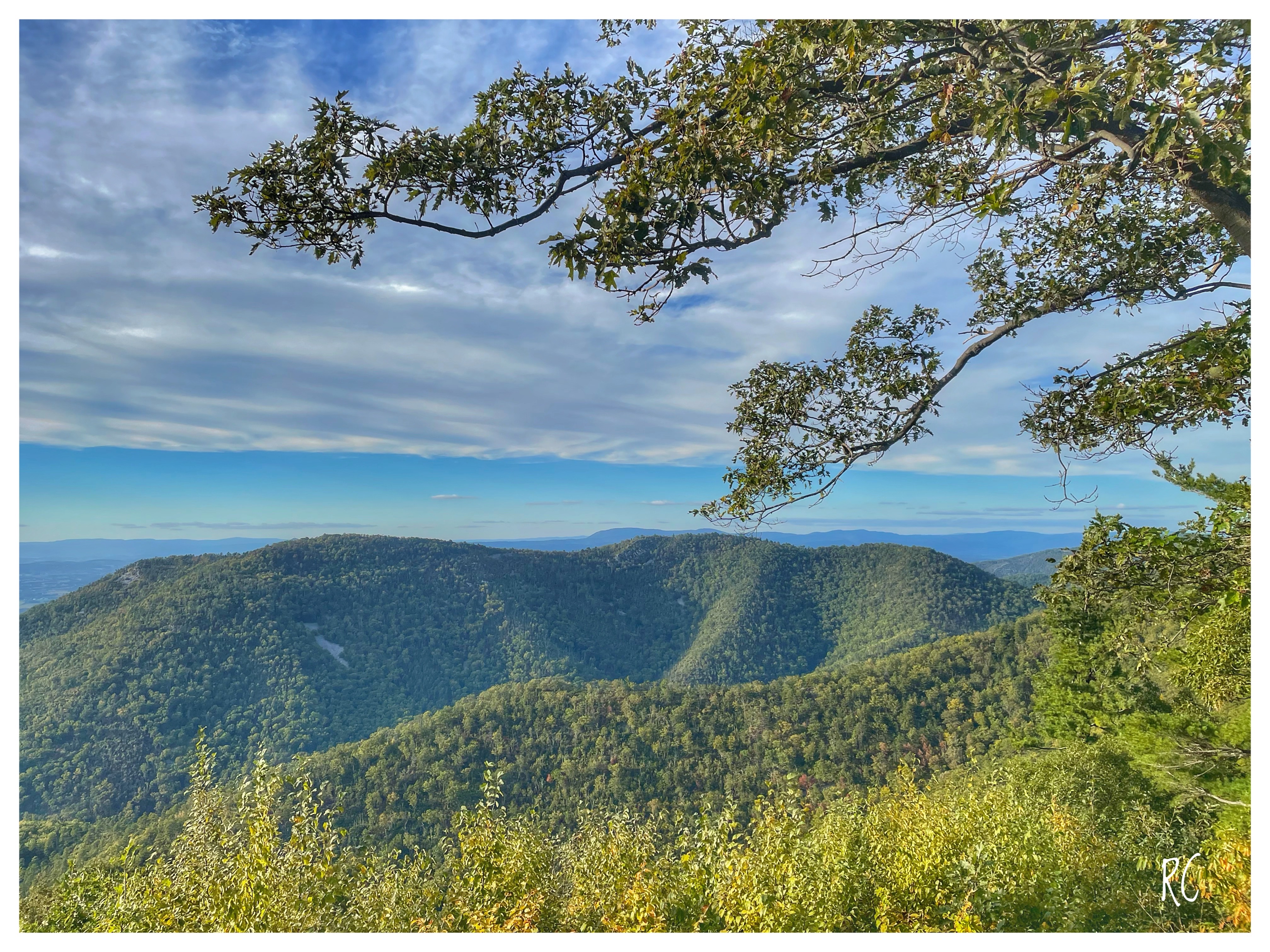
View of the valley from Humpback Rock
Humpback Rock Trail
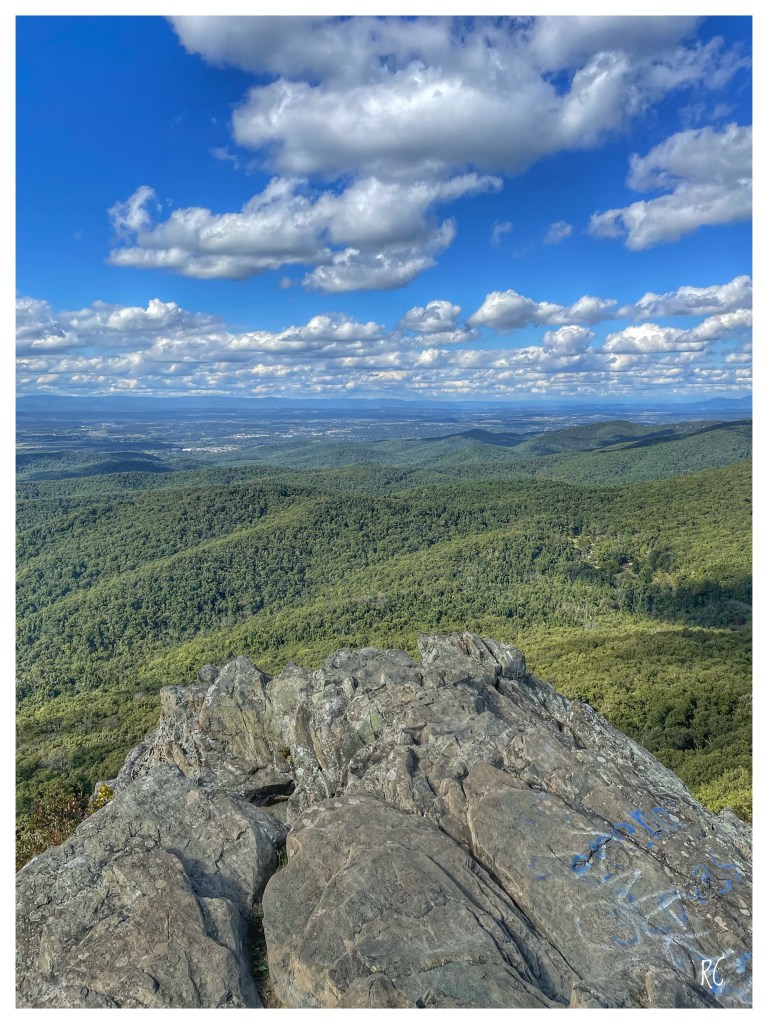
We hiked on the Humpback Rock Trail, this is a steep rocky uphill climb taking us to an elevation of about 3,200 ft. The strenuous 700-foot climb rewards hikers with spectacular views of the Rockfish and Shenandoah Valleys. It was an amazing “top of the world” experience.
Humpback Rock
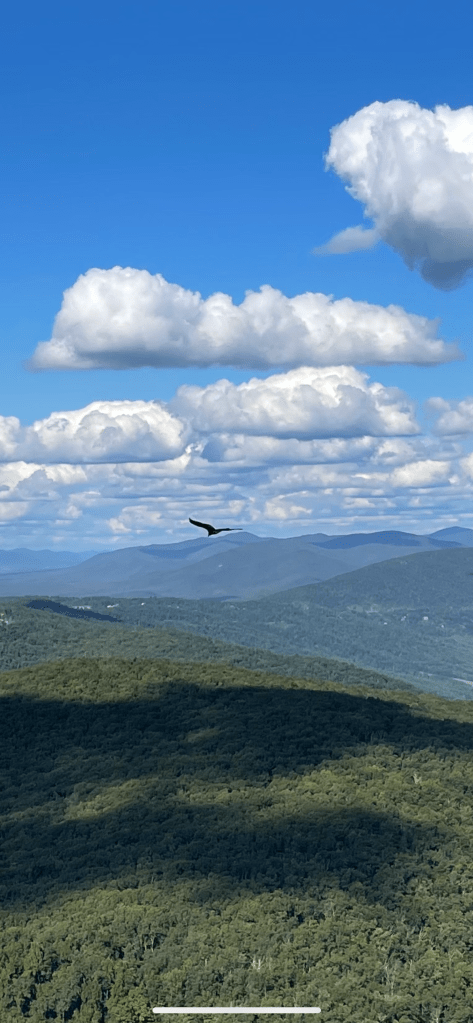
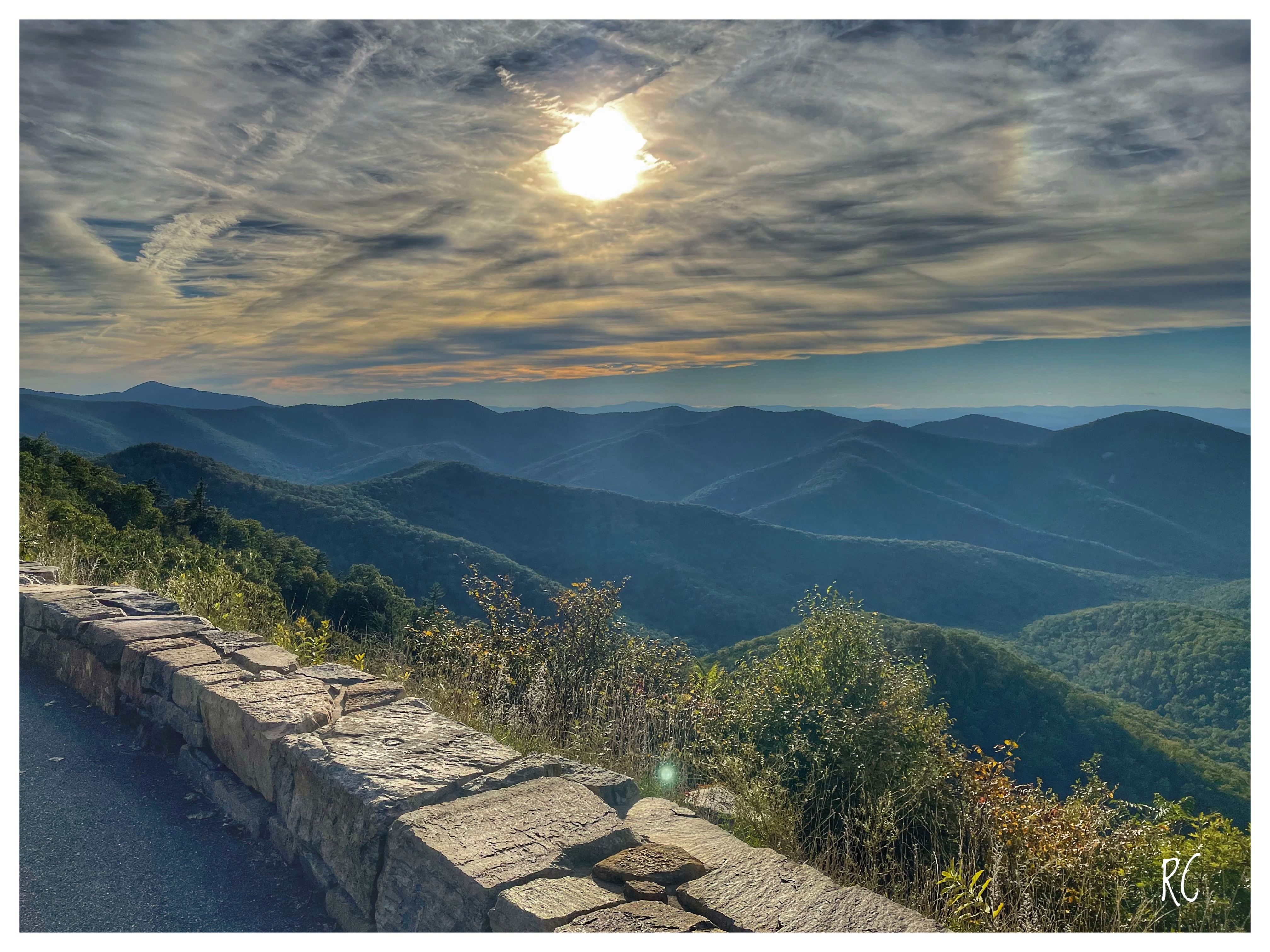
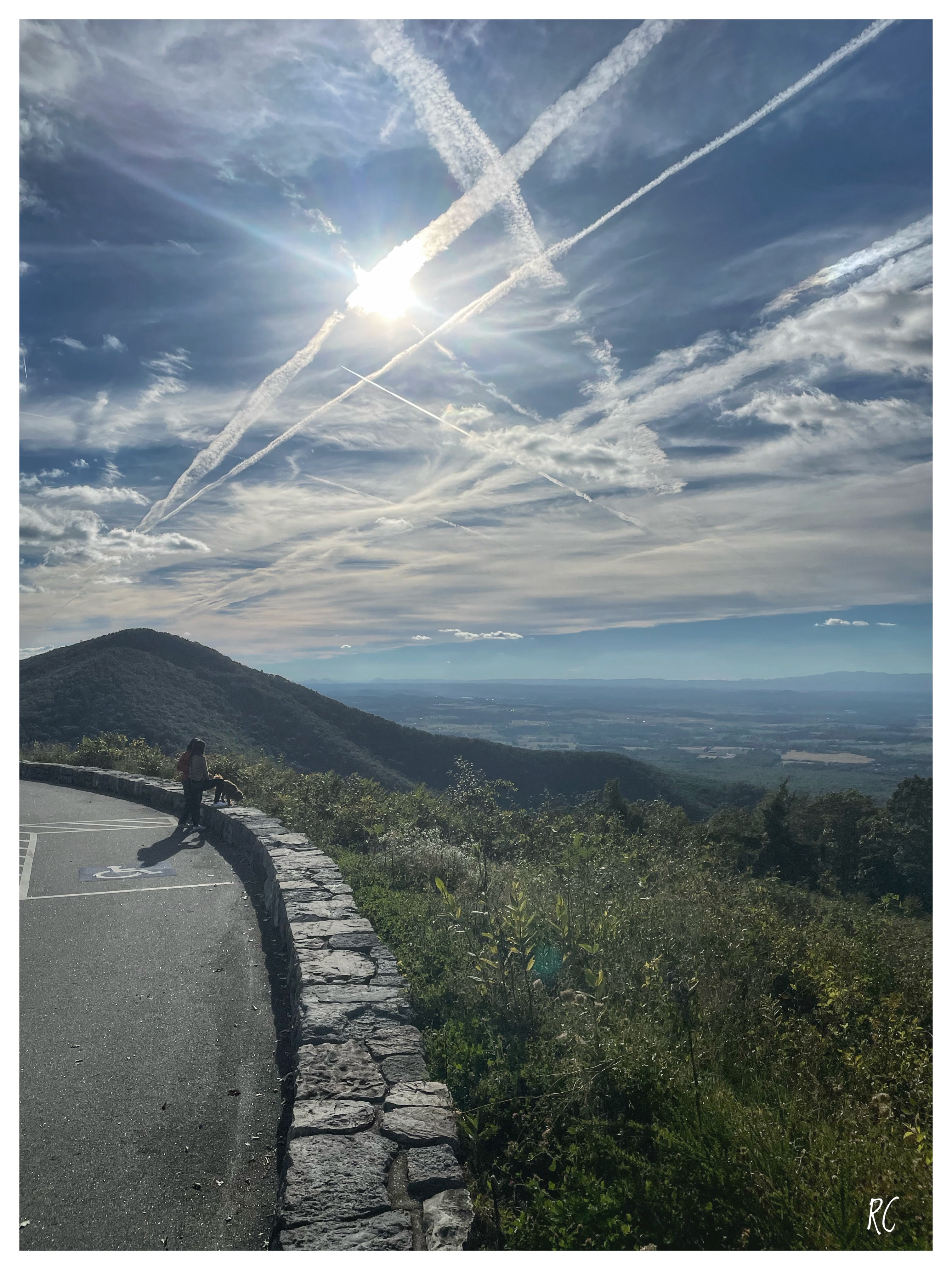
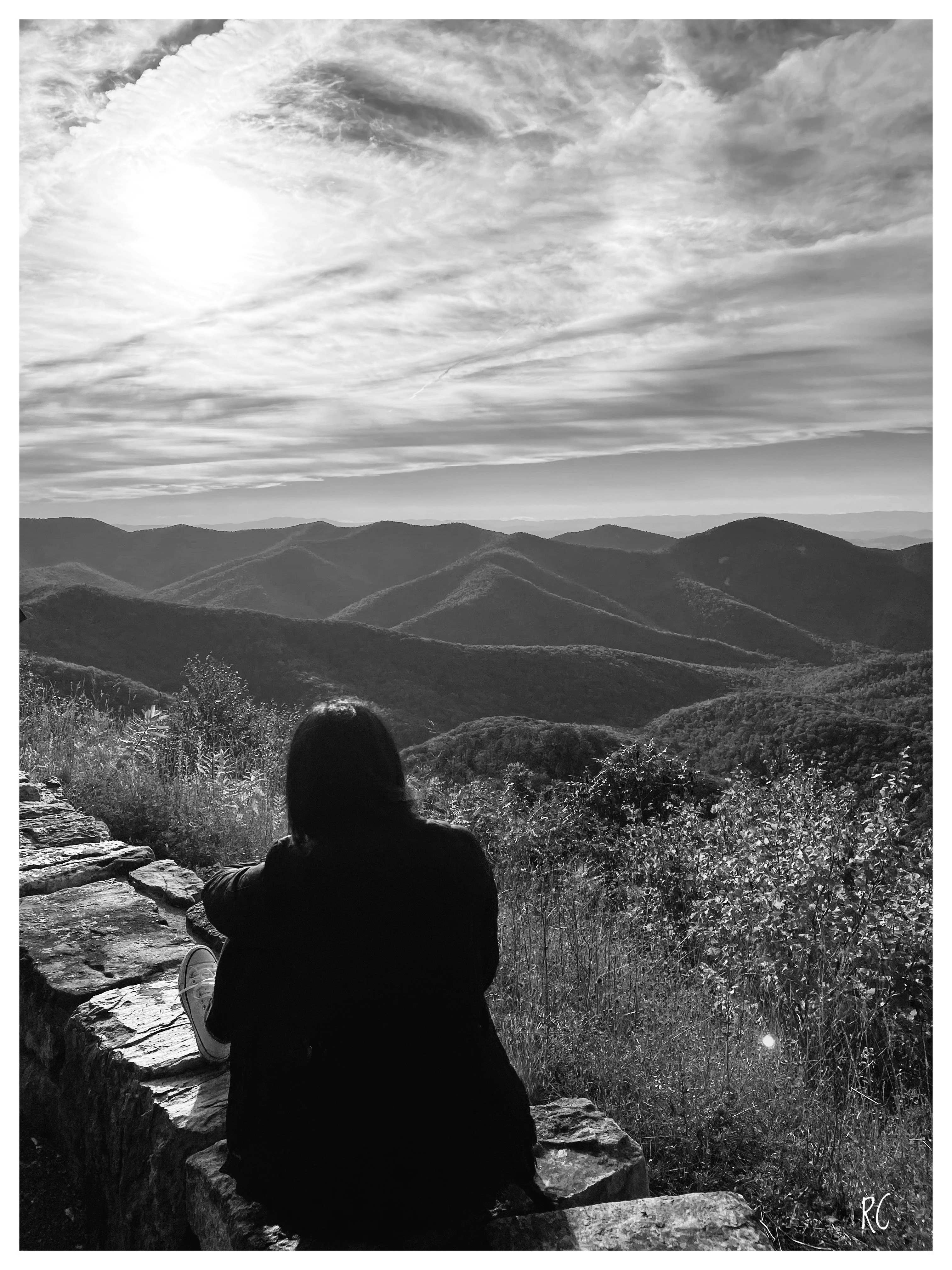
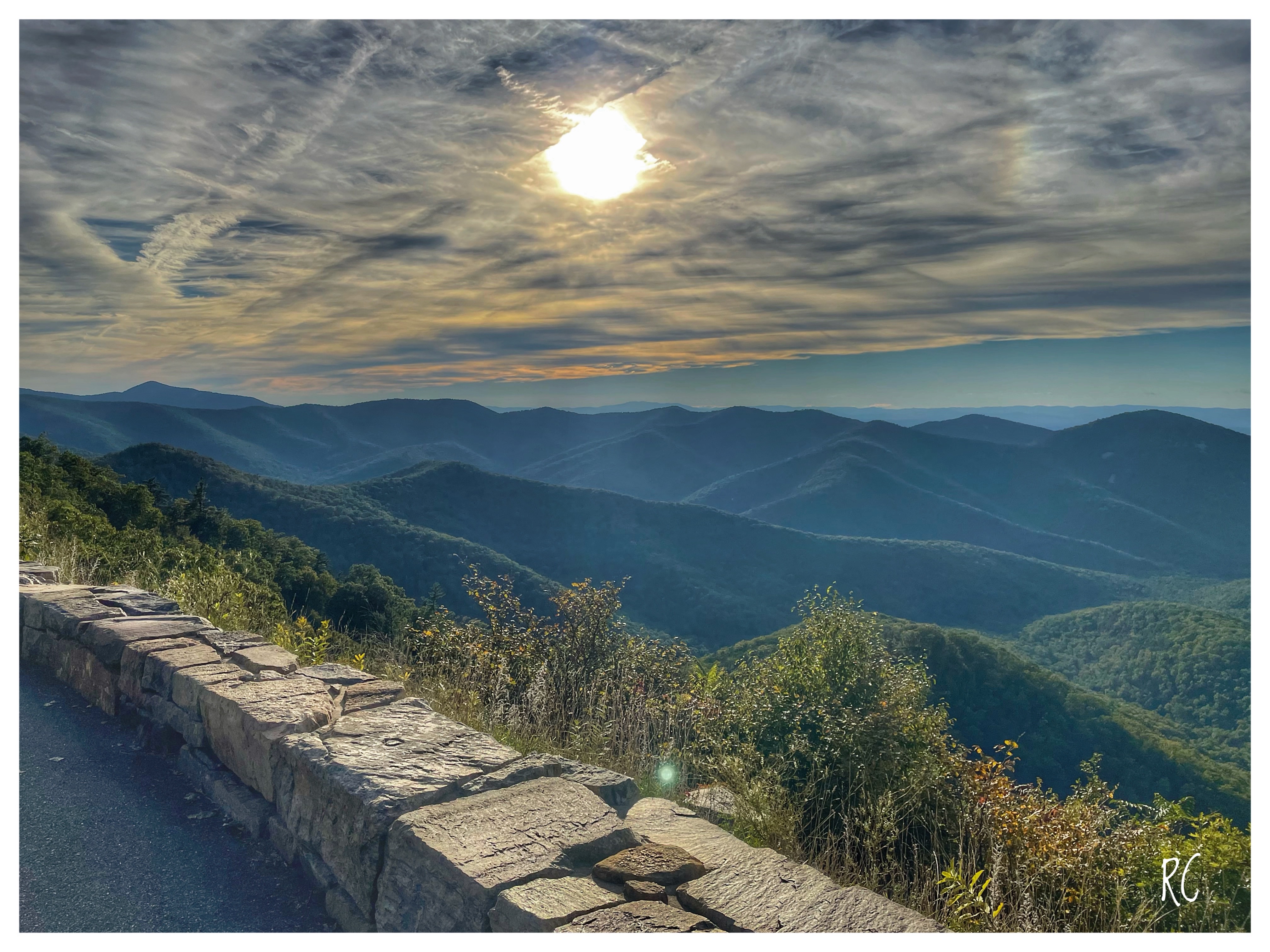
Amazing sights on the Skyline Drive
We went on a scenic drive along the Skyline Drive and stopped at various scenic overlooks along the way. The views from the Rocky Top Overlook were the best. Here are a few pictures from our scenic drive…
Sunrise and sunsets
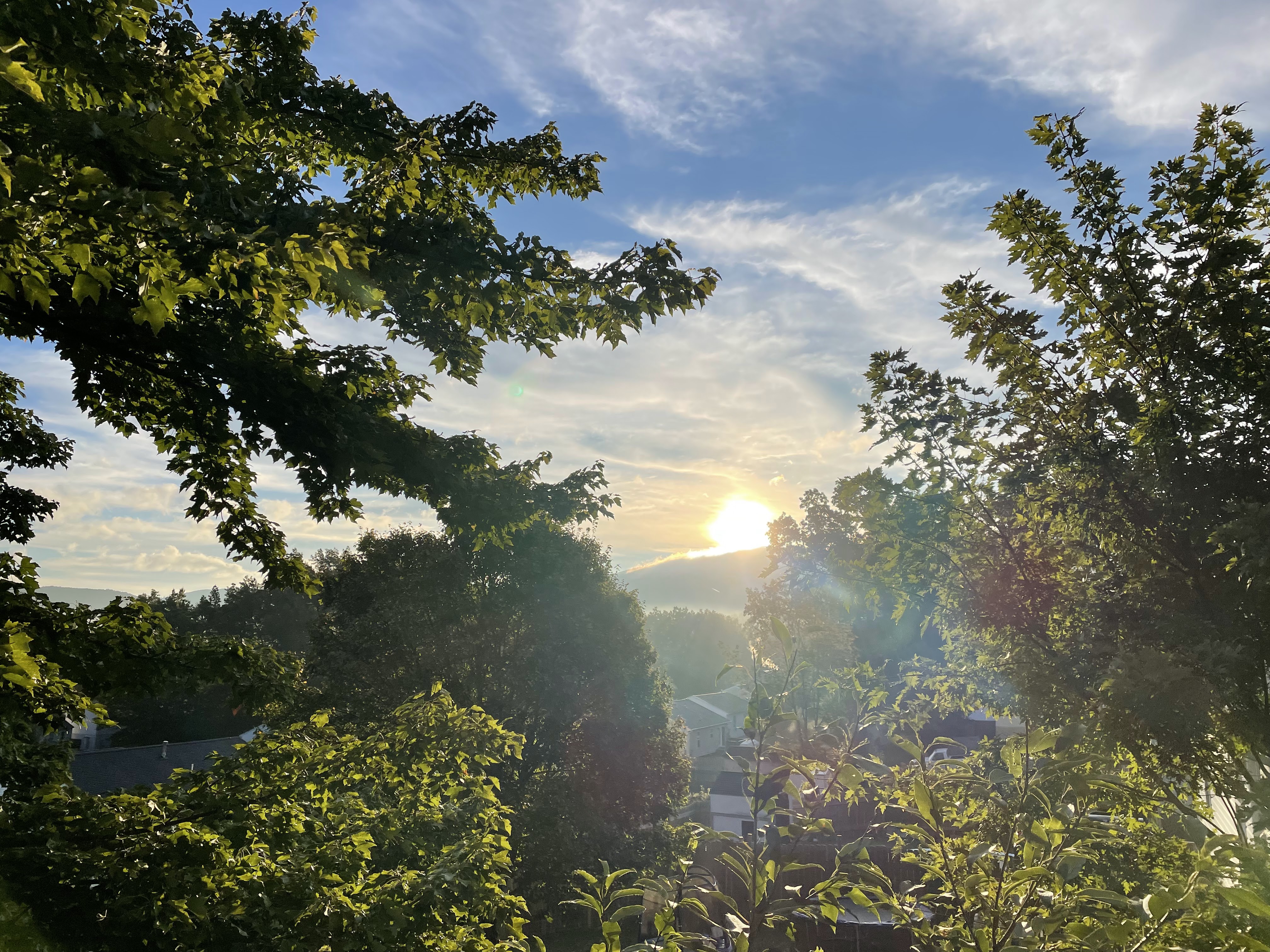
We were to enjoy beautiful views of sunrise and sunset in the mountains. Our Airbnb offered some beautiful views of the sunrise every morning. Here’s my fav shot of the sunrise from the deck of the house.
Sunrise from our Airbnb
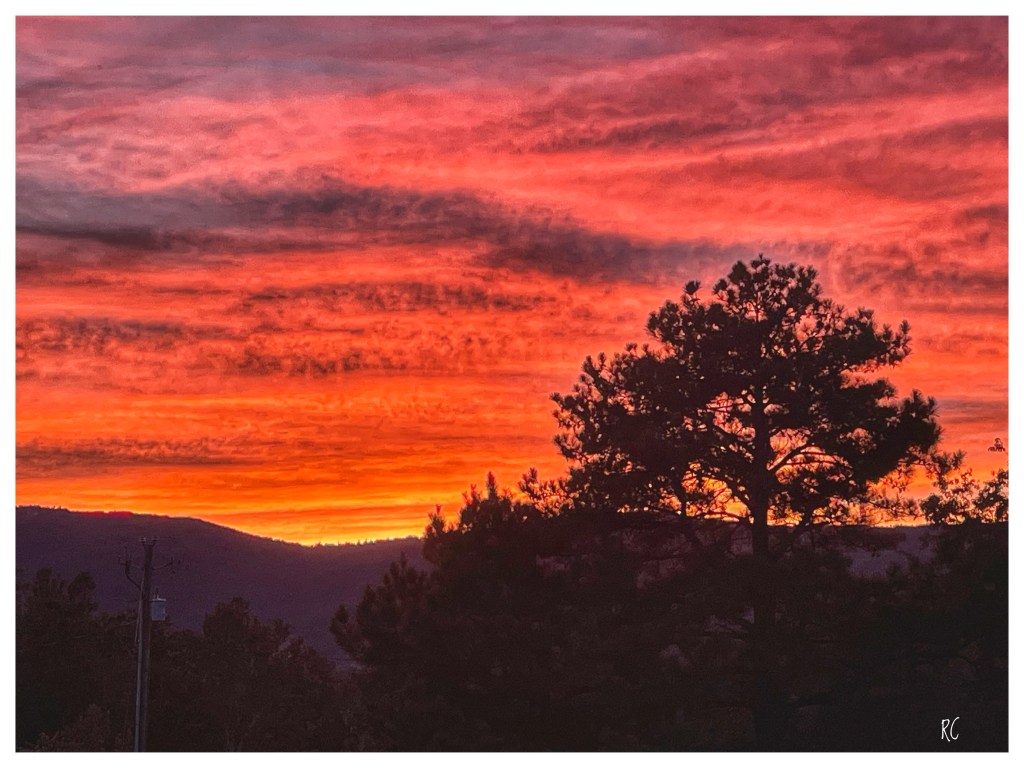
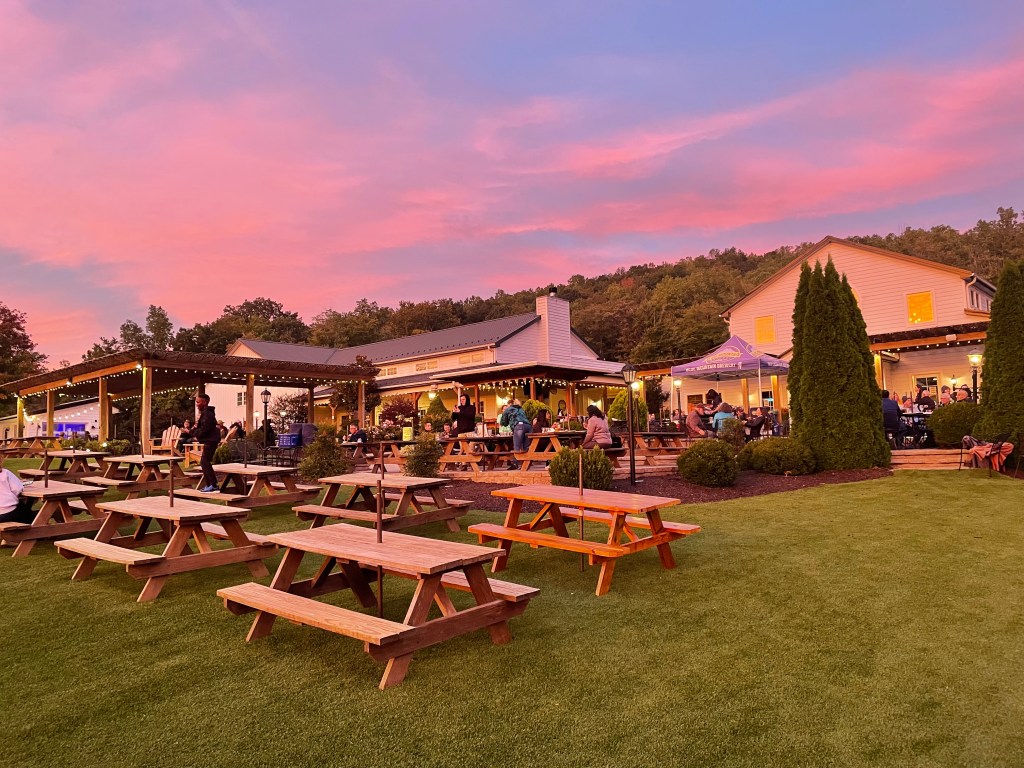
My favorite shot of the sunset was from one of the breweries that we visited along the Blue Ridge Parkway. The red / orange glow in the sky was mesmerizing…
Beer and Wine
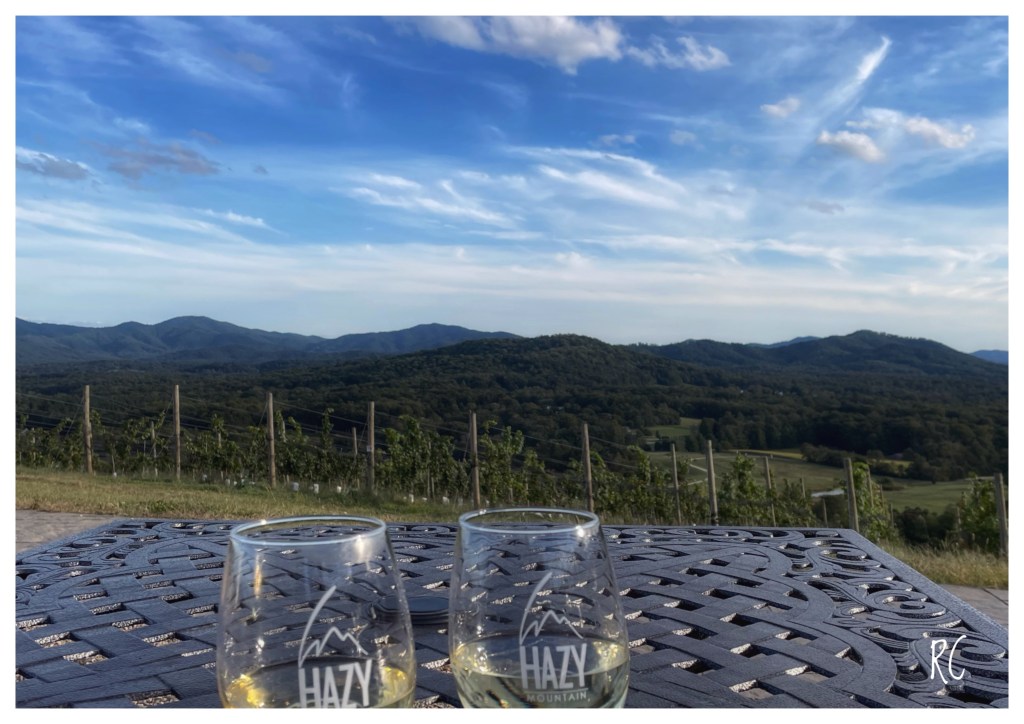
One of our discoveries on this visit is that the Shenandoah Valley is home to many breweries and wineries. We visited a couple of breweries in the area – The Blue Ridge Brewery (in the Blue Ridge Mountains) and the Stable Craft Brewery (in the countryside). If you are a beer aficionado, you should check out the Shenandoah Beerwerks trail in the valley. It takes you on a tour of 19 breweries in the region. There are many wineries in valley – we visited the Hazy Mountain and the Vertias Wineries. The tag line “Virgina is for Lovers” has now been changed to “Virginia is for Wine Lovers” 😉😉. Here are a few pictures from our tours..
We wanted to go on a short family vacation and struggled to agree on the location. We did not want to fly outside the country (COVID), wanted to go some place warm (did not want to go back to Florida), did not want to fly too far (California got eliminated) and eventually agreed on New Orleans. I have been there a few times, but many years ago (pre-Katrina). New Orleans has this reputation of a wild party city (which it is) and the kids had some apprehensions about going there with parents. I had to convince them on all the “fun” things (the exciting Cajun / Creole foods and some NOLA unique beverages) etc. etc. Did not need much arm twisting, they quickly agreed.
I never really took the time to read about the history and culture of New Orleans. So I decided to do some reading about New Orleans, it’s history, cuisine, unique facts and crazy anecdotes about this City. I learnt even more during our visit, mostly from talking to Uber/Lyft drivers, bartenders and common people. neworleans.com offers excellent information on local information, some good information on wikipedia and a few other sources. I have plugged in some of this “gyan” (learning) in the blog. So, here goes….
New Orleans was founded by French in 1718. Then came the Spanish and then it was back to the French. New Orleans being a large port, it was always an attractive target for capture. Eventually, in 1803 the United States “bought” Lousiana from the French (they paid $ 15 M in what is famously known as the Louisiana Purchase). Culturally, New Orleans is an eclectic hybrid of African-American, French and Spanish influences. The Creoles (French or Spanish descendants born in the colony) , the Cajuns ( the original French Colonists) and the slaves from Africa & West Indies are the three groups of people that created this unique potporri of cultures in NOLA
New Orleans is essentially an island between the Mississippi River and Lake Pontchartrain, New Orleans is a city defined and shaped by it’s various waterways. The eastern side of the the river is New Orleans and the west side is called Algiers. Both sides are connected by the Greater New Orleans Bridge (also known as the Crescent City Connection). Louisiana is the only state in America whose political subdivisions are parishes and not counties. The state is divided into 64 parishes and the city of New Orleans is divided into 17 wards and subdivided into precincts.
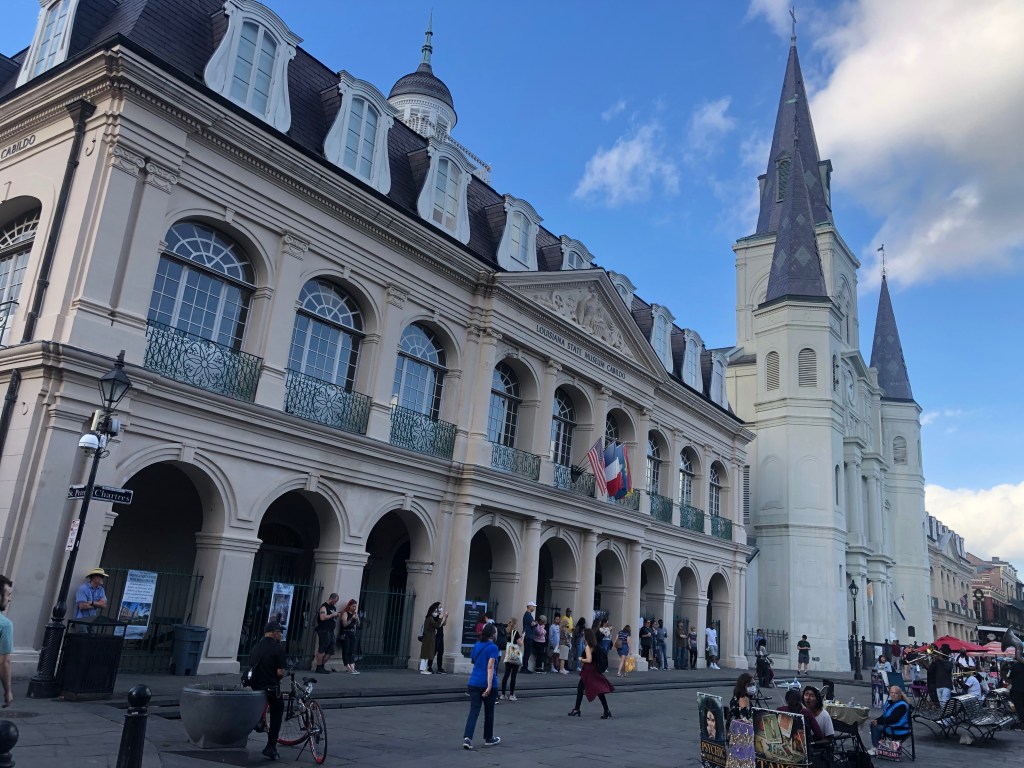
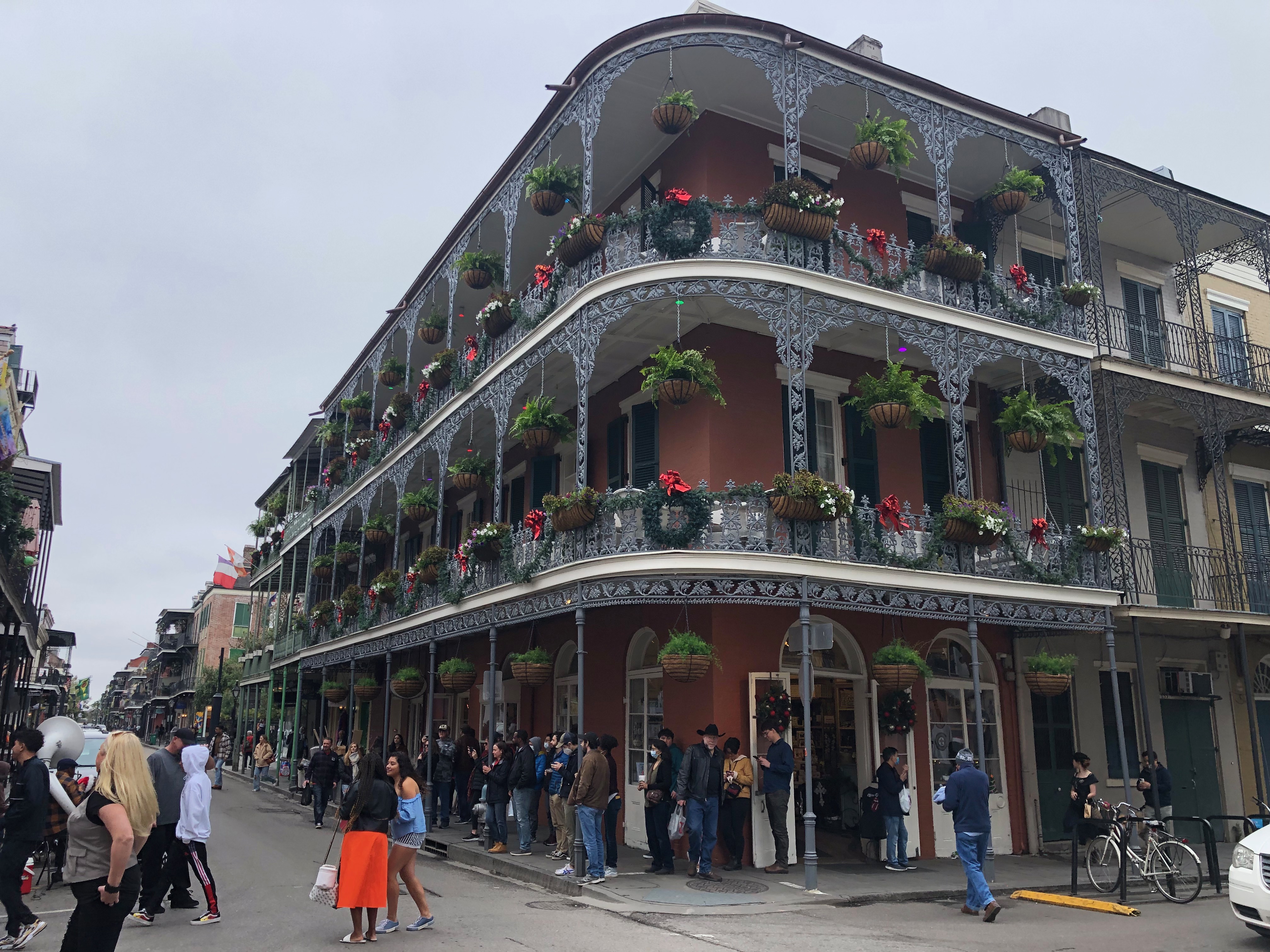
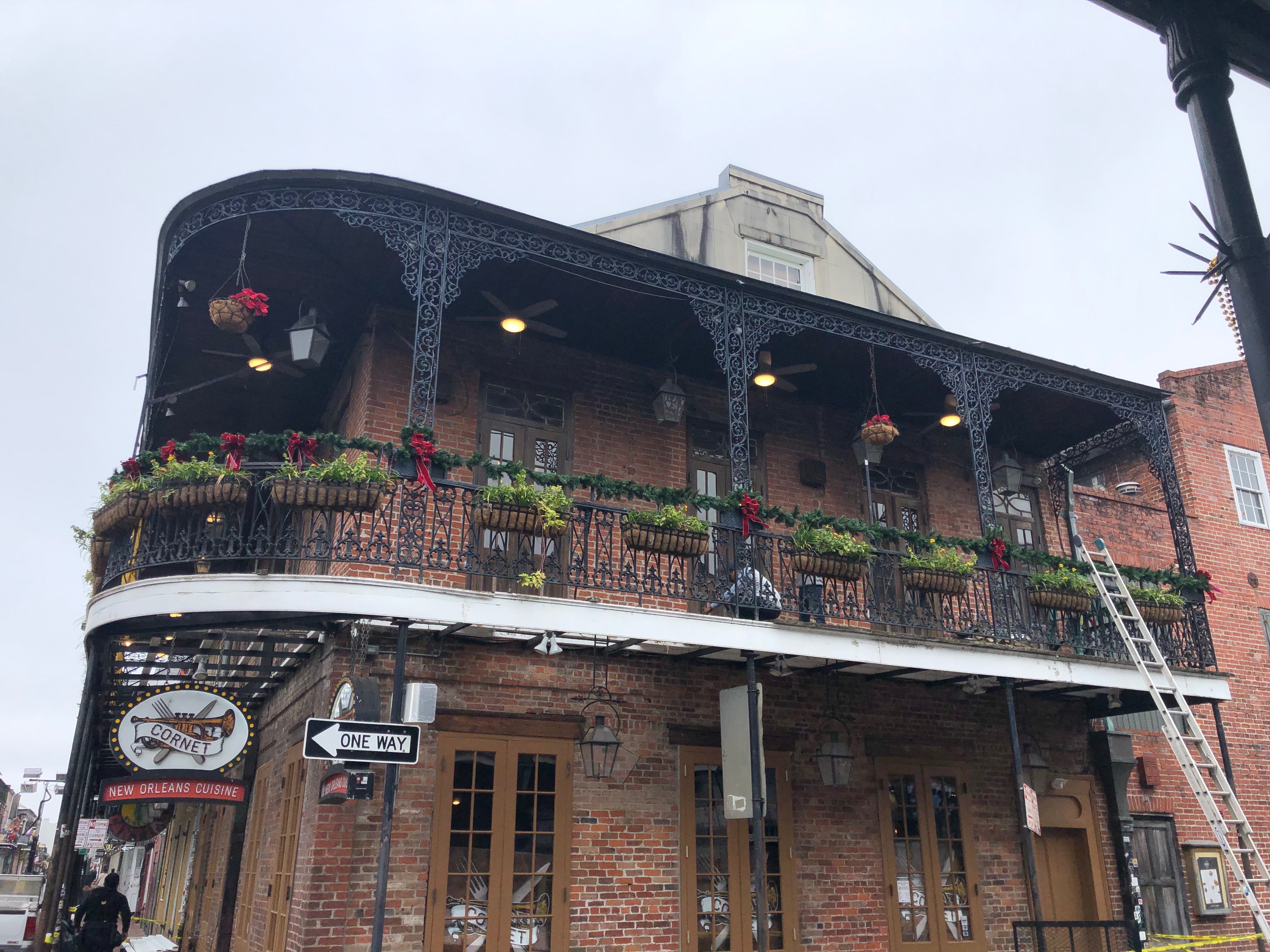
The historic heart of the city is the French Quarter, known for its French and Spanish Creole architecture and vibrant nightlife along Bourbon Street. The French Quarter is a mad potpourri of historic landmarks (Jackson Square, St. Louis Cathedral, Madame LaLaurie’s mansion); timeless traditions (ghost tours, street musicians and artists, Mardi Gras beads) and endless late night revelers (curbside parties, plastic cups with Hurricanes and other alcoholic beverages). This Crown Jewel of New Orleans is curious mix of the old and the new…
Given the crazy times that we live in, we had planned for this vacation to be mostly around food and drink and try to avoid crowds and stay outdoors as much as possible. This meant no visits to jazz clubs on Frenchman street, rides on the NOLA tram cars or crowded bars. Late evening visits to Bourbon Street were anyway struck off the list as a pre-condition to get the girls to sign up for a family visit to NOLA. We knew that NOLA offers a lot to delight the culinary appetite and has started researching restaurants (and bars) in the week leading up to our travel. We had a few places pre-selected from past visits and online research.
We arrived in New Orleans on Wed evening and the “fun” started right away. We were stuck on I-10 on our way from the airport to the AirBnB for 2 hours as there was a major accident on the highway. It was late by the time we reached our home for the next 5 days. We stayed int he ByWater area of New Orleans. We decided to order some food delivery. We ordered some Chicken Po Boys and Veg Gumbo. Check out my blog “Culinary Delights of NOLA” to learn more about the New Orleans Creole and Cajun delicacies.
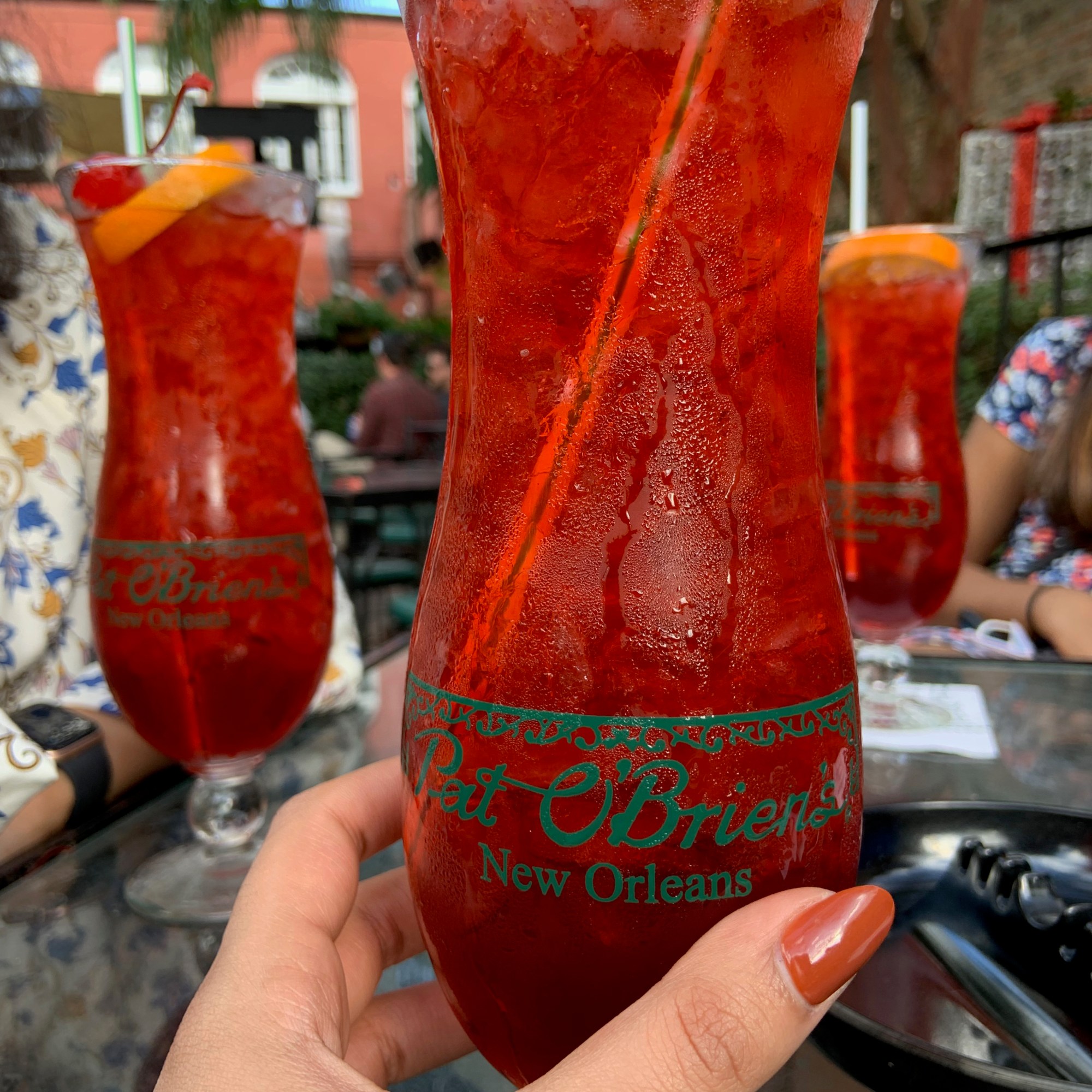
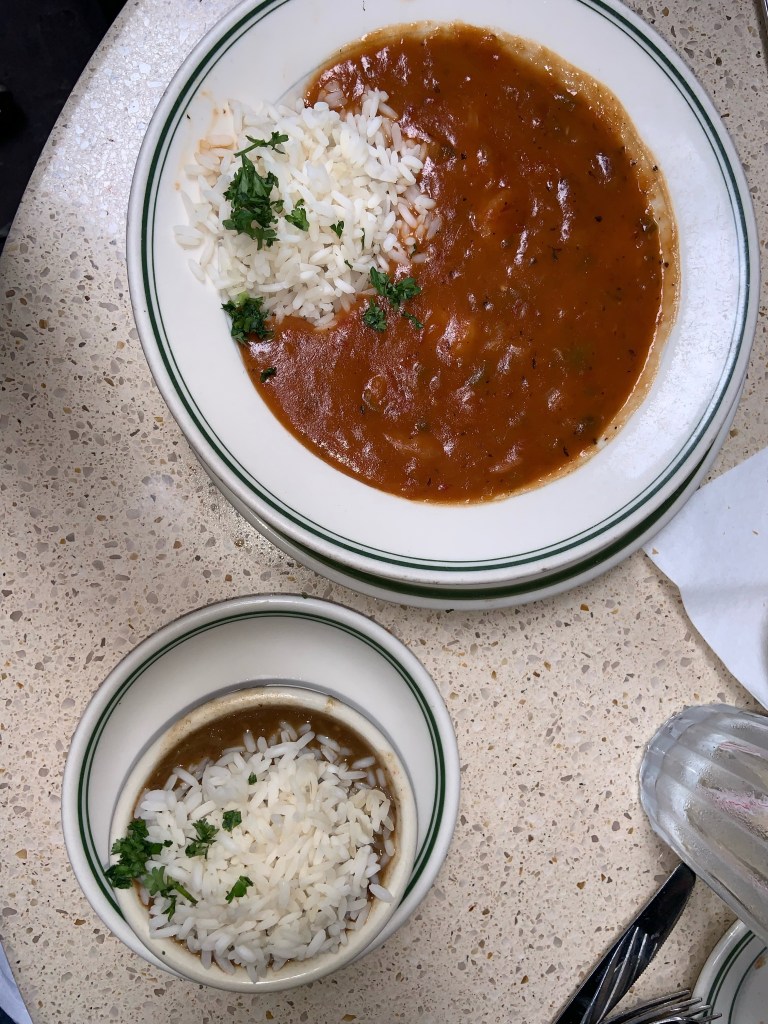
Day 1 – We decided that we should start our adventure in the French Quarter. We “Uber’ed” (actually it was Lyft) straight to Pat O’ Briens. What better to start your NOLA vacation than with an alcoholic beverage. It did not matter that it was only 11.30 am (it is still drinking time somewhere in the world). We ordered the famous Hurricanes. Served in a hurricane lamp shaped glass, we sipped into New Orleans’ favorite libation. (There’s some really interesting history to the Hurricane covered in my next blog). Loaded with a LOT of rum, the Hurricane put us in the right mood to enjoy the French Quarter. The streets were not very crowded ( the night must have ended here for many folks only a few hours ago). We head out to get some lunch at The Gumbo Shop on Peter Street, close to Bourbon Street. The Gumbo Shop is very famous for, you guessed it, their Gumbo. (That’s the Hurricane effect !). We ordered some Seafood and Okra Gumbo, Shrimp Creole and Vegetarian Gumbo. It was yum, yum, yummy. Gumbo is a very traditional dish here in New Orleans. With a heritage claiming both French and West African roots, gumbo is a thick stew served over rice and made with flourand a wide variety of ingredients such as celery, peppers, okra, onions chicken, sausage and/or seafood.
Seafood and Okra Gumbo/ Shrimp Creole
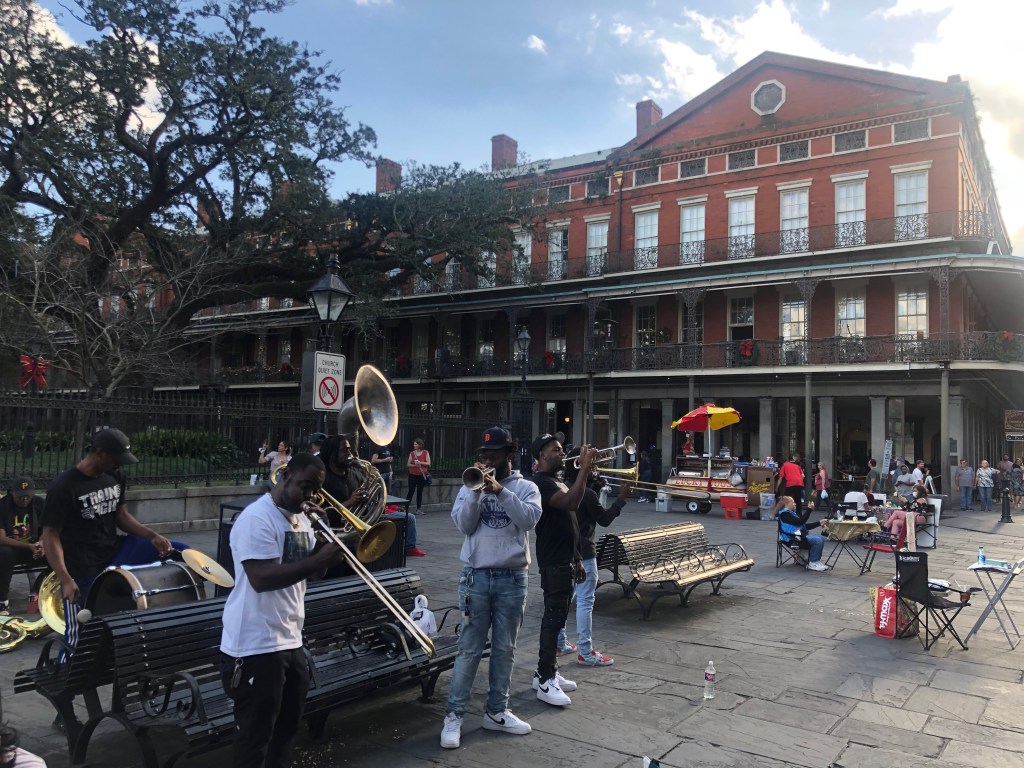
After our Gumbo experience, we walked through the historic Jackson Square. In many ways, Jackson Square is the heart of New Orleans. This city square is the epicenter of the French Quarter. Early French colonial New Orleans was centered on what was then called the Place d’Armes ( lit. ‘weapons’ square’). … Following the 1815 Battle of New Orleans, during the first half of the 19th century, the former military plaza was renamed Jackson Square, for the battle’s victorious General Jackson. We stopped to enjoy the music by a group of street musicians in the square.
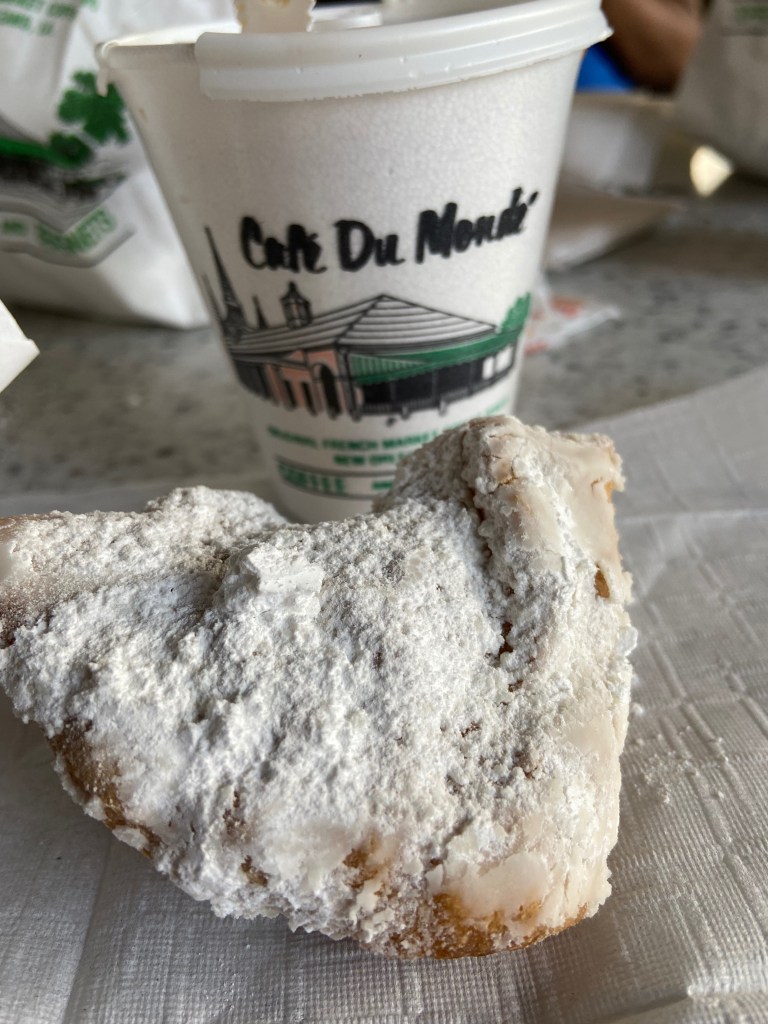
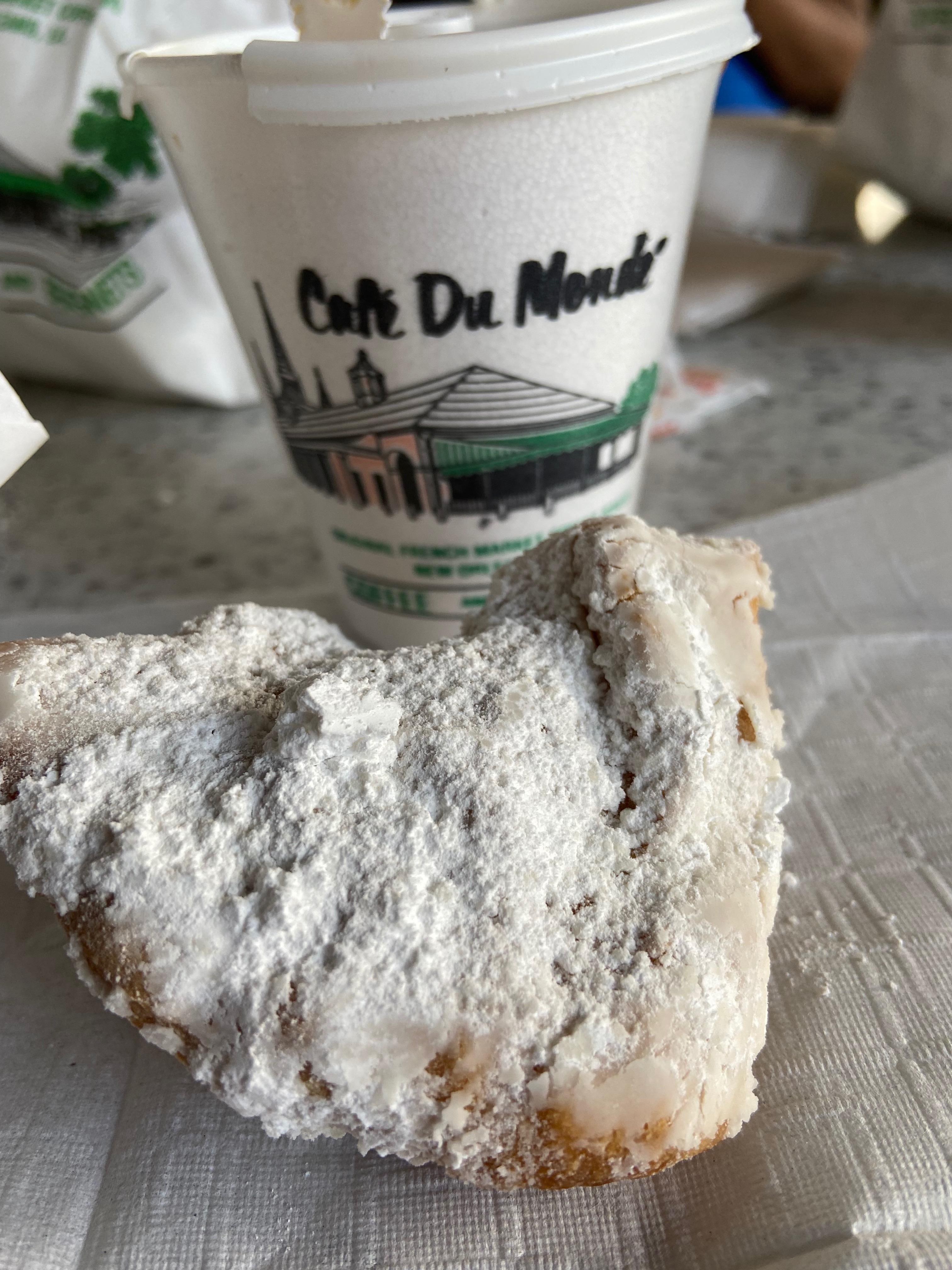
We walked over to another New Orleans speciality – Cafe Du Monde. World famous for their Beignets and Cafe Au Lait (with coffee and chicory). Beignets have their roots in France and best described as square donuts doused with powdered sugar or some refer to them as sugar pillows. The coffee here is quite special. It is not uncommon to see long lines of people waiting for their turn to indulge in this gastronomic experience. After a few Beignets and coffee, we returned to our NOLA home for some rest before heading out for dinner.
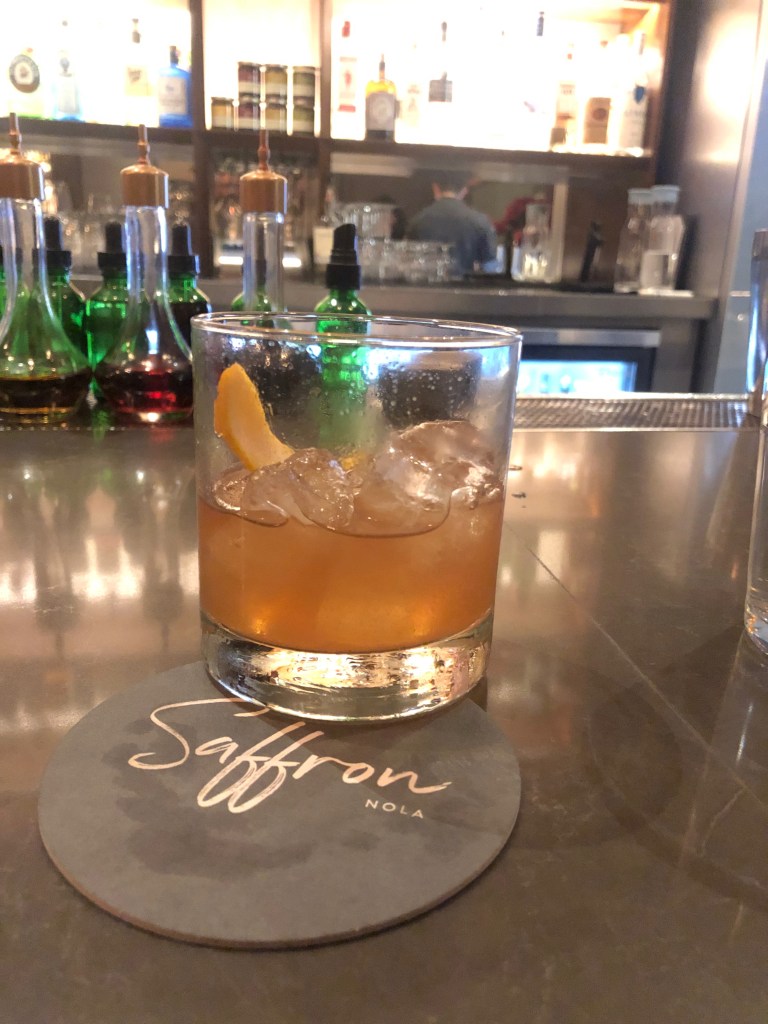
We had planned to get Cocktails at a New Orleans and Indian fusion restaurant called Saffron. This is on Magazine Street (fun fact – The street took its name from an ammunition magazine located in this vicinity during the 18th-century colonial period). Saffron had very unique and exotic cocktails – Holi Smoke ( Bourbon, cyan, cacao, tulsi, pineapple, lemon, Indian snack mix) or Na_Ma_Slay Punch ( Indian rum, Indian gin, darjeeling tea, east India sherry, array, st. Germain, ginger allspice, lemon). The cocktail experience was quite the big_easy nirvana.
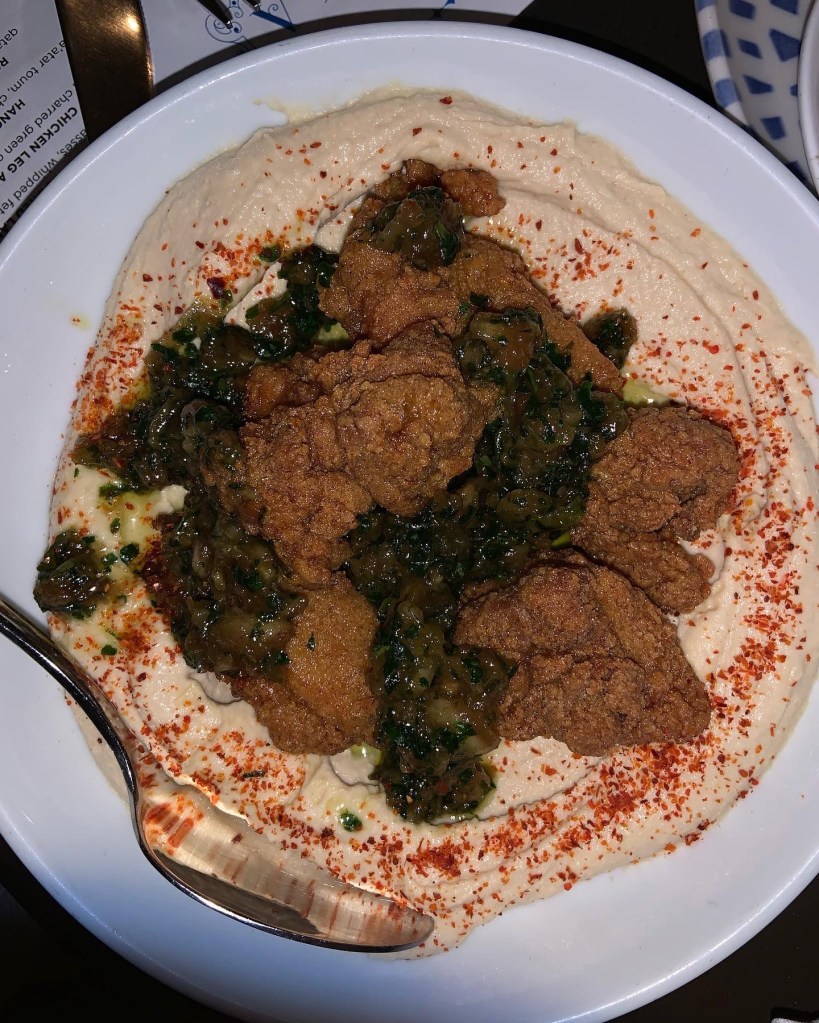
We had dinner reservations at Shaaya, an Israeli restaurant with a southern touch. We were seated outdoors on the patio. The food was served family style with lots of appetizers and small plates. It was an amazing dining experience. The roasted cauliflower and fried chicken hummus were the best. Warm Chocolate Babka was a good way to round up the evening.
Fried Chicken Hummus
Eventful and exciting first day in the big easy. It was a party for our taste buds and teaser for what was to follow over the next few days.
Day 2 – After a beautiful sunny day yesterday, there was some rain today and we had to plan around this. We planned some indoor activity – a visit to the famous WW2 museum. The museum is quite big and very impressive with interactive exhibits and a 4D movie experience.
We went to Rosie’s on the Roof at the Higgins Hotel on Magazine street across the street from the Museum. (History: Hotel was named to honor Andrew Higgins, who designed and built over 20,000 boats in New Orleans that were used in every major amphibious assault of World War II). I had seen pictures of Rosie in the past with the “we can do it” tag line. Never knew the full back story to this (did not study American history). Here’s what I learned about Rosie – She is Rosie the Riveter, a fictitious character created to honor the 6 million women who took up non-traditional jobs during WW II. Rosie remains one of the most iconic images to come out of that conflict.
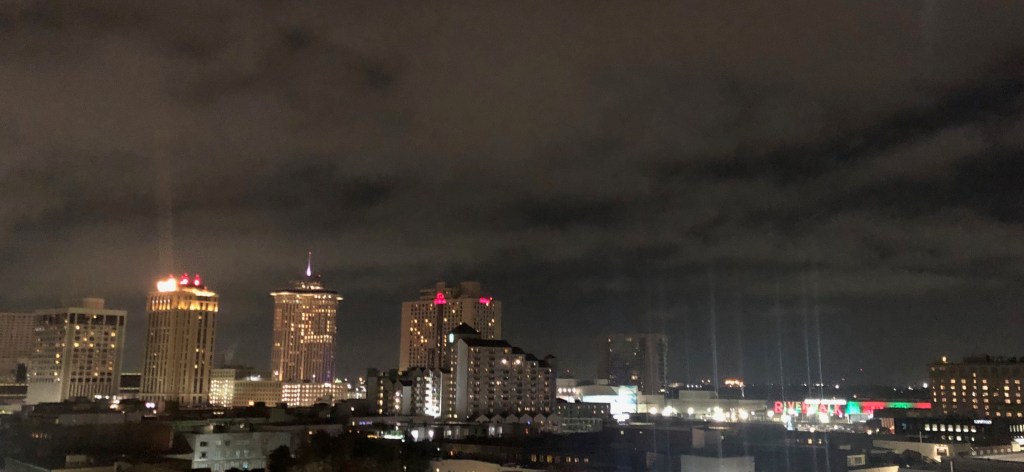
We enjoyed the views of the New Orleans skyline from the rooftop (views of the present city bridge and the French quarter).
We had dinner reservations at Carmo, an eclectic tropical bar and cafe. The food at Carmo was quite amazing. They have some very unique seafood, vegetarian and vegan dishes on their menu. Ceviche (vegan) and Creole Fish were outstanding.
As we drove through various parts of the city over the last couple of days, the devastation caused by Hurricane Katrina in 2005 was still quite evident. There were many homes and commercial property that were abandoned in a few neighborhoods. Our Lyft driver shared his experiences from that terrible tragedy. Most of the city was flooded, under several feet of water, over 2000 lives were lost and the city suffered several billion dollars of damage.
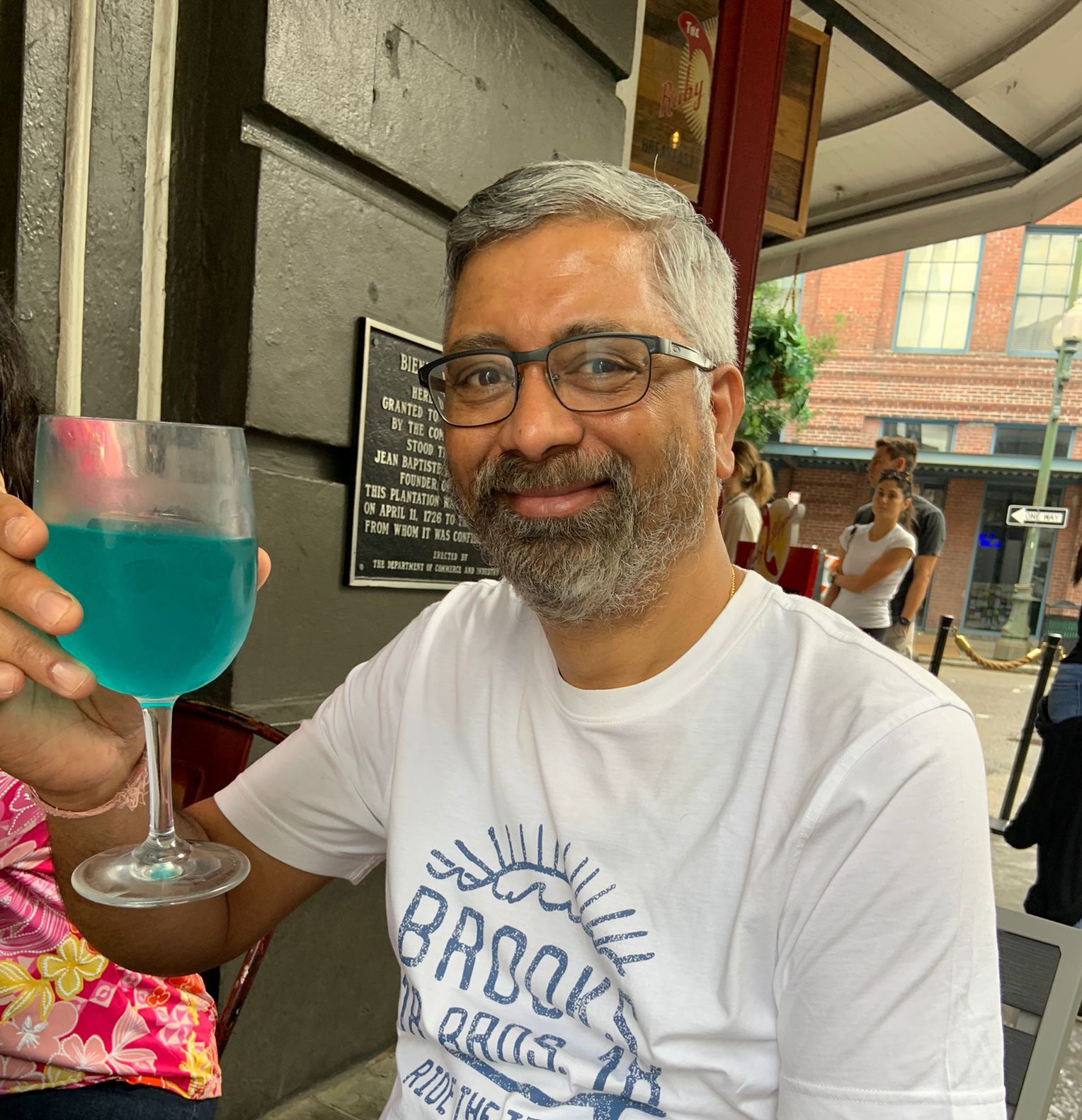
Day 3 – We had reservations for brunch NOLA style at Ruby’s Slipper in French Market. They had a southern twist to almost all the dishes on the menu. My favorite was Sweet Hot Chicken ( Spicy fried chicken with Mike’s hot honey and French Toast bites with a drizzle of maple syrup. Ruby’s mimosas were refreshing and served in generous portions. While the rest of the fam ordered the Ruby Special Mimosas, I ordered the Big Easy Ginger Lime flavor Mimosa ( it was torqouise blue in color). After a leisurely brunch, we walked over to Canal street.
Our Lyft driver gave us a short history lesson about the historic Canal Street. After the Louisiana Purchase (1803), a large influx of other cultures began to find their way into the city via the Mississippi River. Along the division between these two cultures, a canal was planned. The canal was never built but the street which took its place received the name. Residential, commercial and government buildings flourished along Canal Street in the 1800s, which became the dividing line between the primarily Creole French Quarter side, and the primarily American sector, which is now known as the Central Business District. Tensions often arose between these two groups, but Canal Street was a “neutral ground,” a name that now extends to any median in New Orleans.
Canal Street is a happening place, lots of shopping, movie halls, hotels (and several mobile outlets of WeedWorld !!). We went to the historic Roosevelt Hotel to see the Christmas decorations. The lobby was very festive and colorful with holiday decorations. It was very busy and chaotic too. Lots of people here to enjoy the festivities.
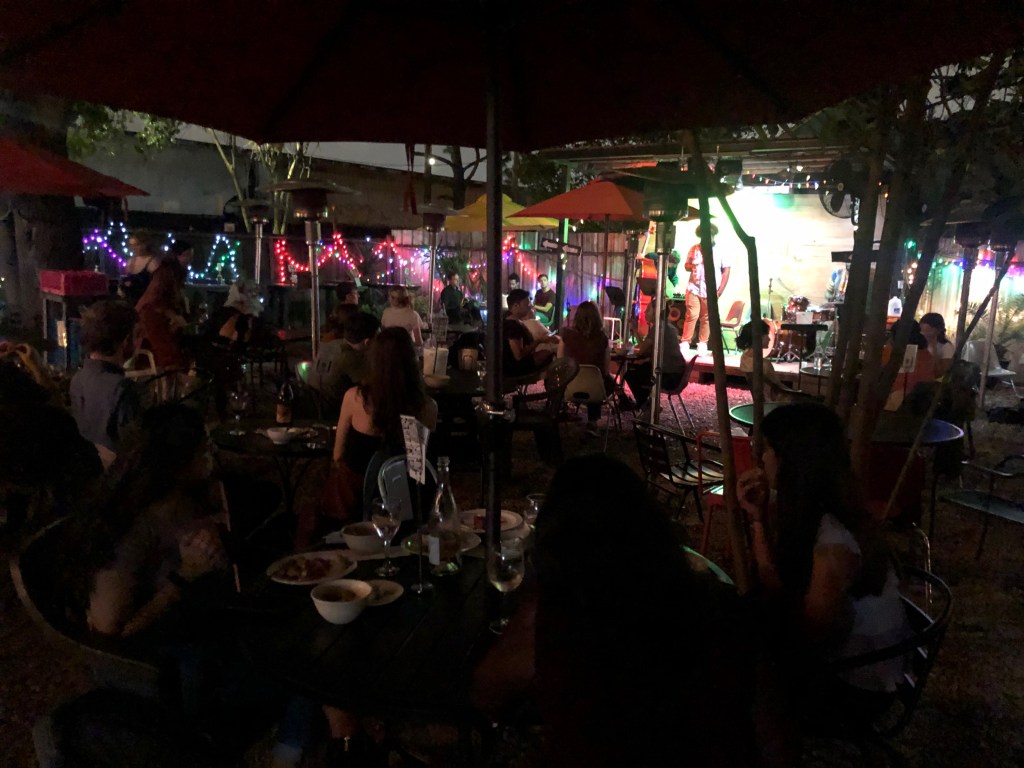
Later in the evening we went to Bacchanal a wine bar / garden where they had live music. It was a unique, relaxed experience, sitting outdoors enjoying wine and lovely jazz music. Quite contrary to what the name “Bacchanal” suggests. A thunderstorm that moved in from the gulf ended our evening rather abruptly.
Our 3 days in NOLA were quite exciting and eventful. Very giddy with lots of history, food and drink. One more day to go..
Day 4 –
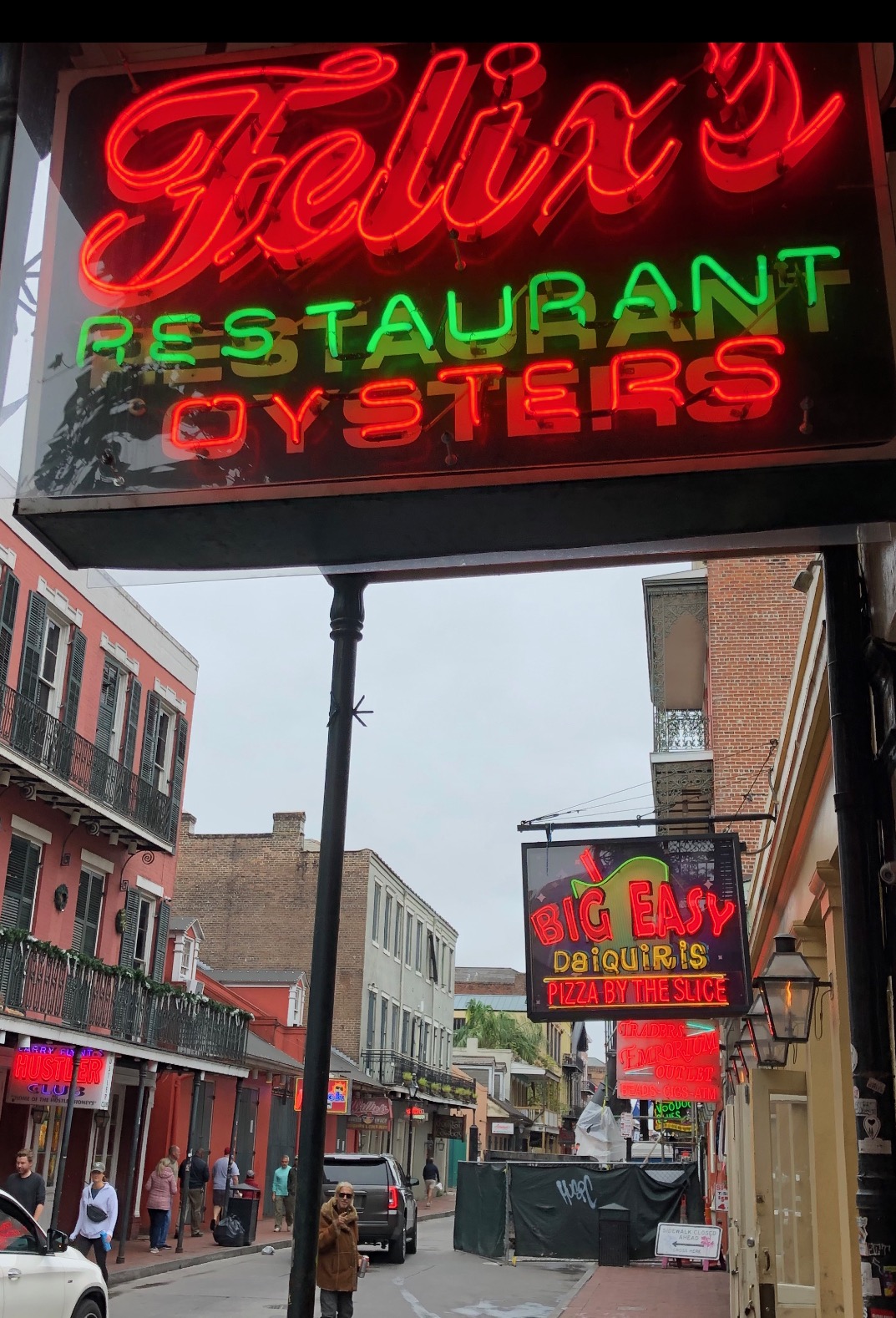
This was our last day in NOLA. We had a few items to check off the list and a few others to do a repeat or three-peat. Our first stop was Felix’s Oyster Bar on Bourbon Street to get a taste of their famous Chargrilled Oysters. I am not an Oysters guy. Watching our daughter relish the Oysters was good for me. I tried some of their Shrimp Cocktail. They were the best that I had ever had, very fresh and yum. We had fried pickles as a side. One item checked on the list, we walked over next door to Big Easy Daiquiris. The Voodoo Daiquiri is often also called “Purple Drank” is a New Orleans specialty. The sweet grape-flavored frozen daiquiri is spiked with bourbon and Everclear (190 proof, grain alcohol), and is apparently very strong. We were not brave enough to try this early in the day. We got a couple of not-so-strong and “non-voodoo” Daiquiris. I did not find anything special about the Daiquiris. I may have appreciated them more on a warmer day.
We walked back to Jackson Then for the three-peat at Cafe Du Monde with their Beignets and Coffee. There was about a half hour wait to get our caffine shot of NOLA special chicory rich coffee and our favorite “sugar pillows”.
Last evening in NOLA, we walked around the Bywater neighborhood. We found a Beirgarten (Bratzy y’all) close to home. We walked in got ourselves from German beers. There was a band playing the blue and folks enjoying Brats and Schnitzels with their German beers.
This wrapped up our visit to NOLA. There are many many more things to do in NOLA. We did not have time or avoided due to the Omicron drama that we are all living. The Natchez Steamboat cruise experience, the swamp tour, jazz clubs on Frenchman St and many many more things are now left for our next visit to NOLA in a post-COVID world. Yes… I still believe that there is such a world in the not too distant future. I am an eternal optimist.
On our way back from Philadelphia we decided to stop by at this rather unique site in Hamilton NJ, Grounds for Sculpture. I have seen some of the giant sized sculpture off I295 many a time and have always wanted to visit the site. Well, today was the day.
As we pulled in to the gates of the park, we had the “welcome gang” by Seward Johnson welcome us to the park.
Seward Johnson, a well known artist, philanthropist created this wonderland of sculpture and art. Started in 1992, this has grown into a 42 acre park with work from several artists across the world. The unique aspect of this is the outdoor, in a garden setting, museum of sculpture.
“It’s easy sometimes to forget the simple things that give us pleasure. If we open our eyes, life is marvelous. The human spirit triumphs, if only for moments in a day. I try to have my work call attention to those moments.” -Seward Johnson
Seward has created these everyday moments so well and you run into them at every turn in the park. There are some which are life size and many others much much larger.
An amazing experience. The pictures that I have shared below do not do justice to the experience. Nevertheless, here are some of my favorite pictures from the Grounds for Sculpture…
This slideshow requires JavaScript.
“I want my work to disappear into the landscape and then take a viewer by surprise. After he gets over the shock of being fooled, it becomes an emotional discovery. Then he owns the sculpture. People often revisit their favorites. They become like friends.” Seward Johnson




















 globalyatra